Prioritization Frameworks
Frameworks give structure to the question of what to address first when demands exceed available attention.
- Ordering care by urgency and stability
- Applying frameworks to scenarios
- Reviewing the rationale behind choices
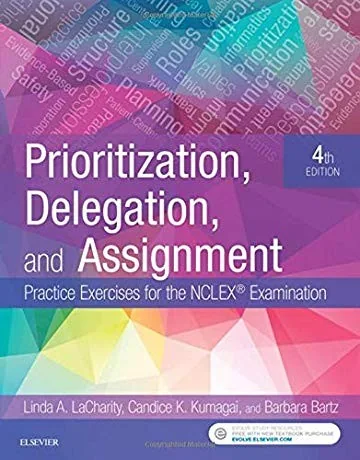
Prioritization, Delegation, and Assignment, Fourth Edition, is a nursing practice workbook focused on deciding what to do first, which tasks to delegate, and how to distribute care. Clinical scenarios and answer rationales give nursing students and graduates material for reviewing patient acuity, staffing responsibilities, and multi-patient decision-making.
Digital ebook. Checkout sends an order request.
The exercises in this workbook progress from basic prioritization concepts to more involved situations involving several patients. Readers assess competing needs, consider patient stability, and examine how staff preparation and scope of practice affect delegation and assignment. Answer keys include rationales so that decisions can be reviewed in relation to the scenario.
Coverage includes prioritization frameworks, recognition of changes in condition, handoff communication, and examples of inappropriate delegation. The fourth edition was written for NCLEX preparation and the transition into nursing practice. Students can use it to discuss clinical reasoning with instructors or study groups, while graduates can revisit the distinctions among prioritizing care, delegating tasks, and assigning patients.
A workbook for the decisions nurses make when several patients need attention at once. Linda A. LaCharity, Candice K. Kumagai, and Barbara Bartz use clinical scenarios and explained answers to rehearse prioritization, delegation within scope of practice, and assignment of care, with difficulty increasing toward multi-patient situations.
The workbook begins with basic prioritization ideas and moves toward situations involving several patients at once. Readers weigh competing needs, judge stability, and consider how preparation and scope of practice shape what may be delegated or assigned. Explained answers let them compare their reasoning with the rationale behind each choice. Coverage includes frameworks for ordering care, recognition of changing condition, handoff communication, and examples of delegation that should not occur. Written for NCLEX preparation and the move into practice, it supports discussion with instructors or study groups and later review of the distinctions among prioritizing, delegating, and assigning.
Frameworks give structure to the question of what to address first when demands exceed available attention.
Scenarios ask readers to notice cues that a patient's status has shifted and to act on them.
Delegation is examined through what may be transferred, to whom, and under what supervision.
Assignment decisions distribute patients and work according to acuity, competence, and continuity.
Later exercises increase complexity so that prioritization must account for several patients at once.
Communication and explanation complete the decision process, making reasoning visible for practice and examination.
Nursing students preparing for the NCLEX and graduates transitioning into clinical practice.
Edition, audience, and study-guide details at a glance.
Prioritization, Delegation, and Assignment, Fourth Edition, is a nursing practice workbook focused on deciding what to do first, which tasks to delegate, and how to distribute care. Clinical scenarios and answer rationales give nursing students and graduates material for reviewing patient acuity, staffing responsibilities, and multi-patient decision-making.
This listing is for the 4th edition. Check the title, ISBN, and book details above before ordering, especially if your course or reading list names a specific edition.
Nursing students preparing for the NCLEX and graduates transitioning into clinical practice.
Yes. This page includes an original study guide with six thematic sections, key takeaways, and a topic map for structured reading.
More books from this subject area.


