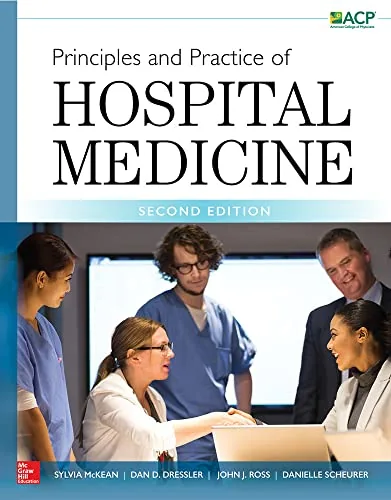
Principles and Practice of Hospital Medicine, 2nd Edition
Edited by Sylvia C. McKean, John J. Ross, Daniel D. Dressler, Danielle B. Scheurer
About this ebook
Principles and Practice of Hospital Medicine, second edition, combines inpatient clinical medicine with the organization of hospital care. Edited by McKean, Ross, Dressler, and Scheurer, it addresses acute illness, diagnostic decisions, care transitions, quality improvement, and hospitalist leadership for trainees and practitioners studying both individual patient care and hospital systems.
Inside this title
Acute inpatient illness and prevention of hospital-acquired complications
Current listed price $59.99Regular price $214.00Digital ebook
Acute and complex inpatient conditions form one strand of this reference, including sepsis, heart failure, stroke, and respiratory failure. Discussions of diagnostic testing and therapeutic decisions sit alongside prevention of hospital-acquired infections and venous thromboembolism. This arrangement places clinical problems within the wider responsibilities of inpatient practice.
Another strand examines handoffs, discharge planning, multidisciplinary coordination, patient safety, and quality improvement. Leadership, professional responsibilities, ethics, end-of-life care, and the economics of hospital medicine broaden the clinical material. Hospitalists, residents, and educators can use the second edition to study how bedside decisions interact with the processes and organizational structures through which hospitals deliver care.
Study guide included
Inside Principles and Practice of Hospital Medicine, 2nd Edition.
McKean, Ross, Dressler, and Scheurer treat hospital medicine as clinical judgment plus the design of care around it. The second edition moves from the hospitalist's expanding role through bedside reasoning, transitions, consultation, testing, and rehabilitation. This guide follows the choices and messages that must survive each boundary between people, services, and settings.
Opening sections describe how the specialty grew, what leadership and value work involve, and where inequity enters service design. Reasoning material covers pretest estimates, likelihood ratios, thresholds, and evidence appraisal, with presentations such as breathlessness, swelling, and confusion. Handoffs, safety culture, and small-cycle improvement follow, then perioperative consultation and co-management. Later parts cover laboratory and imaging tests, procedures at the bedside, postacute rehabilitation and nursing care, and conditions across specialties, ending with prognosis and goals. Each chapter links a mechanism to the decision it informs.
The role and the system
The first chapters trace a shift toward physicians who devote their work to hospitalized patients and move among ward teams. Their scope can include bedside co-management, teaching, improvement projects, and service leadership, which makes organization clinical rather than administrative. Value and equity belong in the same discussion: results turn on access, how people talk, and how processes treat different patients. Improvement then asks which outcomes are counted and who was never counted.
Map each service's contribution
Ask who was never counted
Treat coordination as clinical work
Part I, Section 1
Reasoning before the test
The clinical picture, read in context, produces a working estimate of how probable a diagnosis is before any result arrives. A likelihood ratio describes how much a given finding shifts the odds, and the same result carries different weight at different starting points. Decision thresholds connect that arithmetic to action: whether new information would alter the plan. Evidence appraisal and repeated reassessment keep the assessment open as findings accumulate.
Estimate first, then choose the test
Ask if the answer alters action
Revise when new findings arrive
Part I, Section 2, and Part IV
Transitions that keep their meaning
Moving into, through, and out of the hospital repeatedly risks losing the reason for a plan. A useful handoff states the current problem, outstanding work, likely changes, and who will respond to each. At discharge, the patient and next team both need the information, and any pending result still needs an owner once the ward is no longer involved. Safety work pairs deliberate design with culture, standard work, measurement, and a look at what failed.
State the problem, pending work, and owner
Give every pending result a name
Check the process, not only the outcome
Part I, Sections 3–4
Answering a defined consultation question
Perioperative advice ties a patient's conditions to the planned operation, anesthetic choices, and expected recovery. Heart, lung, metabolic, liver, and blood concerns are weighed in that light. A consultation is strongest when it answers a stated question and explains how the assessment should alter the surgical or recovery plan, including where uncertainty remains. Co-management differs from a one-time opinion because responsibility is divided and revisited through the perioperative period.
Restate the question being asked
Connect advice to the operative plan
Define shared responsibility in advance
Part II, Medical Consultation
Tests, images, and procedures
Diagnostic chapters place each tool beside the question it could resolve, the quality of its return, and what follows if someone acts on it. Laboratory studies, electrocardiography, pulmonary function, urinalysis, and imaging each have limits that matter when a result looks ambiguous or poorly obtained. Procedures such as vascular access, sampling, and drainage require a stated reason, an account of risk and alternatives, and a plan for who records and follows up the finding.
Name the question a test answers
Plan for an ambiguous result
Carry procedure findings to the team
Part V, Diagnostic Testing and Procedures
What comes after the ward
Rehabilitation, physical therapy, swallowing support, nursing facility care, safety planning, and hospice are treated as decisions that begin before discharge, not after it. Where someone goes next hinges on function plus available help as much as on the medical problem, and the receiving service must know what tasks remain and which change should trigger contact. For patients with several conditions, a generalist combines specialty input, while prognosis and shifting priorities reshape the plan over time.
Match destination to function and support
Tell the next setting what to watch
Revisit goals as priorities shift
Parts III and VI, and Ch. 105
Chapter and section map
Comanagement of Orthopedic Patientsp. 23
Diagnostic Reasoning and Decision Makingp. 45
Care Transitions at Hospital Dischargep. 90
Plan-Do-Study-Actp. 130
Role of the Medical Consultantp. 325
Postacute Care Rehabilitation Optionsp. 463
Using Prognosis to Guide Treatmentp. 754
Basic Diagnostic Testsp. 771
Key takeaways
State what a result would alter in the next decision before ordering the test.
Give every pending task an owner at each handoff, including after discharge.
Measure whether a safety step was completed and whether the receiver could act on it.
Hospital medicine trainees, hospitalists, and advanced practice clinicians who need a framework linking bedside reasoning, consultation, transitions, and hospital system work across services and settings.
Topics covered
hospital medicine
clinical reasoning
care transitions
perioperative consultation
quality improvement
diagnostic testing
discharge planning
patient safety
Questions about this ebook.
Edition, audience, and study-guide details at a glance.
What is Principles and Practice of Hospital Medicine, 2nd Edition about?
Principles and Practice of Hospital Medicine, second edition, combines inpatient clinical medicine with the organization of hospital care. Edited by McKean, Ross, Dressler, and Scheurer, it addresses acute illness, diagnostic decisions, care transitions, quality improvement, and hospitalist leadership for trainees and practitioners studying both individual patient care and hospital systems.
Which edition of Principles and Practice of Hospital Medicine, 2nd Edition is this?
This listing is for the 2nd edition. Check the title, ISBN, and book details above before ordering, especially if your course or reading list names a specific edition.
Who is Principles and Practice of Hospital Medicine, 2nd Edition for?
Hospital medicine trainees, hospitalists, and advanced practice clinicians who need a framework linking bedside reasoning, consultation, transitions, and hospital system work across services and settings.
Does this page include a study guide?
Yes. This page includes an original study guide with six thematic sections, key takeaways, and a chapter and section map for structured reading.