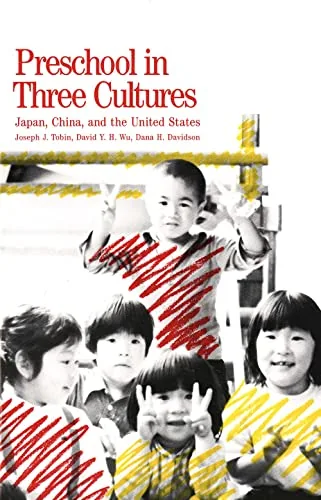
Cover of Preschool in Three Cultures: Japan, China, and the United States

Preschool in Three Cultures: Japan, China, and the United States

By Joseph J. Tobin, David Y. H. Wu, Dana H. Davidson

About this ebook

Preschool in Three Cultures compares early childhood education in Japan, China, and the United States through video-based ethnography. Joseph J. Tobin, David Y. H. Wu, and Dana H. Davidson combine classroom observations with participants' interpretations, examining discipline, play, teaching, and family involvement for readers of comparative education and cultural anthropology.

Inside this title
  • Video-based classroom observation paired with educator and community responses
Current listed price $8.99Regular price $15.00Digital ebook
Review order preview

Digital ebook. No physical book.

Format
Digital ebook
ISBN
9780300162387
Last updated
2026-11-03

What this book covers.

Video recordings of preschool days provide the shared material for this comparative study. Educators and community members respond to the footage, producing several interpretations of routines that might otherwise seem self-evident. This multivocal method connects classroom observation with participants' explanations of what children and teachers are doing.

Discipline, play, academic instruction, teacher-child relationships, and parental involvement reveal differing expectations of early education. Published in 1989, the book examines these practices within the cultural settings of Japan, China, and the United States. It offers early childhood educators, education students, and anthropologists a historical comparative study of how social values enter ordinary preschool life and influence judgments about appropriate teaching.

Study guide included

Inside Preschool in Three Cultures: Japan, China, and the United States.

Three preschool systems are placed side by side through filmed days in Japanese, Chinese and American classrooms. Tobin, Wu and Davidson then ask educators and community members to comment on the footage. The method makes routine choices visible and shows how cultural assumptions shape what counts as good early teaching.

Video gives the study a shared object of discussion. Rather than relying on one observer's judgement, the authors gather reactions from teachers, parents and others, producing several readings of the same scene. Discipline, play, instruction and family involvement become entry points into wider values about childhood and authority. Published in 1989, the book belongs to comparative education and cultural anthropology. It lets readers see that ordinary preschool practices carry expectations about independence, obedience, learning and the division of responsibility between home and school.

Filming the preschool day

Video recording is the study's core method, giving the researchers a common record to work from. Footage captures routines that participants might otherwise describe selectively. The camera turns ordinary moments into material that can be replayed and compared across settings.

  • Video supplies a shared record of classroom life
  • Routines become visible for comparison
  • Recording supports detailed cross-cultural analysis
Topic 1

Multiple voices, multiple readings

The authors do not claim a single authoritative interpretation. Educators and community members respond to the same footage, and their readings diverge in instructive ways. This multivocal approach shows that observation is filtered through cultural expectations.

  • Different participants interpret the same scenes differently
  • No single reading is treated as definitive
  • Interpretation is itself culturally situated
Topic 2

Discipline and teacher authority

How children are managed and corrected becomes a window onto broader ideas about authority. Expectations vary in how much independence or compliance is assumed to be appropriate. Discipline is presented as a cultural practice rather than a purely technical one.

  • Approaches to discipline differ across settings
  • Authority is understood through cultural expectations
  • Classroom management reflects wider social values
Topic 3

Play, work and instruction

The balance between play and structured teaching is examined in each setting. What counts as productive activity, and how much academic instruction is appropriate, varies. The comparison reveals assumptions about childhood and learning that are rarely stated aloud.

  • Play and instruction are weighted differently
  • Assumptions about childhood shape daily schedules
  • Expectations of learning vary across cultures
Topic 4

Parent and community involvement

Families and communities are treated as part of the preschool picture rather than outside it. The degree and form of parental involvement reflects ideas about who is responsible for early upbringing. Responses to the footage show where home and school expectations converge or clash.

  • Parental roles differ across the three settings
  • Responsibility for early upbringing is distributed differently
  • Home and school expectations can converge or conflict
Topic 5

Cultural values and early education

The study's wider claim is that preschool routines embody cultural values. Questions of independence, group membership, obedience and learning carry meanings that extend beyond the classroom. The book offers a way to read everyday practice as evidence of social priorities.

  • Everyday routines express cultural priorities
  • Early education is embedded in social values
  • Comparison reveals what each setting takes for granted
Topic 6

Topic map

  • Video Ethnography as MethodTopic 1
  • Interpreting Classroom FootageTopic 2
  • Discipline and Teacher AuthorityTopic 3
  • Play, Work and InstructionTopic 4
  • Parent and Community InvolvementTopic 5
  • Cultural Values in Early ChildhoodTopic 6

Key takeaways

  • Filmed classrooms give a shared basis for comparing early education across cultures.
  • Participants' divergent readings are part of the evidence, not a problem to remove.
  • Routine preschool practices encode cultural assumptions about authority and learning.

Early childhood educators, education students, and anthropologists interested in comparative classroom practice and the cultural meanings of teaching.

Topics covered

  • Preschool in Three Cultures
  • Tobin Wu Davidson
  • comparative early childhood education
  • video ethnography
  • Japanese Chinese American preschools
  • discipline and play in preschool
  • cultural values and teaching
  • multivocal ethnography

Questions about this ebook.

Edition, audience, and study-guide details at a glance.

What is Preschool in Three Cultures: Japan, China, and the United States about?

Preschool in Three Cultures compares early childhood education in Japan, China, and the United States through video-based ethnography. Joseph J. Tobin, David Y. H. Wu, and Dana H. Davidson combine classroom observations with participants' interpretations, examining discipline, play, teaching, and family involvement for readers of comparative education and cultural anthropology.

Who is Preschool in Three Cultures: Japan, China, and the United States for?

Early childhood educators, education students, and anthropologists interested in comparative classroom practice and the cultural meanings of teaching.

Does this page include a study guide?

Yes. This page includes an original study guide with six thematic sections, key takeaways, and a topic map for structured reading.

Keep your curiosity going.

More books from this subject area.

More education & learning sciences ebooks