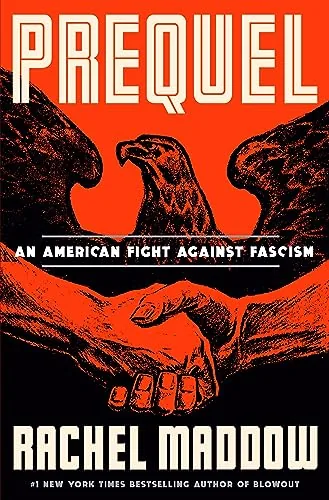
Prequel: An American Fight Against Fascism examines American fascist movements and the people who opposed them during the 1930s. Rachel Maddow follows political networks, propaganda, investigators, journalists, and whistleblowers, presenting a historical narrative for readers interested in extremism, democratic institutions, and the challenges of exposing organized threats to government.
Inside this title
American fascist organizing, political networks, and propaganda during the 1930s
Current listed price $9.99Regular price $17.00Digital ebook
Maddow traces American far-right organizing through the connections among political figures, business interests, and propaganda campaigns. Her narrative considers the climate in which fascist ideas circulated and the work required to expose their networks. Journalists, investigators, and whistleblowers form part of that story.
The account also raises questions about public attention, the response of institutions, and the difficulty of securing accountability. Its focus on the 1930s gives readers a historical setting for considering resistance to antidemocratic movements in the United States. The book suits general history readers and those studying political communication, domestic extremism, or the relationship between civic action and the defense of democratic government.
Study guide included
Inside Prequel: An American Fight Against Fascism.
Maddow reconstructs the American far right of the 1930s and the loose alliance of journalists, investigators and whistleblowers that tried to expose it. Political networks, business money and propaganda form the connective tissue of the story. The result is a history of organised extremism and of the institutional and civic response it provoked.
The narrative follows fascist organising as it moved through political circles, funding and mass communication. Maddow shows how ideas travelled between figures and organisations rather than appearing spontaneously, and how a climate of sympathy gave them room. Against this, she sets the people who gathered evidence, published findings and pressed for consequences. Questions of public attention, institutional reluctance and accountability run through the account. Set in the 1930s, the book gives readers a historical case for thinking about democratic defence, propaganda and domestic extremism.
The shape of American fascist organising
The book examines domestic fascist activity as an organised phenomenon rather than a scattering of isolated voices. Groups and individuals are connected to one another, and the movement is shown developing its own structures and media. The focus is on how organising took form inside the United States.
Domestic extremism is treated as organised, not incidental
Groups built their own structures and outlets
The movement is examined in its American setting
Topic 1
Networks of politics, money and propaganda
Political figures, financial backers and propagandists are shown in relation to one another. Money and messaging are presented as connected resources that sustained the movement. The narrative stresses links and transactions rather than a single leader's intent.
Political actors are linked to financial supporters
Propaganda depends on money and distribution
Connections matter more than a single figure
Topic 2
The climate that let extremist ideas circulate
Attention turns to the conditions in which fascist ideas found listeners during the 1930s. Public mood, existing prejudices and communication channels are treated as part of the explanation. The argument is about receptivity as much as about the organisers themselves.
Public mood shaped how ideas were received
Existing channels carried extremist messaging
Receptivity is treated as part of the problem
Topic 3
Journalists, investigators and whistleblowers
The opposition is populated by reporters, investigators and insiders who disclosed what they knew. Their work is presented as effortful and often contested rather than inevitable. The book credits the gathering and publication of evidence as a form of civic action.
Reporting and investigation exposed networks
Whistleblowers supplied inside knowledge
Exposure was contested and difficult work
Topic 4
Institutional response and public attention
Institutions and the public are examined for how quickly, or slowly, they responded. The narrative considers the gap between available evidence and official action. Attention is treated as a scarce resource that organisers and their opponents competed to direct.
Official responses lagged behind available evidence
Public attention was contested and uneven
Institutions are judged by their willingness to act
Topic 5
Accountability and the defence of democracy
The account raises the question of what accountability requires when organised threats are exposed. It connects the historical episode to broader problems of safeguarding democratic institutions. The 1930s setting becomes a frame for thinking about civic vigilance.
Exposure does not automatically produce consequences
Democratic defence depends on institutional will
The 1930s case speaks to later debates
Topic 6
Topic map
Far-Right Movements of the 1930sTopic 1
Political Networks and Business PatronageTopic 2
Propaganda and Public PersuasionTopic 3
The Investigators and the PressTopic 4
Whistleblowers and ExposuresTopic 5
Institutions, Public Opinion and AccountabilityTopic 6
Lessons for Democratic ResilienceTopic 7
Key takeaways
American fascism in the 1930s is presented as a connected network rather than a fringe curiosity.
Exposure depended on journalists, investigators and insiders willing to act on evidence.
The gap between evidence and institutional response is a central theme.
General history readers, students of political communication and extremism, and anyone interested in how democracies confront organised antidemocratic movements.
Topics covered
Prequel Rachel Maddow
American fascism 1930s
domestic extremism history
propaganda and democracy
anti-fascist investigators
whistleblowers and accountability
political networks history
democratic institutions
Questions about this ebook.
Edition, audience, and study-guide details at a glance.
What is Prequel: An American Fight Against Fascism about?
Prequel: An American Fight Against Fascism examines American fascist movements and the people who opposed them during the 1930s. Rachel Maddow follows political networks, propaganda, investigators, journalists, and whistleblowers, presenting a historical narrative for readers interested in extremism, democratic institutions, and the challenges of exposing organized threats to government.
Who is Prequel: An American Fight Against Fascism for?
General history readers, students of political communication and extremism, and anyone interested in how democracies confront organised antidemocratic movements.
Does this page include a study guide?
Yes. This page includes an original study guide with six thematic sections, key takeaways, and a topic map for structured reading.