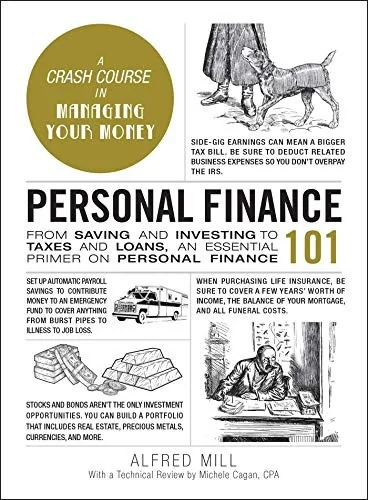
Personal Finance 101 introduces everyday money management for readers beginning to study budgeting, borrowing, saving, and retirement planning. Topic-based explanations cover financial goals, net worth, debt repayment, credit scores, and investment basics, allowing readers to approach related financial concepts in a single introductory handbook.
Inside this title
Financial goals, net worth, and household budgets
Current listed price $2.99Regular price $8.00Digital ebook
The book starts with ways of describing a personal financial situation: goals, assets, liabilities, and the money moving through a household budget. These foundations lead into saving, managing bills, understanding credit, and comparing approaches to debt repayment. The emphasis is on explaining everyday financial terms and decisions in accessible language.
Retirement accounts, employer contributions, compound interest, and the distinction between saving and investing extend the discussion to longer time horizons. Its topic-based handbook format supports reading individual sections as well as following the subjects in sequence. The intended audience includes beginners and readers refreshing their understanding of the concepts involved in personal finance.
Study guide included
Inside Personal Finance 101.
Money management gets easier once the terms stop blurring together. Mill separates budgeting from borrowing, saving from investing, and short-term bills from long-term retirement, giving beginners a working vocabulary for decisions they are already making, often without a clear picture of how the pieces fit.
The handbook opens with ways to describe a financial situation: goals, assets, liabilities, and the money moving through a household budget. From there it moves to saving, managing bills, understanding credit, and comparing approaches to debt repayment, explaining each term in plain language. Longer horizons follow, including retirement accounts, employer contributions, compound interest, and the distinction between saving and investing. Chapters can be read on their own or in sequence, which suits readers who want to look up one subject without losing the larger picture.
Goals, assets, and liabilities
A financial picture starts with what a person wants and what they already hold. The book asks readers to name goals, list assets and liabilities, and see the difference as a starting point rather than a judgment. Clear description comes before advice, so the numbers can be used rather than merely recorded.
Name goals before choosing products
List assets and liabilities separately
Treat description as a starting point
Topics 1-2
Budgets and household cash flow
A budget tracks money coming in and going out. The book treats it as a practical description of household cash flow, useful for spotting gaps and making bills manageable. The emphasis stays on building a picture a reader can act on without turning budgeting into an exercise in guilt.
Track money in and money out
Use the budget to spot gaps
Keep the exercise practical, not punitive
Topics 2-3
Credit scores and borrowing
Credit is explained through the score that lenders consult and the habits that shape it. The book connects borrowing terms to the cost of repayment, so a reader can see why the same purchase can carry different prices. The discussion stays introductory and avoids promising quick fixes.
Connect credit habits to the score
Link borrowing terms to total cost
Avoid promises of quick fixes
Topics 3-4
Approaches to debt repayment
Debt is treated as a problem with more than one workable solution. The book compares repayment approaches and the tradeoffs between them, including how interest and minimum payments affect the timeline. Readers are given practical language for evaluating options rather than a single prescribed method.
Compare repayment approaches and tradeoffs
See how interest changes the timeline
Evaluate options instead of following one method
Topics 4-5
Saving and investing distinguished
Saving and investing are related but not interchangeable. The book separates them by purpose and time horizon, explaining why money needed soon behaves differently from money set aside for later. Compound interest enters as the mechanism that makes long horizons matter, and the distinction gives readers a way to match accounts to goals.
Separate saving from investing by purpose
Match time horizon to the account
See how compounding rewards patience
Topics 5-6
Retirement accounts and employer matching
Long-term planning has its own vocabulary. The book explains retirement accounts, employer contributions, and the effect of starting early, without assuming prior familiarity. The aim is to make an employer benefit statement or a retirement menu legible enough that a reader can ask better questions.
Explain retirement account basics
Clarify how employer contributions work
Show why starting early matters
Topics 6-8
Topic map
Goals, assets, and liabilitiesTopic 1
Net worth and household budgetsTopic 2
Bills and household cash flowTopic 3
Credit scores and borrowingTopic 4
Debt repayment approachesTopic 5
Saving and investing as distinctTopic 6
Retirement accounts and employer matchingTopic 7
Compound interest over timeTopic 8
Key takeaways
A budget and net worth statement turn vague financial worry into numbers a person can work with.
Credit and debt decisions carry costs that become clearer when interest and repayment terms are compared.
Saving and investing serve different time horizons, and compound interest rewards starting early.
Beginners and readers refreshing their understanding of household money management, including people who want a plain-language reference they can consult one topic at a time.
Topics covered
Personal Finance 101
budgeting basics
net worth
credit scores
debt repayment
compound interest
retirement accounts
saving versus investing
Questions about this ebook.
Edition, audience, and study-guide details at a glance.
What is Personal Finance 101 about?
Personal Finance 101 introduces everyday money management for readers beginning to study budgeting, borrowing, saving, and retirement planning. Topic-based explanations cover financial goals, net worth, debt repayment, credit scores, and investment basics, allowing readers to approach related financial concepts in a single introductory handbook.
Who is Personal Finance 101 for?
Beginners and readers refreshing their understanding of household money management, including people who want a plain-language reference they can consult one topic at a time.
Does this page include a study guide?
Yes. This page includes an original study guide with six thematic sections, key takeaways, and a topic map for structured reading.