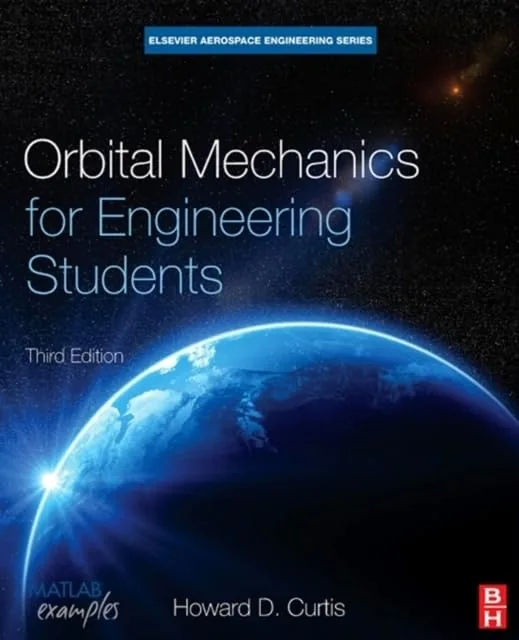
Orbital Mechanics for Engineering Students, 3rd Edition
By Howard D. Curtis
About this ebook
Orbital Mechanics for Engineering Students, Third Edition, introduces spacecraft motion and trajectory analysis for undergraduate aerospace engineers. Howard D. Curtis builds from vector kinematics and Newtonian mechanics to orbital elements, transfers, perturbations, and interplanetary flight. Worked examples and numerical methods connect mathematical development with satellite and mission problems.
Inside this title
Two-body motion and conversions between orbital elements and states
Current listed price $31.00Regular price $78.00Digital ebook
The early material establishes the mechanics needed to describe motion in space, including vectors, gravitation, and the two-body problem. Orbital elements connect position and velocity calculations with the geometry of a trajectory, providing a framework for understanding Earth-centered and interplanetary orbits.
Trajectory design includes Hohmann transfers and gravity assists, followed by departures from ideal Keplerian motion. Perturbation topics consider Earth's oblateness, atmospheric drag, and third-body effects. Numerical orbit propagation and MATLAB-based methods accompany the analytical treatment. Aerospace engineering students can follow the worked examples and homework exercises as part of an astrodynamics course, while readers studying spacecraft dynamics can focus on the connection between orbital calculations and mission analysis.
Study guide included
Inside Orbital Mechanics for Engineering Students, 3rd Edition.
Written for aerospace undergraduates, this text turns Newtonian mechanics into practical tools for spacecraft trajectories. Curtis moves from vectors and gravitation to orbital elements, transfer design, and disturbance analysis, with worked examples and computer-based exercises that mirror the calculations engineers perform during mission planning.
The sequence starts with the vector and kinematic background required for three-dimensional motion, then states the gravitational two-body problem and solves it. Converting orbital elements to position-velocity vectors and back becomes a recurring skill, supported by procedures for determining an orbit from observations. Maneuver planning follows, including single-burn changes and transfer arcs between orbits, before the discussion widens to planetary departure and flyby geometry. The later material confronts departures from the ideal model caused by oblateness, drag, and other bodies, and introduces numerical integration as the practical response. Software exercises run alongside the analytical development.
Kinematic and gravitational foundations
Motion in space is first described with position, velocity, and acceleration vectors expressed in rotating or inertial frames. Newton's gravitational law then supplies the force model, and the reduction of a two-body system to an equivalent one-body problem sets up everything that follows.
Vector kinematics in moving frames
Inverse-square gravitation
Reduction to relative motion
Topics 1-2
Geometry of orbits and element conversion
Six parameters fix an orbit, and the text shows how each one corresponds to an observable feature of the path. Equations linking those elements to instantaneous position and velocity are derived and then inverted, so calculations can proceed in either direction depending on what is known.
Classical orbital elements
Element-to-state and state-to-element transforms
Energy and angular momentum relations
Topic 3
Determining an orbit from data
Practical work begins with incomplete measurements. The book presents methods for extracting an initial orbit from angles, ranges, or a short arc, and it discusses the sensitivity of the result to observational error. These techniques connect textbook geometry with tracking data.
Gibbs and Herrick-Gibbs approaches
Angles-only and range-based solutions
Error sensitivity
Topic 4
Maneuvers and transfer design
Changing an orbit requires velocity increments, and the text quantifies their cost. Coplanar transfers, plane changes, and combined maneuvers are analyzed with the impulse approximation, and phasing and rendezvous are treated as timing problems layered on top of geometry.
Impulsive velocity changes
Hohmann and non-Hohmann transfers
Plane change and phasing
Topic 5
Interplanetary trajectories
Leaving Earth's neighborhood introduces the sphere-of-influence concept and hyperbolic escape asymptotes. The text assembles patched-conic solutions for planetary arrival, and gravity assists are explained as momentum exchange with a moving planet rather than a free gain in speed.
Sphere of influence and escape asymptotes
Patched-conic planetary transfer
Gravity-assist geometry
Topic 6
Disturbances and numerical propagation
Kepler's solution is an idealization, and the final themes catalogue what spoils it. Nonspherical gravity, atmospheric friction, and third-body pulls are described qualitatively and with perturbation equations, while numerical integration and software tools are offered as the general solution method.
Oblateness and drag effects
Third-body perturbations
Numerical integration and software practice
Topics 7-8
Topic map
Vectors, frames, and kinematicsTopic 1
Gravitation and relative motionTopic 2
Orbital elements and state vectorsTopic 3
Initial orbit determinationTopic 4
Orbital maneuversTopic 5
Interplanetary and gravity-assist trajectoriesTopic 6
Perturbation sourcesTopic 7
Numerical orbit propagationTopic 8
Key takeaways
Orbital elements and state vectors are two views of the same information; fluency in converting between them underpins most work.
Every maneuver has a velocity cost, so mission design is a budgeting exercise as much as a geometric one.
Real trajectories require perturbation models and numerical integration, not closed-form solutions alone.
Undergraduate aerospace engineering students in an astrodynamics course, plus practicing engineers refreshing trajectory fundamentals.
Topics covered
orbital mechanics
astrodynamics textbook
spacecraft trajectory design
orbital elements
Hohmann transfer
interplanetary trajectories
gravity assist
orbit perturbations
numerical orbit propagation
Questions about this ebook.
Edition, audience, and study-guide details at a glance.
What is Orbital Mechanics for Engineering Students, 3rd Edition about?
Orbital Mechanics for Engineering Students, Third Edition, introduces spacecraft motion and trajectory analysis for undergraduate aerospace engineers. Howard D. Curtis builds from vector kinematics and Newtonian mechanics to orbital elements, transfers, perturbations, and interplanetary flight. Worked examples and numerical methods connect mathematical development with satellite and mission problems.
Which edition of Orbital Mechanics for Engineering Students, 3rd Edition is this?
This listing is for the 3rd edition. Check the title, ISBN, and book details above before ordering, especially if your course or reading list names a specific edition.
Who is Orbital Mechanics for Engineering Students, 3rd Edition for?
Undergraduate aerospace engineering students in an astrodynamics course, plus practicing engineers refreshing trajectory fundamentals.
Does this page include a study guide?
Yes. This page includes an original study guide with six thematic sections, key takeaways, and a topic map for structured reading.