By Abraham Silberschatz, Peter Baer Galvin, Greg Gagne
About this ebook
Operating System Concepts, tenth edition, explains the principles underlying process execution, memory, storage, and system protection. Silberschatz, Galvin, and Gagne combine operating system theory with examples from systems including Linux and Windows. The text serves computer science students and technical readers studying how operating systems coordinate hardware resources and software activity.
Inside this title
Process scheduling, thread management, synchronization, and deadlock handling
Current listed price $32.00Regular price $83.00Digital ebook
Processes and threads introduce the problems of scheduling concurrent work, sharing data, and avoiding deadlocks. The text examines synchronization mechanisms such as mutexes, semaphores, and monitors alongside scheduling and resource-allocation algorithms. Memory chapters develop the relationship between paging, virtual memory, page replacement, and system performance.
Storage and file systems receive attention through directory structures, allocation methods, free-space management, and the kernel's I/O responsibilities. Protection and security extend the discussion to controlling access and isolating system activity. Case studies connect these concepts to recognizable operating systems, giving university students and independent learners a way to compare general design principles with particular implementations.
Study guide included
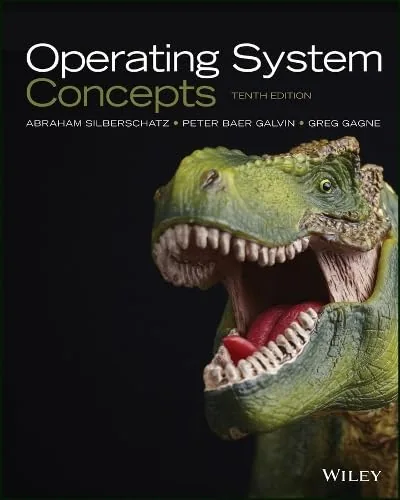
Inside Operating System Concepts, 10th Edition.
An operating system exists to make scarce hardware usable by many programs at once. That simple goal produces hard questions about privilege, ordering, sharing, and failure. This textbook works through those questions from kernel interfaces to file systems, using concrete systems and traced examples to show why each design choice carries a cost.
The tenth edition opens by describing system organization and the kernel interface, then develops processes and threads, CPU scheduling, synchronization, and deadlock. Memory chapters cover paging, translation of addresses, and virtual memory; storage chapters cover I/O, disks, and file systems. Protection and security add explicit rules about who may act on what. Later material turns to virtual machines, distributed systems, and case studies of Linux and Windows. Throughout, examples should be read as records of state, ownership, and timing, especially where operations appear simultaneous but are not.
Where applications meet the kernel
User programs run with restricted authority. A system call hands control to a fixed kernel gate, where the kernel checks arguments and access rights, and hardware interrupts or timers can pull attention back. Architectural choices—a large kernel, loadable modules, layers, or a small core served by cooperating processes—change isolation and the cost of crossing boundaries. Comparing designs means naming the service and following its path to hardware or protected data.
Follow a request across the boundary
Note what gets checked, and when
Price the cost of isolation
Chs. 1–2 · Introduction and operating-system structures
Processes, threads, and the scheduler
A process holds an address space, open files, and similar assets; a thread holds a point of execution while sharing the rest. Keeping those ideas apart clarifies both collaboration and conflict. Scheduler policies trade response time, throughput, completion time, and fairness, and each choice has a failure mode: short jobs stuck behind long ones, overhead from tiny quanta, or low-priority work that never runs.
Separate resources from execution state
Judge policies against a workload
Watch for starvation and overhead
Chs. 3–5 · Processes, threads, and CPU scheduling
Coordination, races, and deadlock
Correctness in concurrent code depends on protecting invariants across an update and on acquisition order. Locks, semaphores, and monitors coordinate at different levels, while condition waits let a thread sleep until state changes. Deadlock arises when holders wait on one another in a cycle. Prevention changes how resources are granted; avoidance checks whether a requested grant leaves a safe state; detection hunts cycles after the fact. A consistent lock order removes one common cause.
Protect the invariant, not just the variable
Check progress plus bounded waiting
Trace lock order before blaming the CPU
Chs. 6–8 · Synchronization and deadlocks
Translation, locality, and page faults
Paging splits virtual addresses into numbered pages plus offsets and divides physical RAM into frames; page tables hold mappings and rights; a translation cache avoids repeat lookups. The process sees one contiguous space even when frames are scattered. Demand paging defers loading until a page is needed, so a missing page triggers retrieval and replacement. Workloads that keep returning to a few pages behave very differently from those exceeding available frames and thrashing.
Trace a translation before costing it
Use locality to predict faults
Count hits and misses explicitly
Chs. 9–10 · Main memory and virtual memory
Storage, I/O, and the file abstraction
Behind a filename sit device operations, placement choices, and consistency checks. The I/O layer offers uniform operations for varied hardware, and buffering, caching, and controller concurrency explain why an application call may return before physical work finishes. Directories organize names; free-space and allocation structures decide placement. Metadata updates create crash windows, so file systems trade routine speed for the power to rebuild a consistent state.
Distinguish namespace from physical placement
Ask where work is deferred
Imagine failure after each write
Chs. 11–15 · Storage, I/O, and file-system design
Trust boundaries and real systems
Authentication answers who is acting; protection decides which actions a subject may take on a given object. Access-right tables, capability lists, and least-privilege thinking reveal overly broad grants. Virtual machines add a monitor-mediated boundary between guests and host resources. Case studies of Linux and Windows return to kernel structure, CPU scheduling, memory management, file storage, and access control, giving readers a common set of questions for comparing designs rather than a list of features.
Keep identity separate from permission
Look for unnecessarily broad grants
Compare systems by the same questions
Chs. 16–21 · Security, advanced topics, and system case studies
Chapter and section map
Introduction and operating-system structuresChs. 1–2
Processes, threads, and schedulingChs. 3–5
Synchronization and deadlocksChs. 6–8
Main and virtual memoryChs. 9–10
Mass storage and I/OChs. 11–12
File systemsChs. 13–15
Security and protectionChs. 16–17
Virtualization, networks, and case studiesChs. 18–21
Key takeaways
Draw process assets and thread execution state as separate boxes before analyzing sharing, scheduling, or apparent simultaneity.
Inspect lock ownership plus wait conditions before blaming CPU contention for a stall.
Judge RAM and I/O from a reference string or a request trace, not one average time.
Computer science students and working engineers who want a durable foundation in operating-system internals, from scheduling and synchronization to memory, storage, security, and real kernel case studies.
Topics covered
operating systems
process scheduling
virtual memory
concurrency control
deadlock prevention
file systems
system security
kernel architecture
Questions about this ebook.
Edition, audience, and study-guide details at a glance.
What is Operating System Concepts, 10th Edition about?
Operating System Concepts, tenth edition, explains the principles underlying process execution, memory, storage, and system protection. Silberschatz, Galvin, and Gagne combine operating system theory with examples from systems including Linux and Windows. The text serves computer science students and technical readers studying how operating systems coordinate hardware resources and software activity.
Which edition of Operating System Concepts, 10th Edition is this?
This listing is for the 10th edition. Check the title, ISBN, and book details above before ordering, especially if your course or reading list names a specific edition.
Who is Operating System Concepts, 10th Edition for?
Computer science students and working engineers who want a durable foundation in operating-system internals, from scheduling and synchronization to memory, storage, security, and real kernel case studies.
Does this page include a study guide?
Yes. This page includes an original study guide with six thematic sections, key takeaways, and a chapter and section map for structured reading.