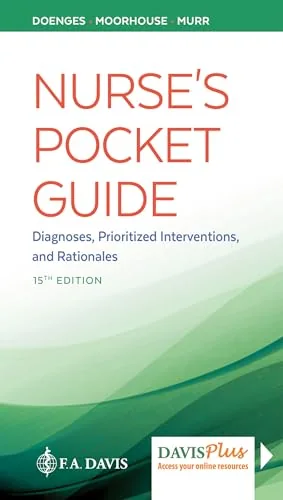
Nurse's Pocket Guide links nursing diagnoses with expected outcomes, prioritized interventions, and explanatory rationales. The fifteenth edition gives nursing students and practicing nurses a structured care-planning reference, helping them examine how assessment findings relate to diagnostic choices, intervention priorities, documentation, and evaluation of a patient's response to care.
Inside this title
Pairs nursing diagnoses with outcomes and prioritized interventions
Current listed price $16.00Regular price $32.00Digital ebook
Diagnosis entries provide a consistent route through care planning, beginning with definitions and moving toward expected outcomes and proposed actions. Alphabetical and clinical-category organization supports consultation by diagnostic term or patient problem. The emphasis on prioritized interventions makes the ordering of care a central subject of the guide.
Rationales explain the reasoning behind interventions, while diagnostic clusters show relationships among commonly associated problems. The text also considers selecting diagnoses from assessment data, applying NANDA-I terminology, documenting plans, and revising care in response to outcomes. Students can use the fifteenth edition for care-plan assignments and clinical learning; nurses can consult it when reviewing the structure and logic of nursing diagnoses.
Doenges, Moorhouse, and Murr turn a client's response into a nursing plan that can be traced. Alphabetical entries link assessment cues to measurable outcomes, ranked actions, and the reasoning behind each step, while a second index begins with a condition or a stated worry. The fifteenth edition expects readers to adapt every entry rather than copy it.
Chapter one walks through assessment, diagnosis, planning, implementation, and evaluation as a loop that restarts whenever findings change. The core alphabetical section gives each diagnosis a definition, contributing or vulnerability factors, and both reported and observed indicators, followed by suggested outcomes, interventions, and rationales. A third chapter reverses the search, listing diagnoses that commonly accompany a condition or concern. Appendices supply an adult assessment tool, diagnostic divisions, and a worked diabetes plan with a concept map. The book rewards readers who check a label against real cues and who write goals another nurse could evaluate.
Assessment baseline and the care loop
Assessment blends the person's account, direct observation, and records, sorted by what the person does and what worries them, so related cues sit together. Baseline ability, home resources, and personal goals change what a finding means and which concern comes first. From there the process moves through diagnosis, planning, implementation, and evaluation, and it restarts whenever new information or a stalled plan calls the earlier reading into question.
Record baseline function before interpreting change
Group cues by concern rather than by source
Reopen the loop when progress stalls
Ch. 1, The Nursing Process and Planning Client Care
Reading a diagnosis entry against cues
Each alphabetical entry supplies a definition, a diagnostic division, contributing or vulnerability factors, and both reported and observed indicators. Begin by reading the definition, confirm what it covers, and only then judge which indicators are present. Bracketed text marks author suggestions inside standardized language, so the two should not be confused. A problem-focused diagnosis needs current evidence; a risk diagnosis needs documented vulnerability, and mixing the two hides the reasoning.
Check the definition before accepting a label
Separate present indicators from risk factors
Notice which text is standardized and which is added
Ch. 2, Nursing Diagnoses in Alphabetical Order
Observable outcomes and evaluation criteria
A usable goal names the actor, the visible change, and the review date. Suggested outcomes can be reshaped around the person: demonstrating a skill, naming contributing factors, or taking part in something that matters to them. Nursing Outcomes Classification terms give shared vocabulary, but a standard label needs a specific indicator before anyone can judge progress, and the person should agree that the target is worth reaching.
Attach a time and an observer to every goal
Test feasibility against the recorded baseline
Let the client confirm the target matters
Ch. 2, Desired Outcomes and Evaluation Criteria
Prioritized actions and written rationales
Actions sit in priority order and frequently open by clarifying what drives the concern. Rationales state the purpose, which lets a reader judge fit rather than follow order. Age, diagnosis, aims, and care setting decide whether an action belongs, and the guide marks where independent nursing work ends and collaboration or an order begins. The record should hold the cue, the step taken, and how the person answered.
Ask what each action is meant to change
Flag steps that need an order or a colleague
Write the cue, the step, and the reply together
Ch. 2, Nursing Priorities and Documentation Focus
Condition index as a starting point
The third chapter works in the opposite direction, beginning with a diagnosis or a stated worry and listing diagnoses that often accompany it. That suits a referral or record that supplies a starting point while the nursing response stays unclear. Suggestions are possibilities, not conclusions, so each must be checked against the person's own indicators or vulnerabilities. Missing information sends the reader back to assessment rather than forward to a plan.
Treat index results as candidates needing confirmation
Switch between condition, division, and entry views
Let gaps in evidence trigger more assessment
Ch. 3, Health Conditions and Client Concerns
Prototype plans and concept mapping
The worked diabetes example opens with a collected assessment and constructs a plan around one client's situation. Working backward through it is instructive: every action points back to a goal, and every diagnosis points back to a cue. Concept maps then display contributing factors, worries, and goals as a web, showing how one finding can touch several diagnoses and one action can affect another concern. Reassessment keeps the map honest at handoff.
Trace every action backward to a stated outcome
Prune branches that lack supporting evidence
Update the map before transferring care
Appendix 2, Client Situation and Prototype Plan of Care
Chapter and section map
How to Use the Nurse’s Pocket Guidep. xi
The Nursing Process and Planning Client CareCh. 1 · p. 1
Nursing Diagnoses in Alphabetical OrderCh. 2 · p. 4
Health Conditions and Client ConcernsCh. 3 · p. 978
Adult Medical/Surgical Assessment ToolAppendix 1 · p. 1120
Diagnostic DivisionsAppendix 1 · p. 1132
Prototype Plan and Concept MappingAppendix 2 · pp. 1140, 1156
Key takeaways
Read the definition, then verify its indicators; only afterward adopt a label an index suggested.
Combine a shared outcome term with one concrete, visible target the client actually cares about.
Keep the cue, the action, and the reply in one place so a colleague can judge the plan.
Nursing students building care plans for clinical rotations, and practicing nurses who want a fast reference connecting diagnoses, outcomes, interventions, and documentation expectations in everyday practice.
Topics covered
nursing diagnosis
care planning
NANDA-I labels
nursing interventions
expected outcomes
clinical documentation
nursing process
student nurse
Questions about this ebook.
Edition, audience, and study-guide details at a glance.
What is Nurse's Pocket Guide: Diagnoses, Prioritized Interventions and Rationales, 15th Edition about?
Nurse's Pocket Guide links nursing diagnoses with expected outcomes, prioritized interventions, and explanatory rationales. The fifteenth edition gives nursing students and practicing nurses a structured care-planning reference, helping them examine how assessment findings relate to diagnostic choices, intervention priorities, documentation, and evaluation of a patient's response to care.
Which edition of Nurse's Pocket Guide: Diagnoses, Prioritized Interventions and Rationales, 15th Edition is this?
This listing is for the 15th edition. Check the title, ISBN, and book details above before ordering, especially if your course or reading list names a specific edition.
Who is Nurse's Pocket Guide: Diagnoses, Prioritized Interventions and Rationales, 15th Edition for?
Nursing students building care plans for clinical rotations, and practicing nurses who want a fast reference connecting diagnoses, outcomes, interventions, and documentation expectations in everyday practice.
Does this page include a study guide?
Yes. This page includes an original study guide with six thematic sections, key takeaways, and a chapter and section map for structured reading.