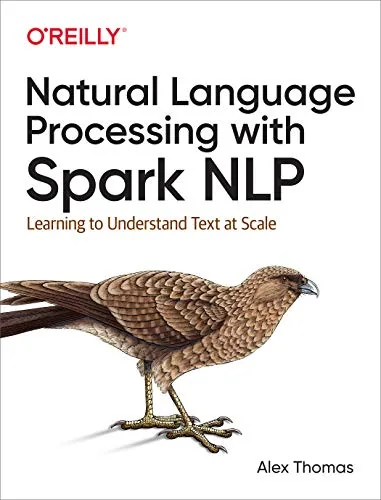
Cover of Natural Language Processing with Spark NLP

Natural Language Processing with Spark NLP

By Alex Thomas

About this ebook

Natural Language Processing with Spark NLP teaches text processing within the Apache Spark ecosystem. Alex Thomas connects linguistic foundations with tokenization, tagging, entity recognition, sentiment analysis, classification, and search through Scala and Python examples. The book addresses data scientists and engineers who know Spark and want to build distributed text-processing pipelines.

Inside this title
  • Scala and Python examples for distributed Spark NLP pipelines
Current listed price $27.00Regular price $59.00Digital ebook
Buy now

Digital ebook. Checkout sends an order request.

Format
Digital ebook
ISBN
9781492047711
Last updated
2026-11-03

What this book covers.

Alex Thomas begins with the representation and processing of language before developing practical pipelines with Spark NLP. Tokenization, lemmatization, part-of-speech tagging, and named entity recognition provide the building blocks. Scala and Python examples connect the concepts with the distributed processing environment of Apache Spark.

Later topics include sentiment analysis, text classification, search, embeddings, and the use of pretrained models. The progression considers how individual language-processing tasks contribute to applications that handle large collections of text. Data scientists, software engineers, and machine learning practitioners familiar with Spark can use this 2020 first edition to study the relationship between NLP concepts, pipeline design, and distributed deployment.

Study guide included

Inside Natural Language Processing with Spark NLP.

Text processing at scale changes what an NLP pipeline must do. This book pairs the linguistic building blocks of tokenization, tagging and entity recognition with the distributed machinery of Apache Spark, using Scala and Python examples to show how the pieces become applications that handle large text collections.

Thomas starts with how language is represented and processed before moving to the practical pipeline. Tokenization, lemmatization, part-of-speech tagging and named entity recognition are introduced as the components on which later tasks depend. Scala and Python examples tie each step to Spark, the environment that makes the processing distributed. Sentiment analysis, text classification, search, embeddings and pretrained models extend the sequence toward full applications. The through-line is the relationship between a single language-processing task, the design of a pipeline, and deployment across large volumes of text. The 2020 first edition is aimed at readers who already know Spark.

Representing and processing language

The book begins with the question of how text is turned into something a system can operate on. Representation choices affect every later step, so the opening material sets constraints rather than offering neutral background. This foundation makes the pipeline stages intelligible as a sequence of transformations.

  • Text must be represented before it can be processed
  • Representation choices constrain later stages
  • The pipeline is a sequence of transformations
Topic 1

Tokenization and lemmatization

Tokenization splits text into units and lemmatization reduces words to a base form. Both are presented as preparatory steps whose decisions ripple through downstream tasks. The text treats them as adjustable components rather than fixed preprocessing.

  • Tokenization defines the unit of analysis
  • Lemmatization normalizes word forms
  • Preprocessing choices affect later results
Topic 2

Part-of-speech tagging

Tagging assigns grammatical categories to tokens and supplies information that later tasks can use. The book connects tags to the syntactic structure they imply. It presents tagging as a component with its own accuracy concerns and its own place in the pipeline.

  • Tags assign grammatical categories
  • Tagging reveals syntactic structure
  • Accuracy matters for downstream use
Topic 3

Named entity recognition

Entity recognition identifies and classifies names and other referents in text. It demonstrates how linguistic annotation becomes structured information that applications can act on. The topic also shows why entity boundaries and categories are not always straightforward.

  • Entity recognition extracts structured referents
  • Annotation enables downstream applications
  • Boundaries and categories can be ambiguous
Topic 4

Sentiment and classification

Sentiment analysis and text classification turn processed text into judgments or categories. The book treats these as applications built on the earlier components, not as isolated tricks. Scala and Python examples connect the model or method to the distributed execution environment.

  • Classification assigns categories to text
  • Sentiment is a specialized classification task
  • Applications build on earlier pipeline stages
Topic 5

Search, embeddings, and deployment

Search, word embeddings and pretrained models extend the pipeline toward retrieval and reuse. Pretrained models reduce the need to begin from scratch while introducing their own integration questions. The closing concern is deployment: how a pipeline built from these pieces runs across large text collections.

  • Search supports retrieval over text
  • Embeddings represent meaning numerically
  • Pretrained models and deployment close the arc
Topics 6–7

Topic map

  • Representing and Processing LanguageTopic 1
  • Tokenization and LemmatizationTopic 2
  • Part-of-Speech TaggingTopic 3
  • Named Entity RecognitionTopic 4
  • Sentiment Analysis and Text ClassificationTopic 5
  • Search and Word EmbeddingsTopic 6
  • Pretrained Models and Distributed DeploymentTopic 7

Key takeaways

  • Build the linguistic components carefully; downstream tasks inherit their choices.
  • Spark is the execution environment, so examples should be read with distribution in mind.
  • Pretrained models save effort but still require integration into the pipeline.

Data scientists, software engineers and machine learning practitioners who already know Spark and want to build distributed text-processing pipelines.

Topics covered

  • Spark NLP
  • natural language processing
  • distributed NLP pipelines
  • tokenization and lemmatization
  • named entity recognition
  • sentiment analysis
  • word embeddings
  • Alex Thomas

Questions about this ebook.

Edition, audience, and study-guide details at a glance.

What is Natural Language Processing with Spark NLP about?

Natural Language Processing with Spark NLP teaches text processing within the Apache Spark ecosystem. Alex Thomas connects linguistic foundations with tokenization, tagging, entity recognition, sentiment analysis, classification, and search through Scala and Python examples. The book addresses data scientists and engineers who know Spark and want to build distributed text-processing pipelines.

Who is Natural Language Processing with Spark NLP for?

Data scientists, software engineers and machine learning practitioners who already know Spark and want to build distributed text-processing pipelines.

Does this page include a study guide?

Yes. This page includes an original study guide with six thematic sections, key takeaways, and a topic map for structured reading.

Keep your curiosity going.

More books from this subject area.

More formal sciences & technology ebooks

Enter your name and email to open a WhatsApp message with your details.