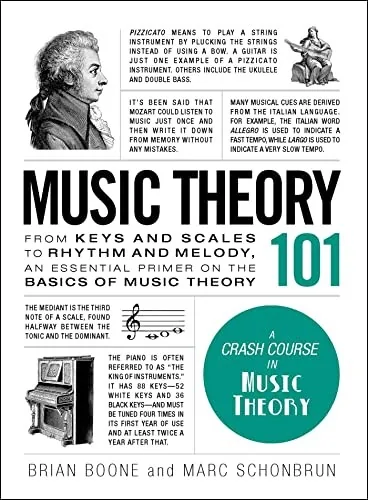
Music Theory 101 introduces the notation and patterns underlying Western music for beginning musicians and interested listeners. Visual examples accompany explanations of pitch, rhythm, scales, intervals, keys, chords, and melody, connecting the language of written music with the structures used in composition and performance.
Inside this title
Musical notation for pitch, rhythm, and expression
Current listed price $6.99Regular price $14.00Digital ebook
Reading music provides an entry point into this introductory guide. Pitch, rhythmic values, dynamics, and articulation establish how a score records musical information. Scales and intervals then explain relationships between notes, with key signatures and the circle of fifths placing those relationships in a wider tonal framework.
Chord construction, inversions, voice leading, and common progressions connect individual notes with harmony and song structure. Melody receives attention through phrasing, motifs, and contour, while time signatures show how beats are organized. Visual aids and examples make the guide suitable for novice instrumentalists, beginning songwriters, and listeners who want to understand the terms used to describe music.
Study guide included
Inside Music Theory 101.
Written music looks like code until pitch, rhythm, and harmony are explained as connected systems. Boone and Schonbrun start with the score and work toward chords and melody, so beginners can read what they play and hear what they read.
Reading music is the entry point. Pitch, rhythmic values, dynamics, and articulation show how a score records what a performer needs, while scales and intervals explain relationships between notes. Key signatures and the circle of fifths widen that framework into tonal organization. Chord construction, inversions, voice leading, and common progressions connect single notes to harmony and song structure, and melody receives attention through phrasing, motifs, and contour. Time signatures show how beats are grouped. Visual examples support novice instrumentalists, beginning songwriters, and listeners who want the vocabulary for what they hear.
Reading pitch and rhythm
Notation is a recording system, and the book begins with what it records. Pitch shows where a sound sits, while rhythmic values and time signatures show when it occurs. Dynamics and articulation add how it is played. Learning to read these elements gives beginners access to music they have not yet heard.
Treat notation as a recording system
Separate where from when
Add dynamics and articulation last
Topics 1-2
Scales, intervals, and keys
Scales organize the notes available in a piece, and intervals describe the distance between them. The book explains major and minor scales before showing how key signatures summarize the tonal center. These relationships give readers a way to predict how notes will behave rather than memorizing each case separately.
Explain major and minor scales
Measure distance with intervals
Let key signatures summarize the center
Topics 3-4
The circle of fifths
The circle of fifths arranges keys by their relationships, making it a map rather than a rule to recite. The book uses it to connect key signatures, related keys, and the movement between them. Seeing the pattern reduces the amount of separate information a beginner has to hold in mind.
Use the circle as a map
Connect key signatures to related keys
Replace memorization with pattern
Topics 4-5
Building chords and inversions
Chords are built from intervals, and the book shows how construction follows from the scale. Inversions are explained as reorderings that change the bass note and the character of a chord without changing its identity. The result is a practical understanding of harmony rather than a list of shapes.
Build chords from scale intervals
Treat inversions as reorderings
Separate chord identity from bass note
Topics 5-6
Progressions and voice leading
Common progressions show how chords move in recognizable patterns. The book explains voice leading as the way individual lines connect between chords, which is where smooth harmony comes from in practice. For songwriters, this links the chord chart to the sound a listener actually hears.
Recognize common chord progressions
Track individual lines between chords
Connect the chart to the sound
Topics 6-7
Melody, phrasing, and meter
Melody is treated as more than a sequence of pitches. The book discusses phrasing, motifs, and contour, showing how repetition and shape create a sense of direction. Time signatures return here to explain how beats group, giving melody a rhythmic frame as well as a tonal one.
Read melody through phrasing and contour
Use motifs to create direction
Group beats with time signatures
Topics 7-8
Topic map
Pitch and the musical staffTopic 1
Rhythm, dynamics, and articulationTopic 2
Major and minor scalesTopic 3
Intervals and key signaturesTopic 4
Circle of fifths and tonal relationshipsTopic 5
Chord construction and inversionsTopic 6
Progressions and voice leadingTopic 7
Melodic phrasing, motifs, and time signaturesTopic 8
Key takeaways
Notation records pitch, rhythm, and expression, giving beginners a way into music they have not played.
Scales and keys explain relationships between notes, reducing harmony to patterns rather than memorized shapes.
Chords, progressions, and voice leading connect individual notes to the sound of a complete piece.
Beginning instrumentalists, apprentice songwriters, and attentive listeners who want to read music and understand the terms used to describe harmony, melody, and rhythm without prior theory.
Topics covered
Music Theory 101
music notation
scales and intervals
circle of fifths
chord construction
voice leading
melodic phrasing
time signatures
Questions about this ebook.
Edition, audience, and study-guide details at a glance.
What is Music Theory 101 about?
Music Theory 101 introduces the notation and patterns underlying Western music for beginning musicians and interested listeners. Visual examples accompany explanations of pitch, rhythm, scales, intervals, keys, chords, and melody, connecting the language of written music with the structures used in composition and performance.
Who is Music Theory 101 for?
Beginning instrumentalists, apprentice songwriters, and attentive listeners who want to read music and understand the terms used to describe harmony, melody, and rhythm without prior theory.
Does this page include a study guide?
Yes. This page includes an original study guide with six thematic sections, key takeaways, and a topic map for structured reading.