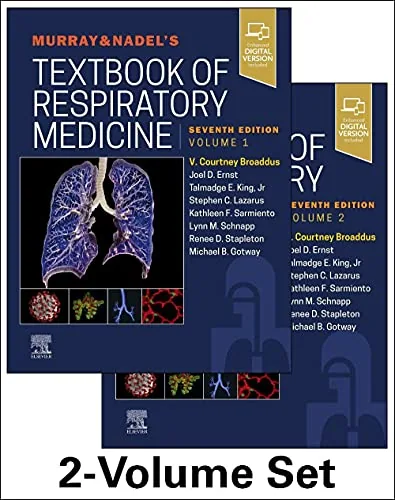
Murray & Nadel's Textbook of Respiratory Medicine, 7th Edition
Edited by V. Courtney Broaddus, Joel D. Ernst, Talmadge E. King Jr, Stephen C. Lazarus, Kathleen F. Sarmiento, Lynn M. Schnapp, Renee D. Stapleton, Michael B. Gotway
About this ebook
Murray & Nadel's Textbook of Respiratory Medicine, seventh edition, connects respiratory science with pulmonary diagnosis, treatment, and critical care. It addresses lung physiology, obstructive and restrictive disease, infection, cancer, vascular disorders, and interventional techniques. Pulmonary trainees, respiratory clinicians, and researchers can study disease mechanisms alongside diagnostic methods and clinical management topics.
Inside this title
Respiratory physiology linked with obstructive, restrictive, and vascular disease
Current listed price $69.99Regular price $279.00Digital ebook
Basic physiology and molecular mechanisms underpin the book's treatment of respiratory disorders. Obstructive disease, including asthma and COPD, appears alongside pulmonary fibrosis, respiratory infections, pulmonary embolism, pulmonary hypertension, and lung cancer. Cancer biology and immunotherapy add detail to the relationship between disease mechanisms and therapeutic approaches.
Critical care topics include mechanical ventilation, ARDS, and sepsis, while diagnostic and procedural coverage extends to ultrasound, bronchoscopy, and interventional pulmonology. Vaping-related injury and sleep-disordered breathing broaden the clinical scope. The seventh edition brings these areas into a shared reference for advanced pulmonary study, allowing trainees and clinicians to examine respiratory conditions from foundational science through investigation and management.
Study guide included
Inside Murray & Nadel's Textbook of Respiratory Medicine, 7th Edition.
Murray & Nadel's two-volume reference maps respiratory disease onto the anatomy and physiology that generate it. Editors led by Broaddus organize lung biology, testing, infection, airway disease, vascular and interstitial conditions, sleep, and critical care, so a clinician can trace a symptom back to a compartment and forward to a management decision.
The seventh edition opens with structure and function: airways, alveoli, vessels, lymphatics, repair, mechanics, and gas exchange. A diagnostic block covers history, examination, imaging, bronchoscopy, microbiology, and pulmonary function testing, with attention to how a measurement was obtained. Disease sections then move through infection, obstructive and interstitial processes, cancer, pulmonary vascular disease, and pleural disorders. Later chapters address sleep, occupational exposure, respiratory involvement in other systemic illness, ventilatory failure, transplantation, and end-of-life care. The organization rewards readers who arrive with a specific question.
Structure explains where gas exchange fails
The opening chapters trace each compartment and what it contributes. Airways conduct and condition air, alveoli present a thin surface for transfer, vessels carry blood past that surface, and lymphatics and mesenchyme handle repair and drainage. Because these parts interact, an injury in one place can show up as a change in resistance, compliance, or oxygenation somewhere else.
Name the compartment before naming disease
Ventilation without perfusion tells half a story
Regional differences hide in whole-lung averages
Chs. 1–14
Testing answers a defined question
History and examination narrow the possibilities; tests are chosen to separate them. Imaging shows where a change sits, microbiology and pathology suggest what produced it, and function testing describes airflow, volumes, and transfer. The book insists on judging technical quality first, because a poor maneuver can imitate a disease pattern and lead an entire workup astray.
Check effort and repeatability before interpreting
Link each modality to what it measures
Read the value against prior studies
Chs. 18–35
Host defense meets infection
Respiratory infection reflects a contest between clearance mechanisms and organisms, shaped by where the patient acquired it. Community, hospital, and ventilator-associated settings imply different likely pathogens, and host susceptibility changes the picture again. The text asks readers to treat a positive culture as one piece of evidence, weighed against sampling method, imaging, and the clinical trajectory rather than read in isolation.
Note where the infection was acquired
Culture results depend on the sample
Clearance failure precedes many pneumonias
Chs. 15–17, 36–72
Overlapping airway diseases diverge
Asthma, COPD, cystic fibrosis, bronchiectasis, and small-airway disorders can all present with cough and wheeze. What separates them is mechanism: inflammation, remodeling, mucus clearance, or structural change. Phenotypes within a single label matter too. The book encourages comparing symptoms, physiology, and imaging over time instead of assigning a diagnosis from one visit or one sound.
Separate inflammation from remodeling
Track variability, not just severity
Exposure history reframes the differential
Chs. 36–72
Tissue, vessels, and pleural space
Breathlessness can originate in lung tissue, in the pulmonary circulation, or in the space around the lung. Interstitial chapters sort diffuse disease by injury pattern and exposure; vascular chapters separate thromboembolism, pulmonary hypertension, and vasculitis; pleural chapters cover fluid, air, infection, and malignancy. Naming the compartment first makes imaging and physiology results easier to reconcile.
An opacity may sit outside the lung
Staging and biology answer different questions
Exposure timing narrows interstitial disease
Chs. 73–116
Sleep, systemic disease, and support
Breathing can fail because control falters during sleep, because the chest wall or muscles weaken, or because another organ system has failed. Chapters on sleep-disordered breathing separate central from obstructive events and tie recordings to sleep stage and position. Later sections connect respiratory function to HIV, transplantation, endocrine disease, pregnancy, and neuromuscular illness, then close with ventilatory support and recovery.
Ask what changes only during sleep
Weakness changes mechanics, not airways
Match support to the failing process
Chs. 117–141
Chapter and section map
Ventilation, Blood Flow, and Gas ExchangeCh. 10
History and Physical ExaminationCh. 18
Pulmonary Function Testing: Interpretation and ApplicationsCh. 32
DyspneaCh. 36
Asthma: Pathogenesis and PhenotypesCh. 60
Idiopathic Pulmonary FibrosisCh. 89
Sleep-Disordered Breathing: A General ApproachCh. 119
Acute Ventilatory FailureCh. 132
Key takeaways
Name the compartment and mechanism before letting similar symptoms suggest the same diagnosis.
Verify maneuver quality before you accept a lung function value as physiology.
Tie each therapy or support mode to the process and outcome it targets.
Pulmonary and critical care fellows, practicing pulmonologists, internists who manage lung disease, and advanced trainees preparing for board review who want a physiology-first reference rather than a quick list.
Topics covered
respiratory medicine textbook
pulmonary function testing
interstitial lung disease
mechanical ventilation
asthma phenotypes
sleep-disordered breathing
pulmonary vascular disease
Questions about this ebook.
Edition, audience, and study-guide details at a glance.
What is Murray & Nadel's Textbook of Respiratory Medicine, 7th Edition about?
Murray & Nadel's Textbook of Respiratory Medicine, seventh edition, connects respiratory science with pulmonary diagnosis, treatment, and critical care. It addresses lung physiology, obstructive and restrictive disease, infection, cancer, vascular disorders, and interventional techniques. Pulmonary trainees, respiratory clinicians, and researchers can study disease mechanisms alongside diagnostic methods and clinical management topics.
Which edition of Murray & Nadel's Textbook of Respiratory Medicine, 7th Edition is this?
This listing is for the 7th edition. Check the title, ISBN, and book details above before ordering, especially if your course or reading list names a specific edition.
Who is Murray & Nadel's Textbook of Respiratory Medicine, 7th Edition for?
Pulmonary and critical care fellows, practicing pulmonologists, internists who manage lung disease, and advanced trainees preparing for board review who want a physiology-first reference rather than a quick list.
Does this page include a study guide?
Yes. This page includes an original study guide with six thematic sections, key takeaways, and a chapter and section map for structured reading.