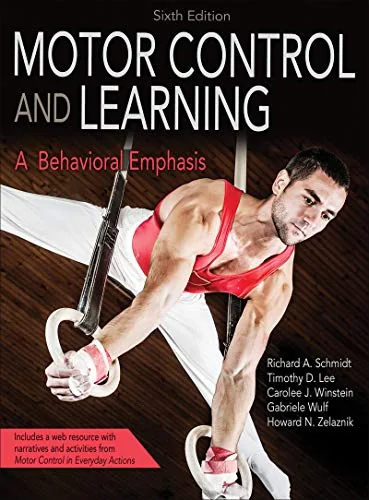
Cover of Motor Control and Learning: A Behavioral Emphasis, 6th Edition

Motor Control and Learning: A Behavioral Emphasis, 6th Edition

By Richard A. Schmidt, Timothy D. Lee, Carolee J. Winstein, Gabriele Wulf, Howard N. Zelaznik

About this ebook

Motor Control and Learning: A Behavioral Emphasis, Sixth Edition examines how movement is organized, performed, and learned. Written for students and researchers in motor behavior, kinesiology, rehabilitation, and related fields, it connects information processing, attention, coordination, motor programs, practice conditions, and feedback with theories and applications of skill learning.

Inside this title
  • Information processing, attention, motor programs, and coordination of movement
Current listed price $29.99Regular price $71.00Digital ebook
Review order preview

Digital ebook. No physical book.

Format
Digital ebook
ISBN
9781492586623
Last updated
2026-11-03

What this book covers.

The sixth edition approaches movement through observable behavior and the processes that shape it. Information processing, attention, motor programs, and coordination supply several ways to examine how sensory information becomes action. The discussion connects cognitive, motivational, and biomechanical perspectives with research on the execution of skilled movement.

Learning receives attention through practice variability, contextual interference, retention, and feedback, including knowledge of results and knowledge of performance. Schema theory and ecological approaches provide different accounts of how skill develops. Students of kinesiology, motor behavior, and rehabilitation can use the text to study the distinction between immediate performance and learning, and to examine the evidence behind practice and instruction choices.

Study guide included

Inside Motor Control and Learning: A Behavioral Emphasis, 6th Edition.

Motor behavior can be studied through what people do, not only what they report. This edition follows that behavioral premise from the processing of sensory information through attention and coordination to the practice conditions and feedback that shape skill, keeping performance and learning as separate questions throughout.

The text opens by framing movement as observable behavior shaped by underlying processes. Information processing, attention, motor programs and coordination supply competing and complementary ways to account for how sensation becomes action. Learning is then approached through practice variability, contextual interference, retention and feedback, with knowledge of results and knowledge of performance treated as distinct forms of information. Schema theory and ecological accounts are set against one another as explanations of skill development. Cognitive, motivational and biomechanical perspectives are brought into the same discussion, and the recurring distinction between immediate performance and durable learning gives readers a basis for judging practice and instruction choices.

Movement as observable behavior

The book's organizing choice is to treat movement as behavior that can be observed and measured, with internal processes inferred from it rather than taken for granted. This keeps the discussion tied to what performers actually do across changes in task and setting. The behavioral stance also explains why the text keeps returning to the separation between how a skill looks today and what has been retained.

  • Movement is treated as measurable behavior
  • Internal processes are inferred from performance
  • The behavioral framing governs later questions
Topics 1–2

Information processing and attention

Sensory information is described as passing through stages of selection, translation and response, and attention is presented as the filter that decides what reaches those stages. The discussion weighs how much of skilled action depends on conscious monitoring versus automatic processing. Attention is connected to the conditions under which a performer can handle competing demands.

  • Processing is broken into identifiable stages
  • Attention selects and limits information
  • Skilled action shifts demands on conscious control
Topic 2

Motor programs and coordination

Motor programs are introduced as stored specifications that allow movement to be organized before and during execution, and coordination is examined as the problem of combining parts into a functional whole. The text considers how degrees of freedom are managed and how timing holds a movement together. These ideas prepare the ground for later questions about how such organization changes with practice.

  • Programs specify movement organization
  • Coordination concerns combining components
  • Timing and degrees of freedom frame the problem
Topic 3

Practice conditions and variability

Practice variability and contextual interference are presented as manipulations with consequences that are not always visible immediately. The text examines schedules that make practice harder in the moment and asks how those conditions affect retention and transfer. This is where the performance-versus-learning distinction becomes practical rather than abstract.

  • Variability changes the practice experience
  • Contextual interference alters scheduling difficulty
  • Retention and transfer are the criteria
Topic 4

Feedback: results and performance

Feedback is divided into knowledge of results, which concerns the outcome, and knowledge of performance, which concerns the movement itself. The book treats each as information with its own uses and limits, and considers how feedback frequency and timing shape what a learner attends to. The discussion keeps feedback tied to the learning question rather than to immediate improvement alone.

  • Knowledge of results addresses outcome
  • Knowledge of performance addresses movement
  • Frequency and timing change what is learned
Topic 5

Competing theories and the learning gap

Schema theory and ecological approaches offer different accounts of how skill develops, one emphasizing generalized motor patterns and the other the coupling of performer and environment. The text sets these against each other without collapsing the disagreement. Reading them together highlights why the performance-versus-learning distinction matters for evaluating any theory of practice.

  • Schema theory stresses generalized patterns
  • Ecological accounts stress perception and environment
  • The theories differ on how skill is represented
Topics 6–7

Topic map

  • Behavior as the Unit of StudyTopic 1
  • Information Processing and AttentionTopic 2
  • Motor Programs and CoordinationTopic 3
  • Practice Variability and Contextual InterferenceTopic 4
  • Feedback: Knowledge of Results and PerformanceTopic 5
  • Schema Theory and Ecological AccountsTopic 6
  • Performance versus LearningTopic 7

Key takeaways

  • Immediate improvement is not evidence of learning; retention and transfer are the tests.
  • Feedback and practice schedules change what a performer attends to, not just how often they succeed.
  • Schema and ecological explanations disagree about representation, so the reader should hold both in view.

Kinesiology and motor behavior students, rehabilitation and physical education trainees, and researchers who want a behavioral account of how movement is organized and learned.

Topics covered

  • motor control and learning
  • behavioral emphasis
  • information processing and attention
  • motor programs and coordination
  • practice variability
  • contextual interference
  • knowledge of results
  • schema theory

Questions about this ebook.

Edition, audience, and study-guide details at a glance.

What is Motor Control and Learning: A Behavioral Emphasis, 6th Edition about?

Motor Control and Learning: A Behavioral Emphasis, Sixth Edition examines how movement is organized, performed, and learned. Written for students and researchers in motor behavior, kinesiology, rehabilitation, and related fields, it connects information processing, attention, coordination, motor programs, practice conditions, and feedback with theories and applications of skill learning.

Which edition of Motor Control and Learning: A Behavioral Emphasis, 6th Edition is this?

This listing is for the 6th edition. Check the title, ISBN, and book details above before ordering, especially if your course or reading list names a specific edition.

Who is Motor Control and Learning: A Behavioral Emphasis, 6th Edition for?

Kinesiology and motor behavior students, rehabilitation and physical education trainees, and researchers who want a behavioral account of how movement is organized and learned.

Does this page include a study guide?

Yes. This page includes an original study guide with six thematic sections, key takeaways, and a topic map for structured reading.