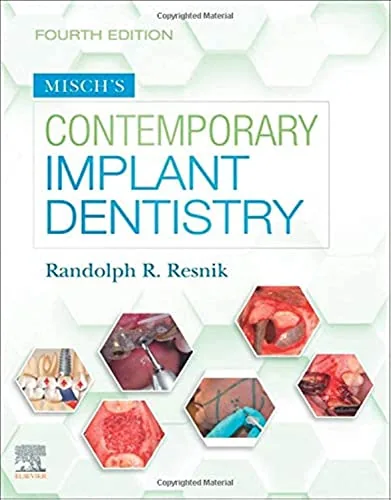
Misch's Contemporary Implant Dentistry, Fourth Edition, examines implant treatment from diagnosis and surgical planning through prosthetic restoration and maintenance. Updated by Randolph R. Resnik, it addresses anatomy, osseointegration, grafting, loading strategies, and complications for dental students, residents, and clinicians studying the surgical and restorative dimensions of implant dentistry.
Inside this title
Implant diagnosis and planning linking imaging with prosthetic design
Current listed price $53.99Regular price $179.00Digital ebook
Treatment planning connects the surgical and restorative discussions in this implant dentistry text. Diagnostic imaging, anatomy, bone quality, and prosthetic design establish considerations that influence implant placement. Coverage includes ridge augmentation, sinus lift procedures, and the biological principles of osseointegration, alongside different approaches to loading implants.
Restorative sections consider single crowns, bridges, and overdentures, while discussion of complications includes both surgical and prosthetic problems and peri-implant disease. Maintenance and follow-up extend the treatment perspective beyond initial placement and restoration. Resnik's fourth edition develops the subject through clinical explanations and color illustrations, providing material for dental education and for practitioners reviewing the relationships among diagnosis, surgical procedures, restorative choices, and continuing patient care.
Implant dentistry works backward from the tooth you intend to build. This reference treats the final restoration as the starting constraint, then asks whether bone, biomechanics, medical history, imaging, surgical technique, and maintenance habits can support it. The result is a planning discipline in which each choice is defended against anatomy, function, and how long the result lasts.
The book opens with the scientific basis: how bone responds to an implant, what surfaces and thread forms do, and how fixture, connector, and crown behave as one mechanical system. A biomechanics section then examines force direction, how often it repeats, and leverage — tall crowns and extended cantilevers matter as much as load magnitude. Medical and radiographic evaluation chapters establish the limits of a case, and planning chapters compare fixed and removable designs for partially and fully toothless arches. The surgery and graft sections address site preparation and tissue reconstruction, while the closing chapters treat peri-implant disease and maintenance as ongoing phases rather than afterthoughts.
Bone holds the implant
Osseointegration is not a one-time event but a continuing relationship between living bone and a loaded fixture. Bone remodels after surgical injury and keeps adapting to the forces it meets. The opening chapters link early stability, healing, and later change to implant geometry, surface treatment, and the quality of surrounding bone. The practical lesson: support depends on biology as much as hardware, so a site is judged by how it behaves over years.
Treat bone as living tissue
Link design to healing
Judge sites over years
Chs. 1–5
Force depends on leverage
Load magnitude alone tells you little. Direction, repetition, and the distance from force to supporting bone determine how much turning effect an implant resists. Crown height and cantilever length act as levers, so a modest bite can still create damaging moments; parafunction and the opposing dentition add further demand. Design responses — more implants, repositioning, altered contour, adjusted contacts — carry tradeoffs in space, access, and complexity that must be weighed before the plan is fixed.
Measure direction and leverage
Count parafunction as load
Weigh design tradeoffs early
Chs. 6–9
History and imaging set limits
Medical assessment and imaging answer different questions, and both constrain what is possible. Systemic disease, smoking, medications, and prior treatment influence healing, bleeding, infection risk, and bone turnover, with severity and stability changing their weight. Imaging adds three-dimensional information about bone volume and nearby anatomy. Planning software lets a proposed implant position be tested against the anticipated tooth form, turning a scan into a way of checking a restorative idea not just finding bone.
Separate history from imaging
Weight conditions by stability
Test position against tooth form
Chs. 10–15
Plan from the restoration backward
Planning starts with the desired teeth: chewing, looks, speech, comfort, and ease of cleaning. Fixed and removable options serve those aims differently, and room for the prosthesis, bone quality, where fixtures can sit, and the opposite arch decide what is realistic. The posterior maxilla illustrates the logic, where sinus anatomy, limited height, and soft bone meet tall crowns. Rather than collapsing these into one problem, it compares responses and how each shifts difficulty and follow-up.
Begin with the desired teeth
Compare fixed and removable
Test bone against the design
Chs. 16–25
Surgery follows the prosthetic plan
Placement is judged by the restoration it will carry, not only by bone volume. Angle, emergence, and clearance follow from three-dimensional position. Tissue chapters separate problems: preserving a site after extraction differs from rebuilding a large defect, and barrier membranes, block grafts, particle grafts, and sinus lifts suit different anatomy and healing conditions. Autogenous material may offer biological advantages, but donor-site demands and complexity belong in the comparison. Immediate placement and immediate loading are distinguished.
Place for the future crown
Match graft to defect
Keep placement distinct from loading
Chs. 26–39
Maintenance reveals what design missed
Long-term success depends on noticing change early, requiring a reference record from the delivery visit. Observations of inflammation, comfort, function, and component stability become meaningful against that baseline. Repeated loosening points toward mechanical demand or a component fault; inflammation and ongoing bone loss raise separate biological questions. The upkeep chapters tie examination, prevention, and recall back to the original design, noting that a restoration hard to clean or examine carries that difficulty into every visit.
Record a delivery baseline
Separate mechanical from biological
Check what design makes hard
Chs. 41–42
Chapter and section map
Scientific BasisPart I
Biomechanical Properties of Dental ImplantsPart II
Medical Evaluation of the Dental Implant PatientCh. 10 · p. 210
Radiographic Evaluation in Oral ImplantologyCh. 11 · p. 275
Treatment Planning PrinciplesPart IV
Implant SurgeryPart VI
Soft and Hard Tissue RehabilitationPart VII
Implant Maintenance: Long-term Implant SuccessCh. 42 · p. 1192
Key takeaways
Sketch the intended restoration first, then test whether anatomy, bone, and patient context can support it.
Judge force by direction and leverage, not magnitude; tall crowns and cantilevers change the equation.
Log tissue signs and hardware events in separate columns before considering their interaction.
Dental students, implant residents, prosthodontists, and oral surgeons who want a restoration-first reference linking biomechanics, imaging, surgery, grafting, and long-term maintenance across a full treatment sequence.
Topics covered
implant dentistry
implant osseointegration
dental biomechanics
bone grafting
treatment planning
peri-implant disease
restorative prosthodontics
dental imaging
Questions about this ebook.
Edition, audience, and study-guide details at a glance.
What is Misch's Contemporary Implant Dentistry, 4th Edition about?
Misch's Contemporary Implant Dentistry, Fourth Edition, examines implant treatment from diagnosis and surgical planning through prosthetic restoration and maintenance. Updated by Randolph R. Resnik, it addresses anatomy, osseointegration, grafting, loading strategies, and complications for dental students, residents, and clinicians studying the surgical and restorative dimensions of implant dentistry.
Which edition of Misch's Contemporary Implant Dentistry, 4th Edition is this?
This listing is for the 4th edition. Check the title, ISBN, and book details above before ordering, especially if your course or reading list names a specific edition.
Who is Misch's Contemporary Implant Dentistry, 4th Edition for?
Dental students, implant residents, prosthodontists, and oral surgeons who want a restoration-first reference linking biomechanics, imaging, surgery, grafting, and long-term maintenance across a full treatment sequence.
Does this page include a study guide?
Yes. This page includes an original study guide with six thematic sections, key takeaways, and a chapter and section map for structured reading.