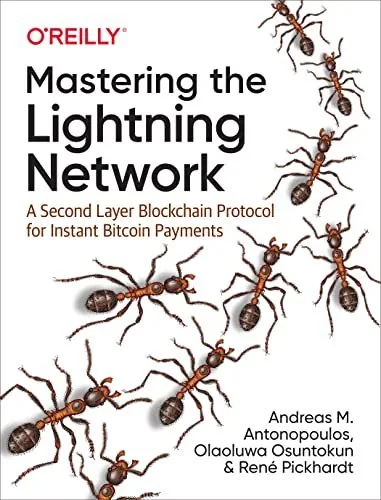
Mastering the Lightning Network: A Second Layer Blockchain Protocol for Instant Bitcoin Payments
By Andreas M. Antonopoulos, Olaoluwa Osuntokun, René Pickhardt
About this ebook
Mastering the Lightning Network explains the payment-channel protocol layered over Bitcoin, from channel mechanics to routing and node operation. Andreas M. Antonopoulos, Olaoluwa Osuntokun, and René Pickhardt write for developers and technically engaged readers, connecting cryptographic foundations with software implementations, payment management, privacy, and network security considerations.
Inside this title
Payment channel funding, updates, closure, and lifecycle mechanics
Current listed price $18.00Regular price $30.00Digital ebook
Payment channels are the starting point for understanding how the Lightning Network coordinates transfers beyond the base blockchain. The book follows channel funding, updates, and closure, then explains how hash time-locked contracts support payments that pass through multiple participants. Routing and pathfinding connect these individual mechanisms to network behavior.
Implementation coverage includes running nodes and working with Lightning software. Security and privacy discussions address questions relevant to operators and application developers, while later topics consider multi-path payments and channel factories. Readers are expected to bring familiarity with Bitcoin fundamentals. The result is a technical account that moves between protocol concepts and the practical structure of a Lightning application.
Study guide included
Inside Mastering the Lightning Network: A Second Layer Blockchain Protocol for Instant Bitcoin Payments.
Lightning moves Bitcoin payments off the base chain without abandoning its guarantees. Antonopoulos, Osuntokun and Pickhardt follow that idea from a single payment channel to a routed network, then into the software and operational choices a node runner faces. The book assumes Bitcoin literacy and builds understanding from mechanics upward.
The starting point is the payment channel: how two parties lock funds, exchange updates and eventually settle on chain. From there the book explains hash time-locked contracts, which let a payment pass through intermediaries without requiring trust in each one. Routing and pathfinding connect individual channels into a network, and the discussion turns to what a node must know and do to participate. Implementation chapters cover running Lightning software, managing channels and handling payments. Privacy and security receive separate treatment, addressing the information a node reveals and the risks an operator carries. Later material considers multi-path payments and channel factories, extending the protocol picture toward greater efficiency.
Payment channels and their lifecycle
A channel is a funding transaction plus a shared record of how the balance should be divided. The book follows the sequence from opening through updates to cooperative or unilateral closure, showing how each state remains enforceable on chain. The lifecycle matters because routing and failure handling depend on what a channel can guarantee at each stage.
A channel is a funding transaction plus balance state
Updates remain enforceable on chain
Closure can be cooperative or unilateral
Topics 1–3
Hash time-locked contract mechanics
HTLCs make forwarded payments conditional. A payment is locked to a hash, and the preimage releases it along the route; time locks ensure funds return if the chain of commitments breaks. The book explains how these two constraints combine to protect participants who do not trust each other, and why the contract's details determine what happens when a payment fails partway.
A hash condition controls release of funds
Time locks return funds when routes fail
The two constraints protect untrusting parties
Topic 4
Routing and pathfinding across channels
Routing turns separate channels into a payment network. The text describes how a sender discovers a path, what a node needs to know about liquidity and fees, and why the shortest route is not always the one that succeeds. Pathfinding is presented as a practical problem under incomplete knowledge, which is why attempts, errors and retries belong in any realistic account.
Paths are discovered from network information
Liquidity and fees shape route choice
Retries are part of normal operation
Topic 5
Running a Lightning node
Operating a node is a distinct skill from understanding the protocol. The implementation chapters cover installation, wallet and channel management, liquidity decisions and the handling of payments. The book is candid about the operational burden: channels require monitoring, capital sits in commitments, and a node that goes offline can create problems for itself and for peers.
Node software must be installed and maintained
Channel liquidity is a managed resource
Offline nodes create problems for peers
Topic 6
Privacy and security tradeoffs
Privacy and security are treated as design consequences rather than add-ons. The text examines what a node reveals through its channels and routing behavior, how observers might infer payment relationships, and what mitigations exist. On the security side it discusses the risks of key management, software configuration and the assumptions an operator makes when funds are held in channels.
Channel structure reveals information
Observers may infer payment relationships
Key management is an operator responsibility
Topic 7
Multi-path payments and channel factories
Later chapters look beyond single-path transfers. Multi-path payments split an amount across routes, improving the chance of success when no single channel holds enough liquidity. Channel factories generalize the funding idea to many participants, aiming to reduce on-chain footprint. Both are presented as extensions of the same primitives, not as separate systems.
Multi-path payments split amounts across routes
Splitting improves success under limited liquidity
Channel factories share one funding transaction
Topic 8
Topic map
Payment Channel FundamentalsTopic 1
Channel Funding and UpdatesTopic 2
Cooperative and Unilateral ClosureTopic 3
Hash Time-Locked ContractsTopic 4
Routing and PathfindingTopic 5
Node Operation and SoftwareTopic 6
Privacy and SecurityTopic 7
Multi-Path Payments and Channel FactoriesTopic 8
Key takeaways
Understand the full payment channel lifecycle before reasoning about routing, failures or node operation.
HTLCs combine a hash condition with a time limit; both must hold for safety.
Node operation is a capital and monitoring commitment, not a passive setup step.
Developers and technically engaged Bitcoin users who want to understand the Lightning protocol, plus operators preparing to run nodes and applications on top of it.
Topics covered
Lightning Network
Bitcoin payment channels
hash time-locked contracts
routing and pathfinding
Lightning node operation
multi-path payments
channel factories
payment privacy
Questions about this ebook.
Edition, audience, and study-guide details at a glance.
What is Mastering the Lightning Network: A Second Layer Blockchain Protocol for Instant Bitcoin Payments about?
Mastering the Lightning Network explains the payment-channel protocol layered over Bitcoin, from channel mechanics to routing and node operation. Andreas M. Antonopoulos, Olaoluwa Osuntokun, and René Pickhardt write for developers and technically engaged readers, connecting cryptographic foundations with software implementations, payment management, privacy, and network security considerations.
Who is Mastering the Lightning Network: A Second Layer Blockchain Protocol for Instant Bitcoin Payments for?
Developers and technically engaged Bitcoin users who want to understand the Lightning protocol, plus operators preparing to run nodes and applications on top of it.
Does this page include a study guide?
Yes. This page includes an original study guide with six thematic sections, key takeaways, and a topic map for structured reading.