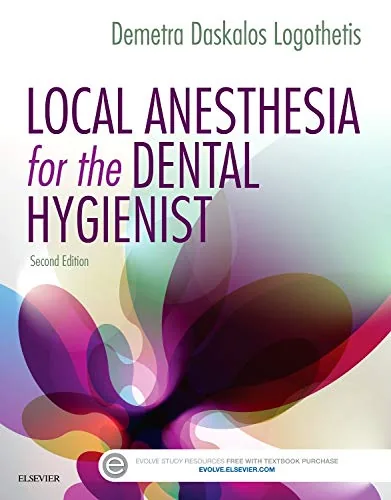
Local Anesthesia for the Dental Hygienist, 2nd Edition
By Demetra Daskalos Logothetis
About this ebook
Local Anesthesia for the Dental Hygienist, second edition, explains the anatomical, pharmacological, and procedural foundations of dental pain control. Demetra Daskalos Logothetis addresses dental hygiene students and practitioners through patient assessment, injection techniques, equipment preparation, complications, and documentation, linking theoretical study with illustrated procedures and case-based learning.
Inside this title
Trigeminal nerve anatomy and oral cavity innervation coverage
Current listed price $7.99Regular price $14.00Digital ebook
Oral innervation and anesthetic pharmacology provide the starting point for this dental hygiene text. Chapters examine the trigeminal nerve, local anesthetic agents, vasoconstrictors, and patient history before moving to injection equipment and administration procedures. This sequence connects the reasons for a technique with its procedural description.
Maxillary and mandibular blocks are considered alongside infiltration and other supplemental injections. The book also discusses recognizing complications, emergency management, documentation, and legal considerations. Illustrations, clinical cases, learning objectives, and self-assessment material support structured coursework. Dental hygiene students and educators can use the second edition to study the relationship among anatomy, assessment, and local anesthesia practice.
Study guide included
Inside Local Anesthesia for the Dental Hygienist, 2nd Edition.
Logothetis frames local anesthesia as a skill that joins communication, neurophysiology, drug selection, assessment, anatomy and readiness. The book shows how pain control supports dental hygiene and how each decision, from history taking to documentation, affects safety and the patient's experience.
The second edition moves from the purpose and physiology of pain control into pharmacology and patient assessment. It then links dosage reasoning, equipment and anatomic knowledge to maxillary and mandibular techniques. A chapter on children and adolescents adds a population-specific view. Closing chapters cover complications, documentation and risk management, while diagrams and technique summaries support supervised learning. The consistent thread is to trace a choice back to the mechanism it changes and forward to the observation that would confirm it.
Start with the person in pain
Opening chapters separate sensory transmission from the lived experience of pain. Anxiety, expectation, previous treatment, fatigue and setting all shape a response. Local anesthesia alters sensation in a region while consciousness remains intact, so explaining purpose and listening to concern are part of the clinical task, not extras around it.
Distinguish transmission from experience
Ask what previous appointments felt like
Explain purpose before proceeding
Chs. 1–2
Follow the drug from tissue to nerve
Neurophysiology describes the action potential and impulse conduction. Local anesthetics interfere with sodium entry through channels, limiting a nerve's ability to start or carry a signal. Pharmacology then distinguishes amide and ester agents and weighs absorption, distribution, metabolism and duration, while vasoconstrictors alter blood flow, duration and interaction questions.
Link channel block to loss of sensation
Compare amide and ester properties
Account for vasoconstrictor effects
Chs. 2–6
Build assessment and dosage literacy
Assessment combines medical, dental and conversational history with examination and psychological evaluation. Allergy history, medications and systemic status matter because components of a preparation raise different concerns. Dosage work separates concentration from volume delivered and treats anesthetic and vasoconstrictor as distinct components, each capable of constraining the plan.
Describe a prior reaction, not just label it
Convert units before combining amounts
Count any earlier administration
Chs. 7–8
Turn anatomy into a coverage map
The anatomy chapter covers orofacial bone and the trigeminal branches serving the treatment region. A coverage map ties a nerve's distribution to the tissues a technique is meant to affect. Equipment and technique chapters then compare maxillary and mandibular approaches, showing why a named technique cannot be swapped for another without changing the field.
Map intended coverage to treatment area
Compare block and supplemental approaches
Note vascular and glandular landmarks
Chs. 9–13
Adapt to age and complications
The pediatric chapter addresses a child's response, communication, anatomy, agent selection and toxicity concerns, building on earlier assessment and calculation chapters. The complications chapter separates local problems, systemic effects and allergic manifestations, and it links recognition to emergency readiness while keeping observation distinct from cause.
Recheck adult assumptions for children
Separate local from systemic reactions
Record the sequence before explaining it
Chs. 14–15
Make records and readiness routine
Legal and risk-management material connects professional duty to how information is gathered, communicated and recorded. A solid record preserves history, the reasoning behind a decision, what occurred and how the patient responded. Exposure prevention is discussed alongside equipment, preparation and emergency readiness, with attention to scope of practice as it stood for this edition.
Record reasoning, not only events
Know the applicable scope of practice
Design routines that reduce exposure
Ch. 16 · Risk management
Chapter and section map
Local Anesthesia in Dental Hygiene PracticeCh. 1
NeurophysiologyCh. 2
Local and Topical Anesthetic AgentsPart II
Preanesthetic AssessmentCh. 7
Determining Drug DosesCh. 8
Local Anesthetic Techniques for the Dental HygienistPart IV
Local Anesthetic ComplicationsCh. 15
Legal Considerations and Risk ManagementCh. 16
Key takeaways
Pair a history of pain or anxiety with an open question about what the patient lived through.
Keep coverage, drug amount and patient-specific limits separate when reading a technique or calculation.
Separate what was observed from possible causes when practicing complication recognition and documentation.
Dental hygiene students and practicing hygienists who are studying the anatomy, pharmacology, assessment and procedural foundations of local anesthesia, including dosage reasoning, complications and documentation, before supervised clinical practice.
Topics covered
local anesthesia
dental hygiene
clinical neurophysiology
drug dosage
injection technique
patient assessment
anesthetic complications
risk management
Questions about this ebook.
Edition, audience, and study-guide details at a glance.
What is Local Anesthesia for the Dental Hygienist, 2nd Edition about?
Local Anesthesia for the Dental Hygienist, second edition, explains the anatomical, pharmacological, and procedural foundations of dental pain control. Demetra Daskalos Logothetis addresses dental hygiene students and practitioners through patient assessment, injection techniques, equipment preparation, complications, and documentation, linking theoretical study with illustrated procedures and case-based learning.
Which edition of Local Anesthesia for the Dental Hygienist, 2nd Edition is this?
This listing is for the 2nd edition. Check the title, ISBN, and book details above before ordering, especially if your course or reading list names a specific edition.
Who is Local Anesthesia for the Dental Hygienist, 2nd Edition for?
Dental hygiene students and practicing hygienists who are studying the anatomy, pharmacology, assessment and procedural foundations of local anesthesia, including dosage reasoning, complications and documentation, before supervised clinical practice.
Does this page include a study guide?
Yes. This page includes an original study guide with six thematic sections, key takeaways, and a chapter and section map for structured reading.