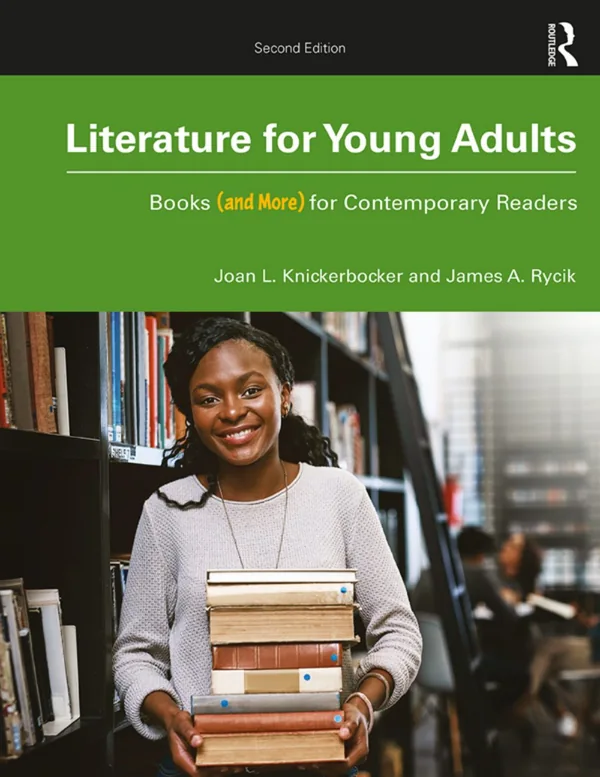
Cover of Literature for Young Adults: Books (and More) for Contemporary Readers, 2nd Edition

Literature for Young Adults: Books (and More) for Contemporary Readers, 2nd Edition

By Joan L. Knickerbocker, James A. Rycik

About this ebook

Literature for Young Adults, 2nd Edition, examines books, genres, and reading formats for adolescent audiences. Joan L. Knickerbocker and James A. Rycik connect literary selection with classroom practice, diverse representation, and digital reading cultures. The text serves teachers, librarians, and education students developing ways to evaluate and discuss young adult literature.

Inside this title
  • Genre coverage includes graphic novels, verse novels, and nonfiction
Current listed price $26.00Regular price $55.00Digital ebook
Review order preview

Digital ebook. No physical book.

Format
Digital ebook
ISBN
9781351067683
Last updated
2026-11-03

What this book covers.

Selecting literature for adolescents involves questions about genre, theme, representation, and the ways young people encounter texts. This book addresses realistic and historical fiction, fantasy, science fiction, nonfiction, graphic novels, and verse novels. Attention to nontraditional protagonists and narrative structures encourages a wider view of the young adult reading landscape.

Digital formats, audiobooks, fan fiction, social reading communities, and multimedia adaptations extend the discussion beyond the printed novel. Selection criteria, lesson ideas, discussion prompts, and project-based activities connect literary analysis with teaching. Educators and librarians can use these perspectives to consider how particular works and formats may fit their readers, collections, and classroom goals.
Study guide included

Inside Literature for Young Adults: Books (and More) for Contemporary Readers, 2nd Edition.

Knickerbocker and Rycik treat young adult literature as a living field rather than a fixed canon. Genres from realistic fiction to verse novels and graphic works are examined alongside digital reading, diverse representation and the practical questions teachers and librarians face when choosing books for adolescents.

The book asks how adults select and teach literature for teenage readers. It surveys realistic and historical fiction, fantasy, science fiction, nonfiction, graphic novels and verse novels, paying attention to nontraditional protagonists and experimental narrative forms. From there it widens to the formats young people actually use: audiobooks, digital texts, fan fiction, social reading communities and multimedia adaptations. Selection criteria and evaluation are treated as professional judgments with consequences. Lesson ideas, discussion prompts and project-based activities connect analysis to classroom and library practice. The result is a text for educators who want both a map of the field and a method for deciding what belongs in front of their readers.

Mapping the Genres

The survey begins with genre because genre shapes both craft and audience expectation. Realistic, historical, fantasy and science fiction are distinguished, then nonfiction and verse forms complicate the categories. The point is a working map, not rigid boxes.

  • Genres carry different conventions
  • Expectations guide reader response
  • Categories overlap in practice
Topics 1–3

Forms Beyond the Novel

Graphic novels and verse novels are treated as substantial literary forms, not shortcuts. The book shows how visual and poetic structures demand different reading strategies and offer different kinds of access.

  • Visual narrative uses image and text
  • Verse novels work through compression
  • Form affects how a text is taught
Topic 4

Representation and Contemporary Themes

Diverse protagonists and current themes are framed as questions about whose stories are available. The book links representation to selection, asking educators to notice what a collection includes and what it leaves out.

  • Representation shapes reader identification
  • Selection reflects values
  • Collections can widen or narrow access
Topic 5

Digital Reading Cultures

Audiobooks, digital texts, fan fiction, social reading and adaptations are treated as part of contemporary reading life. The book asks how these formats change engagement rather than assuming print is the default.

  • Formats change the reading experience
  • Fan activity extends a text
  • Adaptations reach new audiences
Topic 6

Choosing and Evaluating Books

Selection is presented as a reasoned process involving criteria, purpose and knowledge of readers. The book offers ways to evaluate works without reducing judgment to a checklist.

  • Criteria should be explicit
  • Purpose shapes choice
  • Knowing readers matters
Topic 7

Teaching and Discussion

Lesson ideas, prompts and projects turn literary analysis into classroom activity. The book connects discussion to interpretation, encouraging teachers to build on what students bring to a text.

  • Prompts open interpretation
  • Projects extend reading
  • Discussion builds critical response
Topic 8

Topic map

  • Defining Young Adult LiteratureTopic 1
  • Realistic and Historical FictionTopic 2
  • Fantasy and Science FictionTopic 3
  • Nonfiction, Graphic Novels and Verse NovelsTopic 4
  • Diverse Protagonists and Contemporary ThemesTopic 5
  • Digital Reading, Audiobooks and Fan CultureTopic 6
  • Selecting and Evaluating BooksTopic 7
  • Classroom Discussion and ProjectsTopic 8

Key takeaways

  • Know the field before debating the canon; the range is wider than the bestseller shelf.
  • Treat format as part of the text, especially with graphic and verse works.
  • Selection is a professional judgment that should be explainable.

Teachers, librarians and education students who select, teach and discuss young adult literature, including digital and multimodal formats.

Topics covered

  • young adult literature
  • YA books for teachers
  • graphic novels in classrooms
  • diverse YA literature
  • literature selection
  • digital reading
  • adolescent literacy
  • Joan Knickerbocker

Questions about this ebook.

Edition, audience, and study-guide details at a glance.

What is Literature for Young Adults: Books (and More) for Contemporary Readers, 2nd Edition about?

Literature for Young Adults, 2nd Edition, examines books, genres, and reading formats for adolescent audiences. Joan L. Knickerbocker and James A. Rycik connect literary selection with classroom practice, diverse representation, and digital reading cultures. The text serves teachers, librarians, and education students developing ways to evaluate and discuss young adult literature.

Which edition of Literature for Young Adults: Books (and More) for Contemporary Readers, 2nd Edition is this?

This listing is for the 2nd edition. Check the title, ISBN, and book details above before ordering, especially if your course or reading list names a specific edition.

Who is Literature for Young Adults: Books (and More) for Contemporary Readers, 2nd Edition for?

Teachers, librarians and education students who select, teach and discuss young adult literature, including digital and multimodal formats.

Does this page include a study guide?

Yes. This page includes an original study guide with six thematic sections, key takeaways, and a topic map for structured reading.