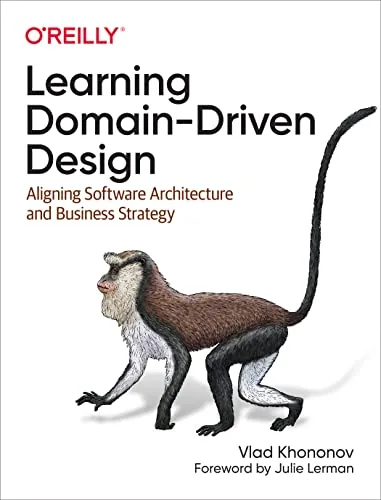
Learning Domain-Driven Design: Aligning Software Architecture and Business Strategy, 1st Edition
By Vlad Khononov
About this ebook
Learning Domain-Driven Design explains how software models and architecture relate to business needs. Vlad Khononov introduces strategic and tactical DDD for developers and architects, covering subdomains, ubiquitous language, bounded contexts, aggregates, domain events, and collaborative discovery, with scenarios that connect modeling decisions to system boundaries and implementation patterns.
Inside this title
Subdomains, ubiquitous language, and bounded contexts explained through scenarios
Current listed price $20.99Regular price $41.00Digital ebook
Business analysis provides the starting point for this guide to domain-driven design. Khononov explains how to distinguish core, supporting, and generic subdomains, establish a shared vocabulary, and identify bounded contexts. Context maps then describe the relationships and integration choices among different parts of a system.
Tactical discussions consider entities, value objects, aggregates, repositories, services, and domain events. The book also explores Event Storming as a collaborative way to discover domain knowledge and relates DDD ideas to architectural approaches such as microservices and event-driven systems. Developers and architects can use its scenarios to examine how business priorities influence modeling depth, boundaries, and the organization of software.
Study guide included
Inside Learning Domain-Driven Design: Aligning Software Architecture and Business Strategy, 1st Edition.
Khononov starts from business rather than code: understand the domain, divide it into subdomains, name the language and draw the boundaries. Strategic and tactical DDD then connect that analysis to aggregates, domain events and architectural choices such as microservices and event-driven systems.
Business analysis is the entry point. Khononov explains how to separate core, supporting and generic subdomains, establish a shared vocabulary and identify bounded contexts, with context maps describing how the pieces relate and integrate. Tactical material then covers entities, value objects, aggregates, repositories, services and domain events, each carrying rules about consistency and responsibility. Event Storming appears as a collaborative way to surface domain knowledge, and the closing discussion relates DDD to microservices and event-driven architecture. Developers and architects can use the scenarios to see how business priorities shape modeling depth, boundaries and the organization of software.
Business before code
Domain-driven design starts by understanding what the business does. Subdomain analysis separates the work that matters most from supporting and generic activity, and that separation guides where modeling effort belongs.
Core subdomains get attention
Supporting work is distinguished
Generic work is recognized
Effort follows importance
Topics 1–2
Ubiquitous language
A shared vocabulary is treated as a design instrument. When business and technical people use the same terms consistently, the model and the conversation stay aligned.
Shared terms reduce translation
Language is part of the model
Consistency is maintained
Misunderstanding is reduced
Topic 3
Bounded contexts and maps
Bounded contexts mark where a model applies, and context maps describe relationships between them. Together they give architecture a vocabulary for boundaries and integration choices.
Boundaries are explicit
Models do not span everything
Context maps show relationships
Integration is a decision
Topics 4–5
Tactical building blocks
Entities, value objects, aggregates, repositories, services and domain events are presented as tools for expressing a model in code. Each carries rules about consistency and responsibility.
Entities have identity
Value objects are immutable
Aggregates define consistency
Domain events record change
Topic 6
Discovery through Event Storming
Event Storming is offered as a collaborative way to surface domain knowledge. The technique brings the people who know the business into the modeling conversation.
Discovery is collaborative
Events structure the conversation
Knowledge is surfaced
Modeling starts from understanding
Topic 7
Architecture follows boundaries
DDD is related to microservices and event-driven systems, with boundaries informing how a system is divided. Architecture is a consequence of domain decisions, not a starting aesthetic.
Boundaries inform services
Event-driven styles are considered
Architecture follows analysis
Trade-offs are explicit
Topic 8
Topic map
Analyzing the Business DomainTopic 1
Core, Supporting and Generic SubdomainsTopic 2
Ubiquitous LanguageTopic 3
Bounded ContextsTopic 4
Context Mapping and IntegrationTopic 5
Entities, Value Objects, Aggregates and Domain EventsTopic 6
Event Storming for DiscoveryTopic 7
DDD, Microservices and Event-Driven ArchitectureTopic 8
Key takeaways
Begin with subdomain analysis; model depth should follow business importance.
Use bounded contexts to make boundaries explicit before choosing an architecture.
Let tactical patterns express a model rather than dictate it.
Software developers and architects who want to apply domain-driven design, from strategic business analysis through tactical patterns, to systems whose structure must reflect business priorities.
Topics covered
domain-driven design
bounded contexts
ubiquitous language
subdomains
aggregates and domain events
event storming
microservices architecture
event-driven systems
Questions about this ebook.
Edition, audience, and study-guide details at a glance.
What is Learning Domain-Driven Design: Aligning Software Architecture and Business Strategy, 1st Edition about?
Learning Domain-Driven Design explains how software models and architecture relate to business needs. Vlad Khononov introduces strategic and tactical DDD for developers and architects, covering subdomains, ubiquitous language, bounded contexts, aggregates, domain events, and collaborative discovery, with scenarios that connect modeling decisions to system boundaries and implementation patterns.
Which edition of Learning Domain-Driven Design: Aligning Software Architecture and Business Strategy, 1st Edition is this?
This listing is for the 1st edition. Check the title, ISBN, and book details above before ordering, especially if your course or reading list names a specific edition.
Who is Learning Domain-Driven Design: Aligning Software Architecture and Business Strategy, 1st Edition for?
Software developers and architects who want to apply domain-driven design, from strategic business analysis through tactical patterns, to systems whose structure must reflect business priorities.
Does this page include a study guide?
Yes. This page includes an original study guide with six thematic sections, key takeaways, and a topic map for structured reading.