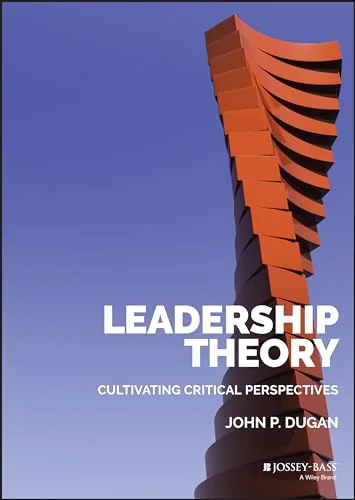
Cover of Leadership Theory: Cultivating Critical Perspectives

Leadership Theory: Cultivating Critical Perspectives

By John P. Dugan

About this ebook

Leadership Theory: Cultivating Critical Perspectives examines leadership models alongside the assumptions and power relationships they contain. John P. Dugan combines theoretical surveys, reflection, and case studies for students of leadership, education, management, and public service, drawing attention to social identity, privilege, inclusion, and the cultural origins of established frameworks.

Inside this title
  • Leadership models examined through historical, cultural, and critical perspectives
Current listed price $21.99Regular price $50.00Digital ebook
Buy now

Digital ebook. Checkout sends an order request.

Format
Digital ebook
ISBN
9781118864227
Last updated
2026-11-03

What this book covers.

John P. Dugan approaches leadership theory as something to question as well as learn. Trait, behavioral, transformational, servant, and authentic approaches are situated within their historical and cultural contexts. Readers are asked to consider whose experiences a model represents, what it assumes about authority, and how those assumptions shape relationships.

Critical, feminist, and postcolonial perspectives broaden the discussion beyond conventional accounts. Reflective prompts and case studies connect theory with a reader's beliefs and organizational experiences, while a developmental sequence supports increasingly detailed analysis. The text can serve undergraduate and graduate courses or leadership development work in organizations concerned with power, social identity, and participation.
Study guide included

Inside Leadership Theory: Cultivating Critical Perspectives.

Leadership theory is taught here as something to question, not just memorize. Dugan surveys familiar models while asking what each assumes about authority, whose experience it represents and how power and social identity shape the relationships a leader enters and the choices made inside them.

Familiar models, among them trait, behavioral, transformational, servant and authentic leadership, are set in the periods and cultures that produced them rather than offered as neutral descriptions. Critical, feminist and postcolonial work widens the frame and presses on who is included, who is heard and who takes part. Prompts for reflection and case studies ask readers to relate theory to their own beliefs and organizational experience, and the material moves through increasing levels of detail. The result suits undergraduate and graduate courses and leadership development work in organizations willing to examine power rather than only technique.

Reading Theory Critically

Theory is treated as an object of inquiry, not a recipe. The book asks what a model assumes, what it leaves out and whose interests it serves. This critical habit is established before the survey of particular approaches, so readers have a way to evaluate what follows.

  • Models carry assumptions
  • Omissions are part of the analysis
  • Critical reading precedes application
Topic 1

Conventional Models in Context

Trait, behavioral, transformational, servant and authentic approaches are presented with their historical and cultural settings. Placing them in context shows that each responded to a particular moment and set of concerns. The survey does not treat the models as timeless truths.

  • Approaches emerged in specific settings
  • Each responds to its historical moment
  • Context changes how a model should be read
Topics 2-3

Power, Privilege and Social Identity

Leadership relationships are shaped by power, privilege and social identity. The text asks readers to notice who gets heard, who is assumed to belong and how authority is distributed. These questions are presented as central to understanding leadership rather than as peripheral concerns.

  • Power shapes who is heard
  • Social identity affects access and authority
  • These questions belong at the center
Topic 4

Critical, Feminist and Postcolonial Perspectives

Critical, feminist and postcolonial approaches broaden the discussion beyond conventional accounts. They raise questions about participation, inclusion and the cultural origins of established frameworks. The book uses them to unsettle assumptions that otherwise go unnoticed.

  • Critical perspectives challenge familiar accounts
  • Feminist and postcolonial lenses widen the frame
  • Cultural origins of theory matter
Topics 5-6

Reflection and Case Analysis

Prompts for reflection and cases invite readers to relate theoretical claims to their own beliefs and organizational experience. The aim is not to apply a model mechanically but to examine how it fits, where it strains and what it hides. This makes the material useful for discussion and development work.

  • Reflection connects theory to experience
  • Cases expose where models strain
  • Application is examined, not assumed
Topic 7

From Models to Practice

The developmental sequence moves toward more detailed analysis and use. Readers are asked to carry critical questions into their own leadership contexts, including organizations concerned with power and participation. Theory becomes a way of seeing practice rather than a set of instructions.

  • Analysis becomes more detailed over time
  • Critical questions travel into practice
  • Theory informs how practice is seen
Topic 7

Topic map

  • Why Theory Needs CritiqueTopic 1
  • Trait and Behavioral ApproachesTopic 2
  • Transformational, Servant and Authentic ModelsTopic 3
  • Power and Social IdentityTopic 4
  • Critical and Feminist PerspectivesTopic 5
  • Postcolonial and Inclusive FramingsTopic 6
  • Reflection, Cases and DevelopmentTopic 7

Key takeaways

  • Learning a model and questioning it are treated as the same task.
  • Power, privilege and social identity are central to leadership analysis.
  • Reflection and cases turn theory into a way of seeing practice.

Undergraduate and graduate students of leadership, education, management and public service, and practitioners in leadership development work who want a critical rather than purely technical approach.

Topics covered

  • leadership theory
  • critical perspectives
  • power and privilege
  • social identity
  • transformational leadership
  • servant leadership
  • postcolonial theory
  • John P. Dugan

Questions about this ebook.

Edition, audience, and study-guide details at a glance.

What is Leadership Theory: Cultivating Critical Perspectives about?

Leadership Theory: Cultivating Critical Perspectives examines leadership models alongside the assumptions and power relationships they contain. John P. Dugan combines theoretical surveys, reflection, and case studies for students of leadership, education, management, and public service, drawing attention to social identity, privilege, inclusion, and the cultural origins of established frameworks.

Who is Leadership Theory: Cultivating Critical Perspectives for?

Undergraduate and graduate students of leadership, education, management and public service, and practitioners in leadership development work who want a critical rather than purely technical approach.

Does this page include a study guide?

Yes. This page includes an original study guide with six thematic sections, key takeaways, and a topic map for structured reading.

Keep your curiosity going.

More books from this subject area.

More business & management ebooks

Enter your name and email to open a WhatsApp message with your details.