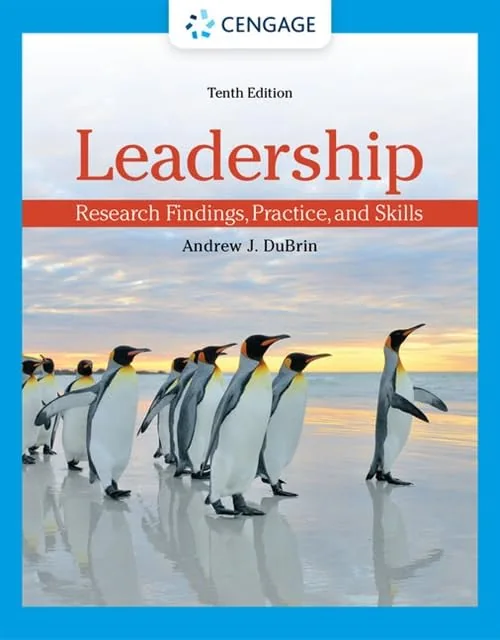
Cover of Leadership: Research, Practice, Skills, 10th Edition

Leadership: Research, Practice, Skills, 10th Edition

By Andrew J. DuBrin

About this ebook

Leadership: Research, Practice, Skills, 10th Edition, links leadership research with exercises for examining organizational behavior. Andrew J. DuBrin covers traits, behaviors, contingency approaches, emotional intelligence, ethics, teams, and change. Cases and self-assessments support management students and professionals studying how leadership concepts apply in workplace relationships.

Inside this title
  • Research findings connect leadership theories with cases and skill exercises
Current listed price $39.99Regular price $117.00Digital ebook
Buy now

Digital ebook. Checkout sends an order request.

Format
Digital ebook
ISBN
9780357716274
Last updated
2026-11-03

What this book covers.

DuBrin places research findings alongside opportunities to analyze leadership in practice. Trait and behavioral perspectives establish a foundation, followed by contingency and situational models that consider the influence of context. Case analyses, skill exercises, and questionnaires invite readers to examine their own assumptions as well as the behavior of leaders in organizations.

The discussion extends to emotional intelligence, authenticity, ethical conduct, and socially responsible leadership. Team decision-making, conflict, organizational change, coaching, mentoring, and the use of influence connect theory with recurring management tasks. The blend of conceptual material and activities suits leadership courses and professionals seeking a structured way to reflect on their workplace interactions.
Study guide included

Inside Leadership: Research, Practice, Skills, 10th Edition.

DuBrin pairs leadership research with activities that ask readers to apply it. Traits and behaviors give way to situational models, then to emotional intelligence, ethics, teams and change, with cases, exercises and self-assessments turning each concept into something examinable in the reader's own workplace.

The text treats leadership as a subject to be practiced as well as studied. It opens with trait and behavioral perspectives, then introduces contingency and situational models that make context central. Emotional intelligence, authenticity and ethics are handled as components of leadership rather than decorations. Team decision-making, conflict, influence, coaching and mentoring connect the concepts to recurring managerial tasks. Organizational change provides the setting where many of these ideas meet. Cases and questionnaires recur throughout, inviting readers to test claims against situations and against their own assumptions. It is built for courses and for professionals who want structure in reflecting on how they lead.

Traits and Behaviors

The opening frameworks ask what leaders are like and what they do. Trait perspectives emphasize enduring characteristics; behavioral perspectives focus on observable action. The book presents both as starting points that later, context-sensitive models qualify.

  • Traits describe dispositions
  • Behaviors describe observable action
  • Neither alone explains leadership
Topic 1

Contingency and Situation

Contingency and situational models argue that effective leadership depends on circumstances. The book uses them to complicate simple prescriptions, showing why the same approach can succeed in one setting and fail in another.

  • Context changes what works
  • Models match style to situation
  • Simple rules rarely hold
Topic 2

Emotional Intelligence and Authenticity

Emotional intelligence and authenticity are treated as learnable capacities that shape relationships. The text connects self-awareness and self-regulation to how leaders handle pressure, feedback and interpersonal friction.

  • Self-awareness underpins regulation
  • Authenticity affects trust
  • Emotional skill is developable
Topic 3

Ethics and Responsibility

Ethical conduct and social responsibility are examined as leadership obligations, not optional virtues. The book raises questions about influence, fairness and the consequences of decisions on people beyond the organization.

  • Ethics informs decisions
  • Responsibility extends beyond results
  • Influence carries obligations
Topic 4

Teams, Conflict and Influence

Team decision-making, conflict and influence are grouped because they occur together in practice. The book considers how leaders shape discussion, handle disagreement and exercise influence without relying on authority alone.

  • Teams need deliberate decision processes
  • Conflict can be managed rather than avoided
  • Influence is broader than command
Topics 5–6

Change, Coaching and Reflection

Organizational change, coaching and mentoring bring the earlier ideas into long-term work. Exercises and self-assessments turn the material back on the reader, making reflection part of the method rather than a closing suggestion.

  • Change requires sustained attention
  • Coaching develops others over time
  • Self-assessment supports learning
Topics 6–7

Topic map

  • Trait and Behavioral PerspectivesTopic 1
  • Contingency and Situational LeadershipTopic 2
  • Emotional Intelligence and AuthenticityTopic 3
  • Ethics and Social ResponsibilityTopic 4
  • Teams, Decisions and ConflictTopic 5
  • Influence, Coaching and MentoringTopic 6
  • Leading Organizational ChangeTopic 7

Key takeaways

  • Use the cases and questionnaires actively; the book is designed for practice.
  • Context does much of the work, so distrust one-size-fits-all rules.
  • Ethics and emotional skill are treated as core, not peripheral.

Management students and working professionals who want a research-informed, exercise-based way to examine their own leadership behavior.

Topics covered

  • leadership research and practice
  • Andrew J DuBrin
  • leadership skills
  • emotional intelligence leadership
  • contingency leadership
  • team leadership
  • ethical leadership
  • leadership self-assessment

Questions about this ebook.

Edition, audience, and study-guide details at a glance.

What is Leadership: Research, Practice, Skills, 10th Edition about?

Leadership: Research, Practice, Skills, 10th Edition, links leadership research with exercises for examining organizational behavior. Andrew J. DuBrin covers traits, behaviors, contingency approaches, emotional intelligence, ethics, teams, and change. Cases and self-assessments support management students and professionals studying how leadership concepts apply in workplace relationships.

Which edition of Leadership: Research, Practice, Skills, 10th Edition is this?

This listing is for the 10th edition. Check the title, ISBN, and book details above before ordering, especially if your course or reading list names a specific edition.

Who is Leadership: Research, Practice, Skills, 10th Edition for?

Management students and working professionals who want a research-informed, exercise-based way to examine their own leadership behavior.

Does this page include a study guide?

Yes. This page includes an original study guide with six thematic sections, key takeaways, and a topic map for structured reading.

Keep your curiosity going.

More books from this subject area.

More business & management ebooks

Enter your name and email to open a WhatsApp message with your details.