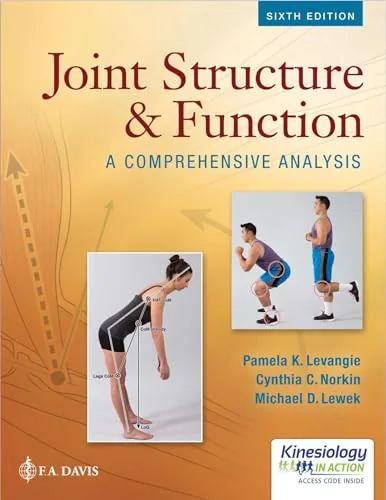
Joint Structure and Function: A Comprehensive Analysis, 6th Edition
By Pamela K. Levangie, Cynthia C. Norkin, Michael D. Lewek
About this ebook
Joint Structure and Function, sixth edition, connects joint anatomy with the mechanics of human movement for physical therapy, occupational therapy, and kinesiology students. Regional coverage of the spine and limbs examines muscle action, joint surface motion, posture, and gait, providing a framework for studying functional movement and rehabilitation.
Inside this title
Joint surface mechanics, including rolling, gliding, and spinning
Current listed price $7.99Regular price $13.00Digital ebook
Movement analysis begins with the relationship between a joint's shape, its available motion, and the forces acting on it. This text introduces mechanical terminology and movement planes before examining the axial skeleton, upper extremity, and lower extremity as related joint complexes.
Discussions of arthrokinematics explain rolling, gliding, and spinning at joint surfaces, while muscle analysis addresses torque production and stabilization. Regional chapters connect these principles with posture, weight bearing, and walking. Students in rehabilitation and exercise science can use the progression to relate anatomical detail to functional tasks; clinicians can revisit particular joint complexes when reviewing movement assessment concepts.
Study guide included
Inside Joint Structure and Function: A Comprehensive Analysis, 6th Edition.
Levangie, Norkin and Lewek build movement analysis from joint anatomy, tissue mechanics and force, then apply it region by region. Spinal, upper-limb and lower-limb chapters lead into posture and walking, where several joints work as one system. Clinical examples connect an observed motion with a plausible mechanical account.
Opening chapters define kinematic and kinetic vocabulary and explain how articular tissue and muscle generate and transmit force. Regional chapters then trace motion through the vertebral column, thorax, jaw, shoulder girdle, elbow, wrist, hand, hip, knee and foot. The closing chapters approach posture and walking as whole-body problems, comparing demands rather than isolating a single joint. Examples model how to move between what a clinician can see and what must be inferred, while flagging the bounds of a simplified account and the measurements that would take the analysis further.
Describing motion, inferring force
Kinematics names direction, displacement and pace of a segment, while kinetics addresses the forces and turning moments behind it. A usable description specifies segment, coordinate frame, plane and direction before any explanation is offered. The text then shows how external loads such as gravity and ground reaction interact with muscle and other tissue, and warns against treating an inferred force as though it were observed.
Name segment, frame and plane
Separate observed motion from inferred force
Trace external loads into tissue response
Ch. 1
Joint tissue mechanics and muscle
Osteokinematics concerns bones moving, arthrokinematics concerns surfaces sliding and rolling, and the gap between them matters. Cartilage, capsule and ligament geometry constrain which motions and degrees of stability a joint permits. Connective tissue deforms differently depending on how fast and how long a load is applied, and muscle force varies with length, speed and moment arms that shift. Creep and stress relaxation show why timing belongs in the description.
Distinguish bone motion from surface motion
Include loading rate and duration
Tie muscle force to length and speed
Chs. 2–3
Spine, thorax and jaw
Vertebral shape, discs, facets and attached muscles differ between regions, so general statements about the spine quickly mislead. Adjacent segments share the motion seen across the trunk, and the same posture can load the column differently depending on direction and external force. Rib and chest-wall movement changes thoracic size during respiration, while the temporomandibular joint blends rotation with translation while the jaw opens or shuts.
Compare regions before generalizing
Include adjacent segments in trunk motion
Link jaw and rib mechanics to their tasks
Chs. 4–6
Upper limb as a chain
Raising the arm combines glenohumeral movement with scapular motion on the thorax, and the joints at each end of the clavicle help position the girdle. Because several structures contribute, an apparent shift in arm posture can have more than one source. Reaching and manipulating differ as well: the elbow sets distance, forearm rotation orients the palm, and wrist and hand shape the grasp, so demands shift from one segment to the next.
Observe scapula and arm together
Separate reaching from grasping
Compare whole tasks, not single joints
Chs. 7–9
Lower limb under load
The hip positions the femur and helps control the pelvis, while the knee depends on tibiofemoral and patellofemoral mechanics plus menisci, ligaments and muscle. During weight bearing, movement at a joint coincides with movement and loading elsewhere, so trunk and foot position belong in the account. The ankle and the several foot joints adapt to the surface and transfer load, and movement at a single level can couple to another.
Track neighboring joints during support
Include trunk and foot position
Relate contact point to task phase
Chs. 10–12
Posture and walking as integrated tasks
Alignment determines where gravity's line falls relative to joints, support support, and holding a position can demand continuous muscle activity, sensory control even when little seems to move. Walking is analyzed by phase: stance supports and transfers load, swing advances the limb. Timing and step length describe performance, while joint motion, ground reaction, moments, power and muscle activity answer other questions, and comparisons should account for speed.
Treat posture as an active demand
Analyze gait by phase and function
Match the measure to the question asked
Chs. 13–14
Chapter and section map
Biomechanical Applications to Joint Structure and FunctionCh. 1
Joint Structure and FunctionCh. 2
Muscle Structure and FunctionCh. 3
Axial Skeletal Joint ComplexesChs. 4–6
Upper Extremity Joint ComplexesChs. 7–9
Hip, Knee, and Ankle and FootChs. 10–12
PostureCh. 13
GaitCh. 14
Key takeaways
State segment, frame and motion before proposing the forces that could produce it.
Compare force vectors and moment arms as one load is handled in different positions.
Use task phase and adjacent joints to keep observation separate from mechanical explanation.
Physical therapy, occupational therapy and kinesiology students who need a mechanics framework for regional joint function, posture and gait, plus clinicians reviewing movement analysis before rehabilitation planning.
Topics covered
joint biomechanics
osteokinematics and arthrokinematics
muscle moment arm
spinal motion
shoulder girdle mechanics
gait cycle analysis
postural control
tissue stress and strain
Questions about this ebook.
Edition, audience, and study-guide details at a glance.
What is Joint Structure and Function: A Comprehensive Analysis, 6th Edition about?
Joint Structure and Function, sixth edition, connects joint anatomy with the mechanics of human movement for physical therapy, occupational therapy, and kinesiology students. Regional coverage of the spine and limbs examines muscle action, joint surface motion, posture, and gait, providing a framework for studying functional movement and rehabilitation.
Which edition of Joint Structure and Function: A Comprehensive Analysis, 6th Edition is this?
This listing is for the 6th edition. Check the title, ISBN, and book details above before ordering, especially if your course or reading list names a specific edition.
Who is Joint Structure and Function: A Comprehensive Analysis, 6th Edition for?
Physical therapy, occupational therapy and kinesiology students who need a mechanics framework for regional joint function, posture and gait, plus clinicians reviewing movement analysis before rehabilitation planning.
Does this page include a study guide?
Yes. This page includes an original study guide with six thematic sections, key takeaways, and a chapter and section map for structured reading.