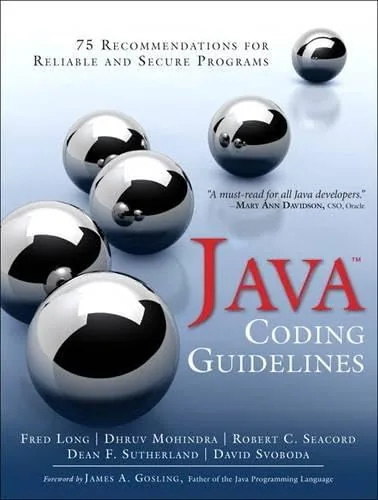
Java Coding Guidelines: 75 Recommendations for Reliable and Secure Programs
By Fred Long, Dhruv Mohindra, Robert C. Seacord, Dean F. Sutherland, David Svoboda
About this ebook
Java Coding Guidelines presents 75 recommendations addressing security, reliability, and maintainability in Java programs. Written for developers, reviewers, and software engineering students, it uses rationales and contrasting code examples to examine input handling, serialization, concurrency, exceptions, access control, and logging within the Java environment described by the book.
Inside this title
Seventy-five recommendations address Java security, reliability, and maintainability
Current listed price $16.99Regular price $30.00Digital ebook
This reference organizes Java programming recommendations around recurring problems in production code. Each guideline explains its reasoning and illustrates the issue with noncompliant and compliant examples, giving readers material to examine during code review or secure development study. References connect the recommendations to the CERT Oracle Secure Coding Standard for Java.
Coverage includes validation of external input, object serialization, thread safety, exception handling, permissions, and security-conscious logging. Maintainability receives attention because unclear code can complicate later changes and review. Published in 2013, the book provides a record of secure Java guidance from that period; platform-specific mechanisms should be understood in that context when studying its examples.
Study guide included
Inside Java Coding Guidelines: 75 Recommendations for Reliable and Secure Programs.
Seventy-five recommendations organize secure Java practice around problems that recur in production code. Each guideline gives a rationale and a pair of contrasting examples, so developers and reviewers can see the risk in one version and the safer alternative in the other, with links to the CERT Oracle standard.
The book is a reference rather than a tutorial. Recommendations are grouped around recurring concerns: validating external input, handling serialization, keeping shared state safe across threads, managing exceptions, applying access permissions and logging without leaking sensitive detail. Maintainability receives attention because code that is hard to follow is also hard to review and change. The compliant and noncompliant examples make each recommendation concrete and give reviewers something to compare against their own code. Published in 2013, the guidance reflects the Java platform of its time, which matters when a recommendation depends on mechanisms that have since evolved.
How the Recommendations Work
Each guideline is built around a rationale and a contrast. A noncompliant example shows the risky pattern, a compliant one shows the safer alternative, and the explanation connects the two. This format makes the book usable in review, where a concrete comparison is often more helpful than a general rule.
Rationale explains why the rule exists
Contrasting examples make risk visible
The format supports code review
Topic 1
Validating External Input
Input that crosses a trust boundary cannot be assumed to be well formed. The recommendations examine validation as a necessary step before data is used, and show how unchecked input becomes a security and reliability problem. The examples keep the focus on where trust changes.
External input crosses a trust boundary
Validation precedes use
Unchecked input threatens security and reliability
Topic 2
Serialization Risks
Object serialization can turn data into executable behavior if it is handled carelessly. The book treats deserialization as a sensitive operation and shows patterns that reduce exposure. The discussion belongs to the wider theme of not trusting data that arrives from outside the program.
Serialized data can carry unexpected behavior
Deserialization needs caution
Trust boundaries apply to object streams
Topic 3
Concurrency and Thread Safety
Shared mutable state is a recurring source of defects in concurrent Java programs. The recommendations address how state is accessed across threads and why some apparently simple patterns fail under interleaving. Thread safety is presented as a design property, not a coating added later.
Shared mutable state needs protection
Interleaving exposes hidden assumptions
Thread safety is a design concern
Topic 4
Exceptions and Access Control
Exception handling and permissions both govern what a program does when something goes wrong or when code attempts an operation it may not be allowed to perform. The guidelines connect clear failure behavior with the enforcement of access boundaries. Both are treated as part of correctness, not cleanup.
Exceptions shape failure behavior
Permissions enforce boundaries
Correctness includes access control
Topics 5-6
Logging and Maintainability
Logging supports diagnosis but can also expose sensitive information or obscure what happened. The text treats logging as a decision with security and operational consequences. Maintainability is linked to the same concern, because unclear code is harder to review and easier to make unsafe.
Logs can leak sensitive detail
Logging is a security decision
Clear code is easier to keep safe
Topic 7
Topic map
Guideline Structure and RationaleTopic 1
Input ValidationTopic 2
Object SerializationTopic 3
Thread Safety and Shared StateTopic 4
Exception HandlingTopic 5
Permissions and Access ControlTopic 6
Logging, Review and MaintainabilityTopic 7
Key takeaways
The contrasting examples are the working core of each recommendation.
Trust boundaries decide where validation and caution are required.
Read the 2013 guidance with its platform context in mind when applying it.
Java developers, code reviewers and software engineering students who want a structured reference on secure, reliable and maintainable Java practice.
Topics covered
Java coding guidelines
secure Java
input validation
serialization security
thread safety
exception handling
access control
CERT Oracle secure coding
Questions about this ebook.
Edition, audience, and study-guide details at a glance.
What is Java Coding Guidelines: 75 Recommendations for Reliable and Secure Programs about?
Java Coding Guidelines presents 75 recommendations addressing security, reliability, and maintainability in Java programs. Written for developers, reviewers, and software engineering students, it uses rationales and contrasting code examples to examine input handling, serialization, concurrency, exceptions, access control, and logging within the Java environment described by the book.
Who is Java Coding Guidelines: 75 Recommendations for Reliable and Secure Programs for?
Java developers, code reviewers and software engineering students who want a structured reference on secure, reliable and maintainable Java practice.
Does this page include a study guide?
Yes. This page includes an original study guide with six thematic sections, key takeaways, and a topic map for structured reading.