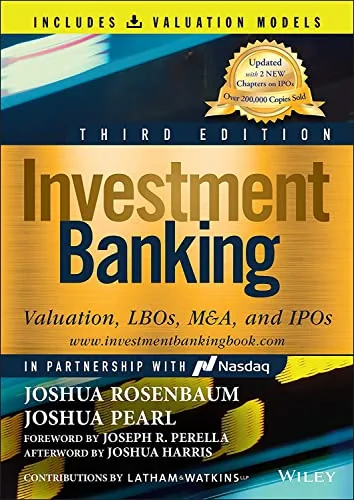
Investment Banking: Valuation, LBOs, M&A, and IPOs, 3rd Edition
By Joshua Rosenbaum, Joshua Pearl
About this ebook
Investment Banking explains the analytical work behind valuation, leveraged buyouts, mergers and acquisitions, and initial public offerings. Joshua Rosenbaum and Joshua Pearl's third edition uses financial exhibits and transaction examples to introduce finance students and analysts to comparable companies, precedent transactions, discounted cash flow, and deal modeling.
Inside this title
Explains comparable companies, precedent transactions, and DCF valuation
Current listed price $29.99Regular price $71.00Digital ebook
Valuation methods form the foundation of this practitioner-oriented finance text. Readers examine how peer companies and past transactions provide market benchmarks, then work through projected cash flows, terminal value, and present value in discounted cash flow analysis. The presentation connects calculations with the assumptions that shape valuation ranges.
Leveraged buyout analysis extends the discussion to financing structures and modeled returns. Merger analysis considers accretion, dilution, synergies, and combined financial statements, while IPO coverage follows underwriting, filings, roadshows, and pricing. Case studies and spreadsheet exhibits show the form of transaction analysis. The third edition suits banking trainees, finance students, and readers in private equity or corporate development studying deal mechanics.
Study guide included
Inside Investment Banking: Valuation, LBOs, M&A, and IPOs, 3rd Edition.
Rosenbaum and Pearl tie valuation to transaction execution. Peer firms, earlier deals, and projected cash flows each give a different picture of worth, while returns in a buyout, the buyer's economics, and demand from investors reveal what a deal can credibly bear. The methods work as cross-checks.
The third edition keeps a single analytical order, following ValueCo as assumptions travel from valuation toward financing and deal decisions. It starts with trading multiples and transaction precedents, moves into leveraged buyouts and discounted cash flow, then tracks choices facing sellers, buyers, and issuers. Use the techniques as mutual checks: their credibility hinges on inputs, context, and plausible alternatives. Finance students and analysts who build models are the audience. Exhibits teach much of the method. Practice with them really matters.
Market comparables and peer sets
Start from how the target brings in sales and what controls its margins. Revenue mix, region, scale, expansion, and capital needs decide whether a given peer is truly comparable, and a narrow group usually beats a lengthy sector list. Note each difference so any premium or discount can be justified economically. Enterprise value goes with operating metrics like EBITDA; equity value goes with earnings owed to shareholders.
Pick peers by economics, not sector labels
Normalize one-time items first
Match numerator to denominator
Move from enterprise value to equity value
Chapter 1, Comparable Companies Analysis
Prices paid in precedent deals
Look for acquisitions with relevant targets, similar economics, and disclosed terms. Calendar timing counts because financing and markets move, and you need to establish whether control changed hands and whether payment took the form of cash, stock, or contingent value. Use target figures known near announcement, not hindsight borrowed from later filings. Derive transaction equity value from consideration, then adjust for debt, cash, and other items.
Screen deals for relevance and disclosure
Deal date carries market context
Separate control premium from synergies
Use announcement-era target metrics
Chapter 2, Precedent Transactions Analysis
Projected cash and terminal value
Build operating forecasts from volume, price, margin, and reinvestment drivers. Begin from operating profit after tax, restore noncash depreciation and amortization, then subtract capital outlays and any increase in working capital tied to operations. Such flows precede financing, so the discount rate must blend debt and equity costs. Beyond the forecast window, value arises from a perpetuity or an exit multiple.
Build free cash flow from drivers
Discount rate must match the flow
Terminal value may dominate the estimate
Test growth against reinvestment needs
Chapter 3, Discounted Cash Flow Analysis
Buyout sources, debt, and return
List the purchase price, refinancing, and fees requiring funds, then match them to new borrowings, sponsor equity, and other permitted sources. Model each debt layer separately where rate, amortization, and seniority differ, because leverage raises the equity return while shrinking the cushion for disappointment. Project cash remaining after investment, interest, and mandatory repayment, then show how surplus cash retires debt.
Balance sources against uses
Model tranches on their own terms
Leverage magnifies both ways
Separate exit pricing from cash generation
Chapters 4–5, Leveraged Buyouts and LBO Analysis
Running a sale and judging a bid
A seller chooses a process balancing price discovery, secrecy, speed, and certainty of completion. An auction creates rivalry but demands broader disclosure and coordination; a targeted search keeps the field narrow. Preparation covers marketing materials, diligence access, bid deadlines, and appraisal of each proposal. On the buy side, compare standalone worth with integration cost, risk, and expected synergies, noting how financing and purchase accounting shape post-close earnings.
Choose a process before naming a price
Auction gains reach, loses secrecy
Compare terms as well as headline price
Accretion is one test, not proof
Chapters 6–7, Sell-Side M&A and Buy-Side M&A
Preparing and pricing an offering
Issuer and underwriters sharpen the equity narrative, test preparedness for public reporting, and finish diligence and disclosure. Primary shares generate cash for the company; secondary shares let current holders sell, and the split changes proceeds and ownership. Marketing presents the company and the risks attached. Bookbuilding records demand at several prices and sizes, and that evidence, with comparables and market conditions, informs price and allocation.
Split primary from secondary shares
Judge readiness for public reporting
Read demand at several prices
Early trading supplies additional evidence
Chapters 8–9, Initial Public Offerings and The IPO Process
Chapter and section map
Comparable Companies AnalysisCh. 1
Precedent Transactions AnalysisCh. 2
Discounted Cash Flow AnalysisCh. 3
LBO AnalysisCh. 5
Sell-Side M&ACh. 6
Buy-Side M&ACh. 7
The IPO ProcessCh. 9
Key takeaways
Match enterprise value to operating metrics and equity value to shareholder earnings so claims are not mixed.
Shift cash flow and resale multiples one at a time before merging them into a pessimistic case.
Weigh offers on price, conditions, and closing certainty, since the headline number conceals material differences.
Finance students and aspiring analysts learning to build valuation, buyout, and deal models, plus practitioners who want a structured refresher on transaction analysis across deal types.
Topics covered
investment banking
comparable companies
precedent transactions
discounted cash flow
leveraged buyout
mergers and acquisitions
initial public offering
valuation models
Questions about this ebook.
Edition, audience, and study-guide details at a glance.
What is Investment Banking: Valuation, LBOs, M&A, and IPOs, 3rd Edition about?
Investment Banking explains the analytical work behind valuation, leveraged buyouts, mergers and acquisitions, and initial public offerings. Joshua Rosenbaum and Joshua Pearl's third edition uses financial exhibits and transaction examples to introduce finance students and analysts to comparable companies, precedent transactions, discounted cash flow, and deal modeling.
Which edition of Investment Banking: Valuation, LBOs, M&A, and IPOs, 3rd Edition is this?
This listing is for the 3rd edition. Check the title, ISBN, and book details above before ordering, especially if your course or reading list names a specific edition.
Who is Investment Banking: Valuation, LBOs, M&A, and IPOs, 3rd Edition for?
Finance students and aspiring analysts learning to build valuation, buyout, and deal models, plus practitioners who want a structured refresher on transaction analysis across deal types.
Does this page include a study guide?
Yes. This page includes an original study guide with six thematic sections, key takeaways, and a chapter and section map for structured reading.