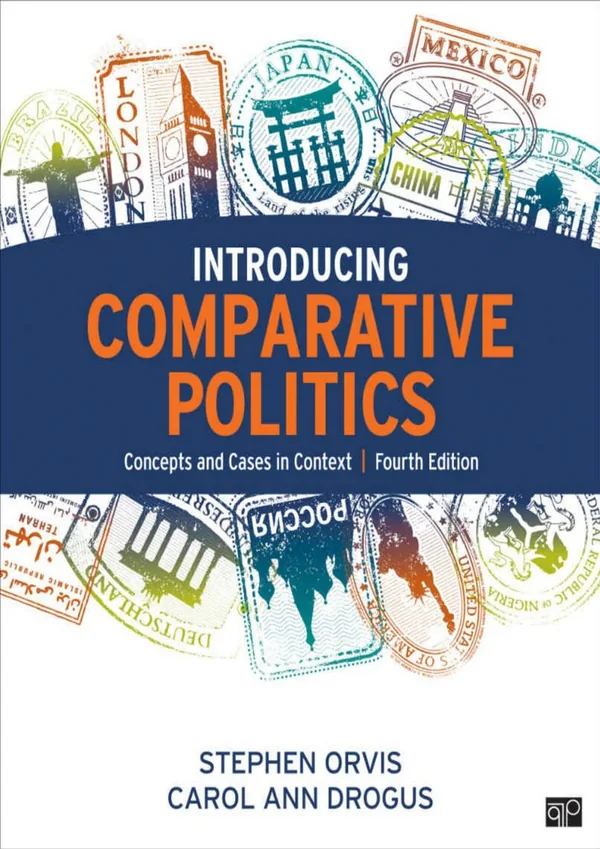
Introducing Comparative Politics: Concepts and Cases in Context, 4th Edition
By Stephen Orvis, Carol Ann Drogus
About this ebook
Introducing Comparative Politics: Concepts and Cases in Context, Fourth Edition connects political concepts with sustained country studies. Stephen Orvis and Carol Ann Drogus examine states, regimes, political economy, identity, and political violence through eleven national cases, giving undergraduate political science students a framework for comparing institutions and political change.
Inside this title
Eleven country cases spanning several regions and political systems
Current listed price $19.99Regular price $40.00Digital ebook
Concepts and country evidence develop together in this introduction to comparative politics. Discussions of state formation, regime differences, democratization, collective identity, and political violence draw on national examples so students can examine how similar questions produce different political outcomes. Political economy adds another basis for cross-national comparison.
The eleven recurring cases include the United Kingdom, France, Germany, Japan, Russia, China, India, Iran, Nigeria, Mexico, and Brazil. Following these countries across themes gives readers continuity while introducing contrasting institutions and histories. The fourth edition is intended for undergraduate comparative politics courses and offers material for classroom discussion, comparative essays, and introductory study in political science or international relations.
Study guide included
Inside Introducing Comparative Politics: Concepts and Cases in Context, 4th Edition.
Orvis and Drogus employ comparison to show who wields power and why comparable institutions produce unlike results. Country cases recur, connecting states, regimes, identity, participation, and economic politics to the evidence scholars actually weigh when arguing about causes across the text.
Part one constructs a comparative framework and presents the modern state, kinds of regime, and political belonging. Part two sets governing and participatory bodies beside contentious action, authoritarian control, and regime transition. Part three turns to economic organization, development, and public policy. A reader may trace one concept across countries or revisit a single case to see how its past informs several questions. Eleven national studies anchor the discussion. No prior coursework is presumed. Undergraduates in political science are the expected audience.
Comparison, outcomes, and forms of power
The opening chapter distinguishes direct action from power over the agenda and power over what people regard as possible. Specify which form matters before gathering evidence, since a ballot captures one public decision, whereas procedural rules and agenda records show how other options were kept from a vote. The most-similar design lines up cases that match on several conditions yet diverge on the result of interest.
Name the kind of power first
Agenda rules explain absent options
Pick cases that answer your question
Keep empirical claims apart from normative ones
Chapter 1
Capacity, legitimacy, and regime rules
Modern states assert authority over territory and depend on bodies that make and enforce decisions. Capacity covers administration, taxation, enforcement, and public goods; legitimacy asks whether that authority is accepted. A government may apply coercion in certain places while lacking staff, funds, or cooperation to enforce rules uniformly. A regime sets how rulers acquire and keep authority and how citizens may participate or demand accountability.
Separate capacity from legitimate authority
Elections occur under both regime types
Ask whether opponents can replace rulers
Measure service delivery on its own
Chapters 2–3
Belonging, categories, and political demands
Faith, national belonging, racial and ethnic descent, gender, and sexuality can each decide who belongs to the political community. They compare settings where such identities grow salient through state formation, public institutions, or collective mobilization. A category's political meaning depends on definition, representation, and links to rights or resources. Formal membership may sit alongside unequal influence, so trace who may claim recognition, under what rules, and whether practice varies.
Ask how a category gained salience
Membership is not the same as influence
Compare legal status with administrative practice
Trace rights to resources
Chapter 4
Institutions that channel participation
Systems built around a parliament, a president, or both arrange relations between executive and legislature in contrasting ways, while courts, bureaucracies, and federal arrangements scatter authority further. Labels indicate where to look, but party systems, coalitions, and administrative customs alter how a formally similar setup performs, especially when several bodies must cooperate to deliver policy. Demands can travel via elections, parties, interest groups, civil society, or movements and protest.
Read institutions as combinations
Labels mark where to look, not results
Follow a claim through several channels
Compare what each side wants and whom it can mobilize
Chapters 5–7
Authoritarian rule and changing regimes
Authoritarian rulers may keep elections, legislatures, courts, or parties. Such bodies can help coordinate elites, gather information, distribute posts, or contain opposition, yet their presence reveals little about the competitiveness of politics. Ask who is free to organize separately, where rulers meet constraints, and what behavior puts a person's post or perks at risk. Coups and transitions can replace leaders without altering the rules that confer power.
Authoritarian institutions can lend stability
Presence of elections proves little
Ask who may organize on their own
Changing rulers differs from changing rules
Chapters 8–9
Economy, growth, and policy choices
The section contrasts three models—liberal, coordinated, and developmental—and their differing degrees of state involvement. Development means more than aggregate output: consider how policy touches jobs, skills, and shares of income, and which alliances back a strategy. Countries can change direction while preserving some earlier institutions. The last chapter applies market-failure logic to welfare, health, and environment, where spillover costs, uneven information, or weak competition can defeat public aims.
Look past growth to jobs and distribution
Coalitions decide which strategy survives
Compare design with implementation
Markets can fail on cost and information
Chapters 10–12
Chapter and section map
IntroductionCh. 1
The Modern StateCh. 2
States and IdentityCh. 4
Governing Institutions in DemocraciesCh. 5
Contentious PoliticsCh. 7
Authoritarian InstitutionsCh. 8
Political Economy of DevelopmentCh. 11
Public Policies When Markets FailCh. 12
Key takeaways
Specify a political outcome in measurable terms before selecting the cases to compare.
Do not let state capacity stand in for regime type when judging performance and accountability.
Trace a policy through delivery and distribution before concluding what produced its effects.
Undergraduate political science students enrolled in comparative politics, plus readers wanting a case-driven introduction to states, regimes, identity, and economic politics across eleven countries and beyond.
Topics covered
comparative politics
modern state
regime types
political identity
democratic institutions
authoritarian rule
political economy
development policy
Questions about this ebook.
Edition, audience, and study-guide details at a glance.
What is Introducing Comparative Politics: Concepts and Cases in Context, 4th Edition about?
Introducing Comparative Politics: Concepts and Cases in Context, Fourth Edition connects political concepts with sustained country studies. Stephen Orvis and Carol Ann Drogus examine states, regimes, political economy, identity, and political violence through eleven national cases, giving undergraduate political science students a framework for comparing institutions and political change.
Which edition of Introducing Comparative Politics: Concepts and Cases in Context, 4th Edition is this?
This listing is for the 4th edition. Check the title, ISBN, and book details above before ordering, especially if your course or reading list names a specific edition.
Who is Introducing Comparative Politics: Concepts and Cases in Context, 4th Edition for?
Undergraduate political science students enrolled in comparative politics, plus readers wanting a case-driven introduction to states, regimes, identity, and economic politics across eleven countries and beyond.
Does this page include a study guide?
Yes. This page includes an original study guide with six thematic sections, key takeaways, and a chapter and section map for structured reading.