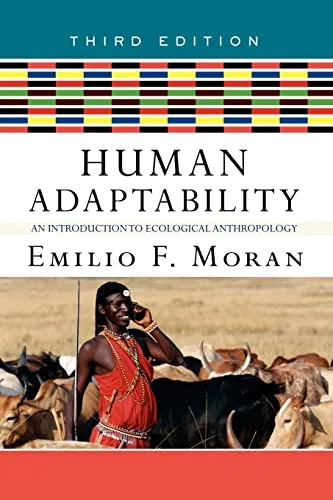
Human Adaptability, 3rd Edition, examines how people respond to environmental conditions through physiology, culture, social organization, and population change. Emilio F. Moran combines ecological anthropology with human ecology and demography. Students and researchers encounter examples from contrasting environments, including Arctic, tropical, arid, and high-altitude regions, within an interdisciplinary account of adaptation.
Inside this title
Physiological, cultural, and demographic dimensions of human adaptation
Current listed price $8.99Regular price $15.00Digital ebook
Moran brings biological and social explanations together to study human-environment relationships. Thermoregulation and nutrition are considered alongside cultural practices, social institutions, and demographic patterns, showing how different kinds of response operate within particular ecological conditions. The focus extends from individuals to populations and their environments.
Regional case studies provide comparisons across cold, tropical, dry, and high-altitude settings. These examples place theoretical concepts in contexts where resources, climate, and social arrangements interact. The book also addresses methods for investigating these relationships and questions raised by broader environmental change. Its third edition supports courses in ecological anthropology, environmental studies, and human ecology, as well as reference reading across the biological and social sciences.
Study guide included
Inside Human Adaptability: An Introduction to Ecological Anthropology, 3rd Edition.
Adaptation is not one thing. People adjust through body, culture, social arrangement and population structure, and Moran keeps those responses in view together. Regional examples from cold, tropical, dry and high-altitude settings show how the same questions look different under contrasting conditions.
Moran treats human-environment relations as an interdisciplinary problem. Physiological responses such as thermoregulation and nutrition are set beside cultural practices, institutions and demographic patterns, so adaptation appears as a combination rather than a single mechanism. The analysis moves between individuals, populations and the environments they inhabit. Case material from Arctic, tropical, arid and high-altitude regions gives the concepts concrete settings and invites comparison across them. Methods for studying these relationships receive attention, as do the questions raised by broader environmental change. The third edition supports courses in ecological anthropology, human ecology and environmental studies, and serves as reference reading across the biological and social sciences.
Adaptation as a combined problem
Moran refuses to reduce adaptation to biology or to culture alone. Physiological capacity, learned practice, social organization and population structure are presented as interacting responses to the same environmental pressures. The framework asks how these levels reinforce or constrain one another in a given setting.
Biological and social explanations combine
Responses operate at several levels
Levels can reinforce or constrain each other
Topic 1
Thermoregulation and nutritional response
The body's response to heat and cold, and its use of food and energy, provide the physiological core of the book. These processes are explained as adaptations with limits, shaped by environment and by what people can obtain. Nutrition connects physiology to subsistence and to the social arrangements that distribute food.
Thermoregulation has environmental limits
Nutrition links body and subsistence
Physiology depends on what is available
Topics 2-3
Culture and social organization
Cultural practices and institutions are treated as adaptive resources, not as decoration on biological life. The book examines how shared knowledge, norms and social arrangements mediate relations with the environment. This view makes culture part of the explanation while avoiding the assumption that every custom is functional.
Culture mediates environmental relations
Institutions organize access to resources
Custom should not be assumed functional
Topic 4
Population dynamics and demography
Populations, not only individuals, adapt. Demographic patterns such as fertility, mortality and migration are considered in relation to environmental conditions and social organization. The text shows how population processes can both respond to and reshape the setting in which adaptation occurs.
Populations adapt as units
Demography responds to environment
Population change reshapes resources
Topic 5
Regional comparisons
Arctic, tropical, arid and high-altitude cases give the framework comparative reach. Each setting poses distinctive problems of cold, heat, water or oxygen, and each elicits a different mix of physiological, cultural and social response. Placing cases side by side reveals which adaptations are general and which are specific.
Each region poses distinct pressures
Responses mix physiology and culture
Comparison separates general from specific
Topics 6-7
Methods and environmental change
The book discusses how researchers investigate human-environment relationships and what different methods can establish. That methodological attention supports the case comparisons. It also frames questions about broader environmental change, asking how adaptation is tested when the conditions themselves shift and earlier responses lose their fit.
Methods shape what can be claimed
Comparison depends on consistent evidence
Changing conditions can outdate adaptations
Topic 8
Topic map
Ecological Anthropology and Human EcologyTopic 1
ThermoregulationTopic 2
Nutrition and EnergyTopic 3
Cultural Practices and InstitutionsTopic 4
Population DynamicsTopic 5
Arctic and High-Altitude CasesTopic 6
Tropical and Arid CasesTopic 7
Methods and Environmental ChangeTopic 8
Key takeaways
Read physiology, culture and demography as interacting responses rather than competing explanations.
Use the regional cases to test whether an adaptation is general or specific to one environment.
Ask what happens to established adaptations when environmental conditions change.
Students of ecological anthropology, human ecology and environmental studies, plus researchers seeking an interdisciplinary introduction to human-environment relationships.
Topics covered
ecological anthropology
human adaptability
human ecology
thermoregulation
nutrition
population dynamics
environmental adaptation
regional case studies
Other editions of this title.
Compare editions, prices, and book details before you choose.
Edition, audience, and study-guide details at a glance.
What is Human Adaptability: An Introduction to Ecological Anthropology, 3rd Edition about?
Human Adaptability, 3rd Edition, examines how people respond to environmental conditions through physiology, culture, social organization, and population change. Emilio F. Moran combines ecological anthropology with human ecology and demography. Students and researchers encounter examples from contrasting environments, including Arctic, tropical, arid, and high-altitude regions, within an interdisciplinary account of adaptation.
Which edition of Human Adaptability: An Introduction to Ecological Anthropology, 3rd Edition is this?
This listing is for the 3rd edition. Check the title, ISBN, and book details above before ordering, especially if your course or reading list names a specific edition.
Who is Human Adaptability: An Introduction to Ecological Anthropology, 3rd Edition for?
Students of ecological anthropology, human ecology and environmental studies, plus researchers seeking an interdisciplinary introduction to human-environment relationships.
Does this page include a study guide?
Yes. This page includes an original study guide with six thematic sections, key takeaways, and a topic map for structured reading.