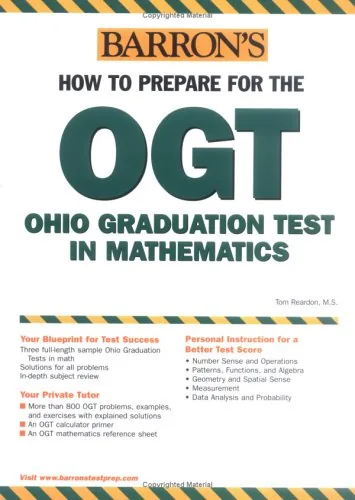
How to Prepare for the Ohio Graduation Test in Mathematics
By Tom Reardon
About this ebook
How to Prepare for the Ohio Graduation Test in Mathematics reviews the content and question styles of the historical OGT mathematics exam. Tom Reardon includes subject review, worked problems, sample tests, calculator guidance, and explained solutions. Students and teachers can use this 2005 guide for edition-specific practice and mathematics revision.
Inside this title
Review of algebra, geometry, measurement, data, and probability
Current listed price $21.00Regular price $64.00Digital ebook
Number sense, measurement, geometry, algebra, data analysis, and probability form the subject base of this OGT preparation guide. Explanations and worked examples introduce problem-solving methods before readers attempt additional exercises. An OGT calculator primer and reference sheet support practice with the tools described in the book.
Three full-length sample tests provide a way to work through the assessment format represented by this 2005 publication. Detailed solutions help readers examine reasoning, locate errors, and revisit topics that need attention. The guide is useful to teachers and learners interested in the former Ohio Graduation Test or in a structured collection of secondary-school mathematics problems, with its historical testing context kept in view.
Study guide included
Inside How to Prepare for the Ohio Graduation Test in Mathematics.
This guide prepares students for the mathematics of a former Ohio graduation test. Tom Reardon combines subject review with worked problems, a calculator primer, and three full-length sample tests whose explained solutions let a reader check reasoning and find where an error began.
The book reviews the mathematics strands associated with the Ohio Graduation Test: number sense, measurement, geometry, algebra, data analysis, and probability. Explanations and worked examples introduce methods before readers attempt exercises of their own, and a calculator primer with a reference sheet supports practice with the tools the exam assumed. Three full-length sample tests then give the assessment format a realistic trial. Detailed solutions allow readers to examine their reasoning, locate mistakes, and return to topics that need more work. Published in 2005, the guide documents a testing programme that has since ended, which matters to anyone using it as a historical record or as a source of secondary mathematics problems.
Reviewing the tested strands
The review moves through the content areas the examination covered: number sense, measurement, geometry, algebra, data analysis, and probability. Each strand is treated as a body of knowledge and skill to be revisited rather than a set of tricks. Covering the strands systematically gives a student a way to identify weak areas and to plan revision instead of practising whatever happens to feel comfortable.
Cover each tested strand
Identify the weaker areas
Plan revision in a systematic way
Topic 1-3
Worked examples as models
Worked examples show a method being applied before the reader is asked to apply it. The book uses them to make reasoning visible step by step, including the decisions that lead to a particular approach. Modelling the process this way supports students who can follow a solution but struggle to begin one on their own, and it gives them language for describing their method.
Make reasoning visible step by step
Show how a method is chosen
Give students language for method
Topic 4
Practising with the calculator
A calculator primer and reference sheet address the tools the examination expected students to use. The material treats the calculator as something to be understood and practised with, not simply permitted, so that students know when a device helps and when it gets in the way. Familiarity reduces avoidable errors and frees attention for the reasoning the problem requires.
Learn when the calculator helps
Practise with the expected tools
Reduce errors that are avoidable
Topic 5
Three full-length sample tests
Three complete sample tests reproduce the shape of the examination, giving practice at working under the format's demands rather than in isolated exercises. Sitting a full paper reveals how stamina, pacing, and question selection affect performance. The samples also let a student experience the mix of topics in one sitting, which is closer to the real task than a chapter of similar problems.
Practise under exam conditions
Notice pacing and stamina
Work the mixed topic set
Topic 6
Learning from explained solutions
Detailed solutions turn the sample tests into a diagnostic tool. By comparing their own work with an explained method, readers can see where reasoning diverged, not merely that an answer was wrong. The guide encourages revisiting a topic after a mistake, so that the solution becomes a route back into the content rather than a final verdict on ability.
Compare reasoning, not just answers
Locate where a method diverged
Revisit topics after mistakes
Topic 7
A guide from 2005
The book belongs to a particular testing era. The Ohio Graduation Test is no longer administered, so the guide's value lies in the content it reviews and the problems it collects as much as in its exam-specific framing. Teachers and readers should keep that context in view, treating the material as a historical artefact and a mathematics resource rather than current test preparation.
Read the guide in context
Treat it as historical record
Use the problems as practice
Topic 1-7
Topic map
Number Sense and MeasurementTopic 1
Geometry and AlgebraTopic 2
Data Analysis and ProbabilityTopic 3
Worked Problems and MethodsTopic 4
Calculator Primer and Reference SheetTopic 5
Three Full-Length Sample TestsTopic 6
Explained Solutions and ReviewTopic 7
Key takeaways
The reviewed strands show which areas need work, turning general worry into a revision plan.
Full-length papers reveal pacing and stamina as well as content knowledge, not only accuracy.
Explained solutions are most useful when they send a reader back into the topic, not just to the answer.
Students and teachers working with the former Ohio Graduation Test, and readers who want a structured collection of secondary mathematics review problems with worked examples and explained answers.
Topics covered
Ohio Graduation Test
mathematics review
sample tests
worked examples
calculator practice
algebra and geometry
test preparation
Questions about this ebook.
Edition, audience, and study-guide details at a glance.
What is How to Prepare for the Ohio Graduation Test in Mathematics about?
How to Prepare for the Ohio Graduation Test in Mathematics reviews the content and question styles of the historical OGT mathematics exam. Tom Reardon includes subject review, worked problems, sample tests, calculator guidance, and explained solutions. Students and teachers can use this 2005 guide for edition-specific practice and mathematics revision.
Who is How to Prepare for the Ohio Graduation Test in Mathematics for?
Students and teachers working with the former Ohio Graduation Test, and readers who want a structured collection of secondary mathematics review problems with worked examples and explained answers.
Does this page include a study guide?
Yes. This page includes an original study guide with six thematic sections, key takeaways, and a topic map for structured reading.