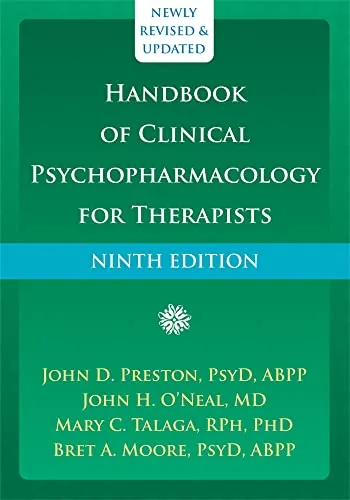
Handbook of Clinical Psychopharmacology for Therapists, 9th Edition
By John D. Preston
About this ebook
Handbook of Clinical Psychopharmacology for Therapists, Ninth Edition introduces psychiatric medications for mental health professionals without specialist pharmacology training. It examines neurobiology, drug classes, effects, interactions, assessment, and communication with prescribers, using cases and tables to connect medication knowledge with the observations and responsibilities of therapists in clinical work.
Inside this title
Neurobiology and major psychiatric medication classes explained together
Current listed price $19.00Regular price $38.00Digital ebook
The handbook begins with the neurochemical ideas needed to understand how psychiatric medications are discussed. It then considers antidepressants, antipsychotics, mood stabilizers, anxiolytics, and stimulants, relating drug categories to diagnostic and assessment questions that arise in mental health care. Cases and summary tables support study and reference.
Attention extends to side effects, contraindications, interactions, adherence, and the assessment of medication response. Discussions of children, adolescents, pregnancy, and older adulthood acknowledge differences among patient populations. The ninth edition is written for therapists who need a vocabulary for medication-related observations and collaboration with prescribers, placing psychopharmacology within an integrated understanding of psychological treatment and professional communication.
Study guide included
Inside Handbook of Clinical Psychopharmacology for Therapists, 9th Edition.
Preston writes for therapists who are not prescribers but who must recognize, describe and discuss medication effects. Neurobiology, drug classes, interactions and special populations are covered so that observation in the therapy room can be communicated clearly to the people who prescribe.
The handbook supplies the neurochemical ideas needed to follow a prescriber's reasoning, then walks through antidepressants, antipsychotics, mood stabilizers, anxiolytics and stimulants in relation to the conditions they address. Side effects, contraindications, interactions and adherence are treated as clinical information a therapist must notice and pass on, and assessing response depends on a baseline and a structured comparison. Children, adolescents, pregnancy and older adulthood each change how a medication is considered. Cases and summary tables support study and quick reference. Throughout, psychopharmacology sits inside integrated care, making the therapist's communication with prescribers part of the clinical work.
Neurobiology as shared vocabulary
The opening material supplies the neurochemical ideas behind psychiatric medication. It gives therapists a way to follow a prescriber's reasoning and to place drug action within a broader account of mental health.
Neurotransmission is explained
Drug action follows from biology
Shared language aids collaboration
Foundations precede drug classes
Topics 1–2
The major drug classes
Antidepressants, antipsychotics, mood stabilizers, anxiolytics and stimulants are each described in relation to the conditions they address. The grouping helps a therapist recognize what a client has been prescribed and why.
Antidepressants are covered
Antipsychotics and mood stabilizers follow
Anxiolytics and stimulants are included
Classes map to diagnoses
Topics 3–4
Effects, interactions and adherence
Side effects, contraindications, interactions and adherence are treated as clinical information a therapist must notice and pass on. The book frames these as observable in session as well as in the prescription record.
Side effects are recognized
Interactions are taken seriously
Adherence is discussed openly
Observation feeds the prescriber
Topic 5
Judging medication response
Assessment of how a medication is working requires a baseline and a way to compare change. The text supplies the questions and the structure a non-prescriber can use when reporting response.
Baselines support comparison
Response is assessed systematically
Change is documented
Reports are specific
Topic 6
Populations that change the calculus
Children, adolescents, pregnancy and older adulthood each alter how medications are considered. The book keeps these groups distinct rather than folding them into general adult guidance.
Children and adolescents differ
Pregnancy raises specific questions
Older adults need separate attention
General guidance is not universal
Topic 7
Communication with prescribers
The handbook places psychopharmacology inside integrated care. Therapists are shown how to describe what they observe and how to raise concerns, making the relationship with the prescriber part of the clinical work.
Observation is reported clearly
Concerns are raised early
Language is shared
Collaboration is part of care
Topic 8
Topic map
Neurobiology of Psychiatric MedicationTopic 1
How Drugs Act and Are DescribedTopic 2
Antidepressants and Mood StabilizersTopic 3
Antipsychotics, Anxiolytics and StimulantsTopic 4
Side Effects, Interactions and AdherenceTopic 5
Assessing Medication ResponseTopic 6
Children, Adolescents, Pregnancy and Older AdultsTopic 7
Collaborating with PrescribersTopic 8
Key takeaways
Learn the drug classes well enough to follow a prescriber's reasoning.
Notice side effects, interactions and adherence in session, not only on paper.
Report observations in specific terms that a prescriber can act on.
Mental health professionals without prescriber training—counselors, therapists, psychologists and social workers—who need working knowledge of psychiatric medication and clear communication with prescribers.
Topics covered
clinical psychopharmacology
psychiatric medication for therapists
drug interactions
antidepressants and antipsychotics
medication adherence
therapist prescriber communication
psychopharmacology special populations
mental health medication guide
Questions about this ebook.
Edition, audience, and study-guide details at a glance.
What is Handbook of Clinical Psychopharmacology for Therapists, 9th Edition about?
Handbook of Clinical Psychopharmacology for Therapists, Ninth Edition introduces psychiatric medications for mental health professionals without specialist pharmacology training. It examines neurobiology, drug classes, effects, interactions, assessment, and communication with prescribers, using cases and tables to connect medication knowledge with the observations and responsibilities of therapists in clinical work.
Which edition of Handbook of Clinical Psychopharmacology for Therapists, 9th Edition is this?
This listing is for the 9th edition. Check the title, ISBN, and book details above before ordering, especially if your course or reading list names a specific edition.
Who is Handbook of Clinical Psychopharmacology for Therapists, 9th Edition for?
Mental health professionals without prescriber training—counselors, therapists, psychologists and social workers—who need working knowledge of psychiatric medication and clear communication with prescribers.
Does this page include a study guide?
Yes. This page includes an original study guide with six thematic sections, key takeaways, and a topic map for structured reading.