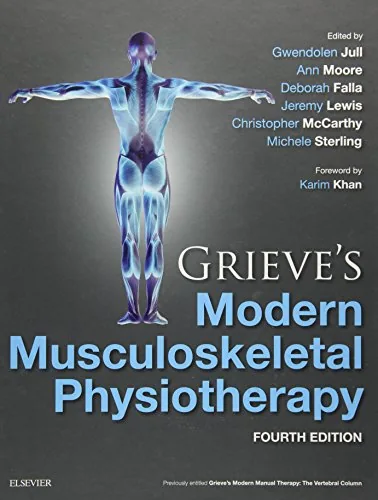
Grieve's Modern Musculoskeletal Physiotherapy, 4th Edition
By Gwendolen Jull, Ann Moore, Deborah Falla, Jeremy Lewis, Christopher McCarthy, Michele Sterling
About this ebook
Grieve's Modern Musculoskeletal Physiotherapy, Fourth Edition, examines spinal and extremity conditions through clinical reasoning and a biopsychosocial perspective. Physiotherapy students and clinicians can study assessment, differential diagnosis, manual therapy, exercise, pain science, motor control, and outcome measurement across acute injury, persistent pain, and rehabilitation of specific musculoskeletal disorders.
Inside this title
Spinal and extremity conditions within one musculoskeletal framework
Current listed price $29.99Regular price $60.00Digital ebook
Spinal and peripheral conditions are brought together within a broader account of musculoskeletal practice. Contributing authors examine the evidence behind assessment and management, relating physical findings to pain mechanisms, function, and the patient's circumstances. Differential diagnosis, red flags, and clinical tests support the discussion of reasoning through a presentation.
Management topics include manual therapy, exercise prescription, pain education, motor control, and motor learning. Examples encompass tendinopathy, osteoarthritis, radiculopathy, shoulder and knee pain, ankle injury, and postoperative rehabilitation. Outcome measures consider impairment, activity, and participation. The fourth edition is intended for physiotherapists and students who want to examine how scientific findings and a biopsychosocial model inform musculoskeletal care.
Study guide included
Inside Grieve's Modern Musculoskeletal Physiotherapy, 4th Edition.
Spinal and limb complaints are approached here as reasoning problems rather than labels. The editors gather pain science, movement research and measurement evidence, then ask readers to convert it into testable explanations. Assessment, manual therapy, exercise and outcome selection each appear alongside regional chapters where rival models compete on the same presentation.
This fourth edition of a long-standing reference, published by Elsevier in 2015, widens the earlier focus on manual therapy. The volume is organised so theory, instrumentation and the clinical encounter build on one another. Opening units cover basic science, measurement and research design; later chapters move into the consulting room and then into regional practice. Contributors rarely push a single method. Instead they offer alternative assessment and management frameworks, asking readers to weigh each claim in light of the evidence and of what a person says about a given activity.
Reading pain at several levels
Nociceptive signals travel through spinal and cerebral circuits that can turn them up or down, which helps explain why tissue findings and a patient's account of pain may not track together. The chapters insist that pain stays a personal experience, so the weight given to any single mechanism has to be judged from the history and the task at hand.
Descending modulation can dampen or amplify input
Sensitisation outlasts visible tissue change
Context sets how much each process counts
Chapters 2 and 6 · pp. 8 and 53
Exercise, learning and tissue capacity
Motor control work shows how feedback, sensation and task demands reshape coordination, and practice can reorganise a movement before muscle changes appear. Tendon chapters tie loading history to what a structure tolerates repeatedly. Functional anatomy adds that speed and posture shift which region bears the load, so any comparison has to state its conditions.
Repeated practice alters movement organisation
Endurance work builds metabolic support
Record posture and speed for fair comparisons
Chapters 5, 7 and 10 · pp. 42, 68 and 106
Choosing measures that answer questions
Observational tools each capture something different: motion capture tracks segments, electromyography reflects activation, imaging shows structure, and quantitative sensory testing probes controlled stimuli. None settles what matters for daily life. A separate chapter sorts generic from region-specific questionnaires and asks whether an instrument taps the construct it claims, stays consistent and can register change that counts.
Define the question before picking an instrument
Generic tools allow cross-service comparison
Check construct, reliability and responsiveness
Chapters 13–21 · Outcome measures, p. 202
Turning studies into service decisions
Trials estimate treatment effects, qualitative work explains how care is experienced or why a programme stalls, and mixed designs join the two. The research chapters also follow evidence into routine practice, where audit checks whether intended processes occur and implementation work examines instruction, routines and the worries voiced by staff or patients standing between a recommendation and its use.
Read a trial for the inference it supports
Audit tests whether processes actually happen
Implementation studies name the practical barriers
Chapters 22–25 · pp. 212–232
Reasoning jointly toward a plan
History, examination and context feed provisional hypotheses, and safety screening matters whenever a presentation might have a non-musculoskeletal cause. Reasoning does not stop at the first appointment; fresh findings and the person's reaction to treatment revise the explanation. Communication is treated as shared sense-making, with risk discussed honestly and self-management carried into the tasks people meet outside the clinic.
Keep safety checks alongside working hypotheses
Revisit the explanation as responses emerge
Explain knowns, uncertainties and acceptable risk
Chapters 26–28 and 36 · pp. 242, 250, 262 and 358
Weighing competing regional explanations
Regional chapters let several frameworks coexist. In the lumbar discussion, mechanical diagnosis sits beside multidimensional care, motor control, treatment classification and movement-system impairment. Elsewhere, shoulder and peripheral joint chapters treat a single observation, such as scapular motion, as one clue whose value rests on the patient's symptoms, what the task demands and other findings, rewarding comparison over habit.
Ask what each model would predict
A lone observation carries uncertain meaning
Prefer comparison over choosing by familiarity
Part IV · Lumbar spine, p. 460 · Shoulder chapters
Chapter and section map
Neurophysiology of Pain and Pain Modulationp. 8
Interaction Between Pain and Sensorimotor Controlp. 53
Neuromuscular Adaptations to Exercisep. 68
Outcome Measures in Musculoskeletal Practicep. 202
Clinical Research to Test Treatment Effectsp. 212
Clinical Reasoning and Models for Clinical Managementp. 242
Communicating with Patientsp. 250
Lumbar Spinep. 460
Key takeaways
Keep any suggested pain mechanism distinct from proof that it accounts for someone's trouble with a named activity.
Pick an activity-based outcome that can be repeated under conditions you have written down.
Judge rival regional models by their predictions and by how those predictions could be checked.
Physiotherapy students, qualified clinicians and educators who want a researched, pluralistic reference on musculoskeletal assessment, manual therapy, exercise and the selection of outcomes for acute and persistent problems.
Topics covered
musculoskeletal physiotherapy
pain mechanisms
clinical reasoning
manual therapy
outcome measures
biopsychosocial assessment
motor control
regional examination
Questions about this ebook.
Edition, audience, and study-guide details at a glance.
What is Grieve's Modern Musculoskeletal Physiotherapy, 4th Edition about?
Grieve's Modern Musculoskeletal Physiotherapy, Fourth Edition, examines spinal and extremity conditions through clinical reasoning and a biopsychosocial perspective. Physiotherapy students and clinicians can study assessment, differential diagnosis, manual therapy, exercise, pain science, motor control, and outcome measurement across acute injury, persistent pain, and rehabilitation of specific musculoskeletal disorders.
Which edition of Grieve's Modern Musculoskeletal Physiotherapy, 4th Edition is this?
This listing is for the 4th edition. Check the title, ISBN, and book details above before ordering, especially if your course or reading list names a specific edition.
Who is Grieve's Modern Musculoskeletal Physiotherapy, 4th Edition for?
Physiotherapy students, qualified clinicians and educators who want a researched, pluralistic reference on musculoskeletal assessment, manual therapy, exercise and the selection of outcomes for acute and persistent problems.
Does this page include a study guide?
Yes. This page includes an original study guide with six thematic sections, key takeaways, and a chapter and section map for structured reading.