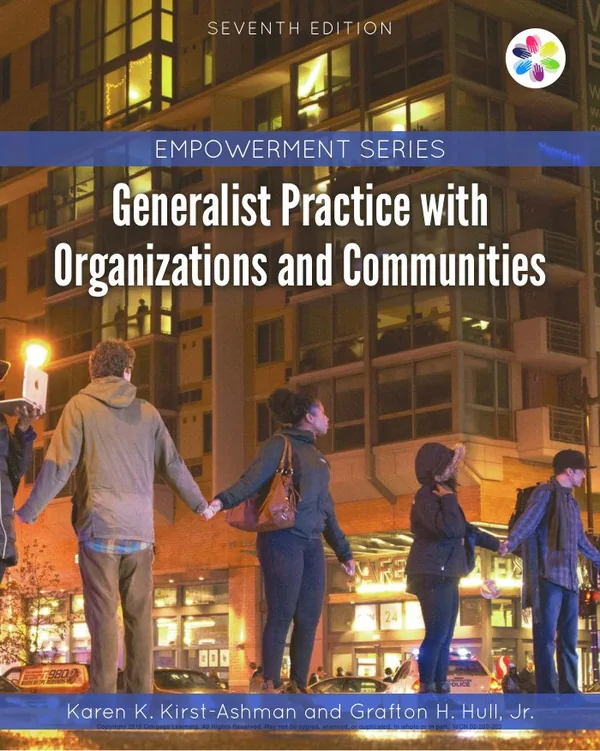
Empowerment Series: Generalist Practice with Organizations and Communities, 7th Edition
By Karen K. Kirst-Ashman, Grafton H. Hull, Jr.
About this ebook
Generalist Practice with Organizations and Communities, 7th Edition, introduces macro social work through systems theory and an empowerment framework. Karen K. Kirst-Ashman and Grafton H. Hull, Jr. connect community assessment, organizational change, advocacy, and program development with ethics, collaboration, and evaluation for social work students and practitioners.
Inside this title
Empowerment and systems theory guide macro practice
Current listed price $27.99Regular price $71.00Digital ebook
Organizations and communities are the focus of this macro practice text in the Empowerment Series. Readers examine how systems theory and empowerment inform assessment, planning, intervention, and evaluation beyond individual client work. Case examples and critical thinking exercises place those ideas in organizational and community situations.
The practical scope includes needs assessment, coalition building, policy advocacy, program design, and the evaluation of services. Grant writing, budgeting, fundraising, and managing organizational change address the resources and relationships that sustain a program. Ethical questions run through decisions about participation, priorities, and resource allocation. The seventh edition supports social work courses and practitioners developing a foundation for work with larger social systems.
Study guide included
Inside Empowerment Series: Generalist Practice with Organizations and Communities, 7th Edition.
A macro social work study guide built on systems theory and empowerment, guiding readers through community assessment, coalition building, advocacy, program design, funding, and evaluation, with sustained attention to ethical decisions and the organisational change that keeps services running well.
Organisations and communities are the subject of this macro practice text. Readers examine how systems theory and empowerment inform assessment, planning, intervention, and evaluation beyond individual client work, with cases and critical-thinking exercises placing ideas in organisational and community situations. Practical scope includes needs assessment, coalition building, policy advocacy, program design, and evaluation of services. Grant writing, budgeting, fundraising, and managing organisational change address the resources and relationships that sustain a program. Ethical questions run through decisions about participation, priorities, and resource allocation. The seventh edition supports social work courses and practitioners building a foundation for work with larger social systems.
Systems theory in macro practice
Systems theory gives macro practice a way to see organisations and communities as sets of interacting parts. The guide uses it to frame assessment: what surrounds a problem, which parts affect which, and where an intervention might enter. The perspective discourages treating a difficulty as isolated and encourages attention to relationships among services, groups, and institutions.
Map the parts that interact around a problem
Identify a viable point of entry
Look at relationships among institutions
Use as the analytical frame before any assessment or planning task.
Empowerment, participation, and voice
Empowerment places the people affected at the centre of change. The guide treats participation as more than consultation: clients and community members help define the problem, set priorities, and shape the response. The practitioner's role becomes facilitating capacity rather than delivering a solution, with attention to who is included and whose voice carries weight.
Let participants define the problem
Facilitate capacity rather than delivering solutions
Examine who is included and heard
Read before the assessment and coalition sections, which apply the principle.
Community needs and strengths assessment
Assessment begins by establishing what a community experiences and what resources it already holds. The guide covers methods for gathering information, involving residents, and interpreting findings, with the aim of turning a broad concern into priorities that can be acted on. Needs and strengths are considered together, so the picture is not only a list of deficits.
Gather information with residents involved
Turn concern into actionable priorities
Record strengths alongside needs
Read with a real community in mind; the exercises depend on concrete detail.
Coalition building and collaboration
Coalition building brings organisations and groups together around a shared purpose. The guide examines how collaboration is formed, sustained, and kept productive when partners have different interests and capacities. Attention goes to roles, communication, and the agreements that let a coalition act, since coordination is treated as work in its own right.
Define roles and shared agreements
Sustain communication across partners
Manage differing interests and capacities
Read after needs assessment, when the purpose of collaboration is clear.
Advocacy and policy change
Advocacy carries community concerns into decisions made elsewhere. The guide connects direct practice with efforts to influence policy, institutions, and resource allocation, and it considers the ethical questions raised when a practitioner speaks for or with a group. Strategy is discussed in terms of targets, timing, and the evidence needed to make a case.
Identify the decision to influence
Gather evidence that supports the case
Weigh speaking for versus with a group
Read alongside the ethics material; advocacy raises representation questions.
Program planning, funding, evaluation
A program turns intent into organised activity. The guide covers design, implementation, and evaluation, together with the resources that sustain them: grant writing, budgeting, and fundraising. Organisational change is included because a program rarely survives without adapting the structure around it. Evaluation closes the loop by asking whether the service did what it intended.
Design a program around assessed priorities
Budget and fund the work realistically
Evaluate whether the service delivered
Read as a sequence: design, resources, organisational change, then evaluation.
Topic map
Systems theory in macro practiceTopic 1
Empowerment and participationTopic 2
Community needs assessmentTopic 3
Coalition building and collaborationTopic 4
Policy advocacyTopic 5
Program design and implementationTopic 6
Grant writing, budgeting, fundraisingTopic 7
Evaluation and organizational changeTopic 8
Key takeaways
Systems theory reframes a problem as a pattern of relationships rather than a single defect.
Empowerment changes the practitioner's role from delivering ready-made solutions to building community capacity.
A program needs funding, organisational adaptation, and evaluation if it is to last.
Social work students taking macro practice courses and practitioners moving beyond individual client work into organisations, communities, advocacy, and program management, including readers preparing for community-level roles.
Topics covered
macro social work
community assessment
coalition building
policy advocacy
program evaluation
organizational change
grant writing
empowerment practice
Questions about this ebook.
Edition, audience, and study-guide details at a glance.
What is Empowerment Series: Generalist Practice with Organizations and Communities, 7th Edition about?
Generalist Practice with Organizations and Communities, 7th Edition, introduces macro social work through systems theory and an empowerment framework. Karen K. Kirst-Ashman and Grafton H. Hull, Jr. connect community assessment, organizational change, advocacy, and program development with ethics, collaboration, and evaluation for social work students and practitioners.
Which edition of Empowerment Series: Generalist Practice with Organizations and Communities, 7th Edition is this?
This listing is for the 7th edition. Check the title, ISBN, and book details above before ordering, especially if your course or reading list names a specific edition.
Who is Empowerment Series: Generalist Practice with Organizations and Communities, 7th Edition for?
Social work students taking macro practice courses and practitioners moving beyond individual client work into organisations, communities, advocacy, and program management, including readers preparing for community-level roles.
Does this page include a study guide?
Yes. This page includes an original study guide with six thematic sections, key takeaways, and a topic map for structured reading.