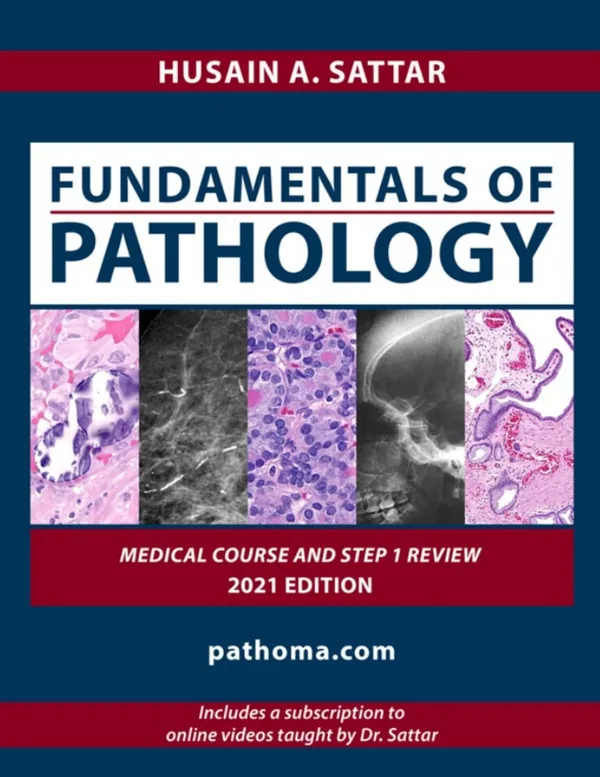
Fundamentals of Pathology, 2021 Edition, presents disease mechanisms in a concise review format for medical students. Husain A. Sattar organizes pathology around causes, development, tissue changes, and clinical significance. Bullet-point explanations, tables, and diagrams cover cellular injury, inflammation, neoplasia, circulatory disturbances, and other foundational topics.
Inside this title
Cell injury, apoptosis, necrosis, inflammation, and tissue repair
Current listed price $26.00Regular price $62.00Digital ebook
Cellular responses to injury establish the starting point for this pathology review. Adaptation, apoptosis, necrosis, inflammation, and repair lead into the mechanisms underlying tumors and disturbances of circulation. The discussion relates causes and disease processes to morphological changes and their clinical significance.
Additional subjects include immune dysfunction, genetic and pediatric disorders, environmental and nutritional injury, and mechanisms of infection. Concise entries and visual summaries make the material suitable for revisiting concepts alongside a medical pathology course. The 2021 edition offers a defined snapshot of the material from that period, with an emphasis on organizing disease mechanisms rather than extended narrative discussion.
Study guide included
Inside Fundamentals of Pathology, 2021 Edition.
Sattar turns pathology into a compact revision map of disease: what starts the process, how cells and tissues react, and why the resulting changes matter at the bedside. Bulleted explanations, tables, and diagrams let medical students revisit mechanisms quickly while following a standard pathology course.
The book is organized so that each topic runs from cause to tissue change to clinical consequence. It opens with how cells adapt to stress and the routes by which injury becomes irreversible, then examines inflammation and the repair that follows. A large section on neoplasia covers tumor classification, carcinogenesis, grading, and staging. Circulatory problems, immune dysfunction, genetic and pediatric conditions, and environmental or nutritional damage extend the survey, while mechanisms of infection close the arc. Entries stay brief and visual, making the edition suited to review rather than long narrative reading. Because it reflects 2021, it offers a fixed snapshot of the field at that point.
Cell injury and adaptation
Cells answer stress with reversible adjustments such as hypertrophy, hyperplasia, atrophy, or metaplasia, and only later commit to death. The text separates apoptosis, a controlled removal, from necrosis, an uncontrolled breakdown that provokes surrounding inflammation. Readers are asked to link each outcome to the damaging agent and the cell type involved.
Distinguish reversible adaptation from cell death
Contrast apoptotic and necrotic pathways
Connect injury type to affected tissue
Topic 1
Inflammation and tissue repair
Acute inflammation brings blood flow, vessel permeability, and leukocyte recruitment into a coordinated response, while chronic inflammation shows a different cellular mix and duration. Repair can restore architecture or leave a scar, depending on tissue type and the extent of damage. The material ties mediators and cell populations to visible signs and healing outcomes.
Relate mediators to the signs of inflammation
Separate acute from chronic patterns
Explain when repair leaves a scar
Topic 2
Neoplasia and tumor behavior
Tumors are described by cell of origin, behavior, and degree of differentiation, with benign and malignant growths separated on structural and clinical grounds. Carcinogenesis is presented as a multistep accumulation of genetic and environmental insults, and grading and staging are introduced as distinct summaries of a tumor. Morphology stays tied to prognosis and management.
Classify tumors by origin and behavior
Treat carcinogenesis as multistep
Keep grading distinct from staging
Topic 3
Circulatory disturbances
Edema, hemorrhage, thrombosis, embolism, infarction, and shock each disrupt normal blood movement in a different way. The text traces how vessel injury, flow, and clotting interact, then explains how the resulting ischemia damages tissue. Emphasis falls on relating the mechanism to the organ and to the pattern of injury seen.
Link vessel injury to clot formation
Trace ischemia to tissue damage
Match mechanism to organ pattern
Topic 4
Immune and genetic disorders
Immune dysfunction includes hypersensitivity reactions, autoimmunity, and immunodeficiency, each with a different failure of recognition or control. Genetic disease is approached through patterns of inheritance and the kinds of mutation that alter protein function. The pairing shows how inherited and acquired defects can converge on similar tissue damage.
Separate hypersensitivity from immunodeficiency
Read inheritance patterns for clues
Connect mutation to protein dysfunction
Topic 5
Environmental, nutritional, and infectious injury
External agents, physical, chemical, and nutritional, cause injury through identifiable routes, and deficiency or excess of nutrients leaves recognizable tissue patterns. Infectious disease is treated through the mechanisms by which organisms colonize, evade defenses, and damage host tissue. These closing themes connect agent and host response rather than listing diseases alone.
Identify the route of external injury
Recognize nutritional deficiency patterns
Explain how organisms damage host tissue
Topics 6–7
Topic map
Cell Injury and Cellular AdaptationTopic 1
Inflammation and Tissue RepairTopic 2
Neoplasia and CarcinogenesisTopic 3
Circulatory and Hemodynamic DisturbancesTopic 4
Immune and Genetic DisordersTopic 5
Environmental and Nutritional InjuryTopic 6
Mechanisms of InfectionTopic 7
Key takeaways
Read every disease as a chain from cause through tissue change to clinical effect.
Use morphology to connect mechanisms with what is seen under the microscope.
Treat grading and staging as complementary summaries rather than substitutes.
Medical students preparing for pathology coursework and examinations, plus trainees who want a concise, mechanism-focused reference for revision.
Topics covered
pathology review
cell injury
inflammation
neoplasia
circulatory disorders
immune dysfunction
medical student pathology
disease mechanisms
Questions about this ebook.
Edition, audience, and study-guide details at a glance.
What is Fundamentals of Pathology, 2021 Edition about?
Fundamentals of Pathology, 2021 Edition, presents disease mechanisms in a concise review format for medical students. Husain A. Sattar organizes pathology around causes, development, tissue changes, and clinical significance. Bullet-point explanations, tables, and diagrams cover cellular injury, inflammation, neoplasia, circulatory disturbances, and other foundational topics.
Who is Fundamentals of Pathology, 2021 Edition for?
Medical students preparing for pathology coursework and examinations, plus trainees who want a concise, mechanism-focused reference for revision.
Does this page include a study guide?
Yes. This page includes an original study guide with six thematic sections, key takeaways, and a topic map for structured reading.