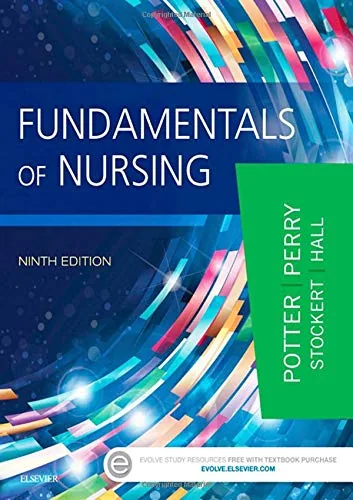
Potter and colleagues' Fundamentals of Nursing, 9th Edition introduces the knowledge, reasoning, and practical skills taught in prelicensure nursing programs. It organizes assessment, patient care, communication, safety, and ethical responsibilities around the nursing process, supported by case studies and exercises for connecting concepts with clinical situations.
Inside this title
Nursing process connects assessment, planning, care, and evaluation
Current listed price $36.99Regular price $109.00Digital ebook
Assessment, diagnosis, planning, implementation, and evaluation provide the framework for this nursing fundamentals text. The coverage moves from introductory professional concepts into patient assessment and practical care, including vital signs, hygiene, mobility, wound care, infection prevention, and medication administration. Health promotion and patient education are considered alongside the skills themselves.
Case studies and critical thinking exercises ask students to connect information with nursing judgments. Communication, cultural considerations, confidentiality, informed consent, delegation, and teamwork broaden the account beyond procedures. The ninth edition serves associate, baccalaureate, and diploma nursing learners studying how foundational concepts and responsibilities come together in the care of individual patients.
Study guide included
Inside Fundamentals of Nursing, 9th Edition.
Professional responsibility meets the nursing process in this ninth edition. Nurses learn to combine evidence, clinical observation, and patient priorities when planning care, then to check whether the care actually met its aims, with survivorship and family context woven in. Cases make the reasoning visible.
Seven units run from the profession and its care settings through development and family life, critical thinking, professional standards, safety, psychosocial care, and physiological needs. Cancer survivorship receives its own chapter, and clinical application questions tie material to decisions. The emphasis on assessment, implementation, and evaluation gives readers a way to connect patient experience with observable outcomes. Units build on one another rather than standing alone. Each chapter ends with review that asks for explanation, not recall. Instructors can sequence the units flexibly.
Professional practice and evidence
Nursing practice shifts across hospitals, community settings, and homes because duties, resources, and follow-up opportunities differ, and one episode may cross several. Nurses provide direct care, education, advocacy, coordination, and evaluation. Evidence-based practice starts with a focused question, then appraises research while weighing clinical expertise, patient preference, and whether a change actually worked.
Know where care continues after transfer
Turn uncertainty into a focused question
Judge research against the local context
Unit I · Ch. 1–5
Caring through life transitions
A health history reveals what a patient hopes to keep or regain, from daily activities to family involvement. Developmental stages frame questions, but individual ability and preference still steer the encounter. Cultural awareness begins by examining assumptions and asking how beliefs, language, support, and past care shape decisions. Survivorship is treated as its own concern, with lingering symptoms and uncertainty.
Learn how each person defines wellness
Recognize the work of survivorship
Let the family explain routine changes when invited
Unit II · Ch. 6–14
Reasoning and the nursing process
Assessment draws on the patient's account, observation, examination, and existing records, and a nurse rechecks findings that conflict or arose under changing conditions. Grouping related clues identifies a patient response fit for the nursing plan, which differs from a medical diagnosis. Planning attaches a goal others can understand, and evaluation compares the response with that goal.
Organize and validate the findings
Use outcomes to direct care
Evaluate what changed for the patient
Unit III · Ch. 15–21
Ethics, communication, and teaching
Ethics and legal duties shape everyday choices about privacy, consent, and disclosure, and patients need room to question and object. When family involvement is agreed, clarify what relatives should know and what the patient keeps private. A record separates observations, patient reports, decisions, and pending follow-up. Teaching runs as a process with assessment and evaluation, closing the loop via teach-back.
Make decisions understandable to patients
Distinguish observation, report, and decision
Close the teaching loop with the patient's own words
Unit IV · Ch. 22–26
Safety, assessment, psychosocial care
Safety and quality connect with infection prevention, mobility, vital signs, physical assessment, and medication administration. Compare new observations with baseline and circumstances, since an odd reading may reflect measurement conditions. Stress, loss, spiritual concerns, sexuality, and self-concept shape how a patient meets illness. A quiet patient may be tired, worried, grieving, or processing information.
Look for patterns and prevent errors
Interpret measurements with their conditions
Include psychosocial concerns in assessment
Units V–VI · Ch. 27–38
Physiological needs and recovery
Activity, hygiene, oxygenation, fluid balance, sleep, pain, nutrition, elimination, skin, sensory change, and surgical care overlap in practice. Limited mobility affects hygiene, sleep, and skin; pain changes appetite and willingness to participate. Care shifts as a person prepares for a procedure, returns, and resumes routines, and a good transition record names function, support, teaching done, and open questions.
Connect findings across systems
Follow recovery across transitions
Record progress and remaining need separately
Unit VII · Ch. 39–50
Chapter and section map
Nursing and the Health Care EnvironmentUnit I
Caring Throughout the Life SpanUnit II
Caring for the Cancer SurvivorCh. 8
Critical Thinking in Nursing PracticeUnit III
Professional Standards in Nursing PracticeUnit IV
Foundations for Nursing PracticeUnit V
Psychosocial Basis for Nursing PracticeUnit VI
Physiological Basis for Nursing PracticeUnit VII
Key takeaways
Use the patient's account, observed findings, and prior records together when validating an assessment.
Specify activity, level of help, and timing when writing a functional goal.
Evaluate what changed for the patient before marking a nursing priority resolved.
Prelicensure nursing students in fundamentals courses, plus instructors who build case-based lessons. Also useful for new graduates wanting a structured review of the nursing process.
Topics covered
fundamentals of nursing
nursing process
patient assessment
clinical reasoning
patient safety
patient education
psychosocial care
evidence-based practice
Other editions of this title.
Compare editions, prices, and book details before you choose.
Edition, audience, and study-guide details at a glance.
What is Fundamentals of Nursing, 9th Edition about?
Potter and colleagues' Fundamentals of Nursing, 9th Edition introduces the knowledge, reasoning, and practical skills taught in prelicensure nursing programs. It organizes assessment, patient care, communication, safety, and ethical responsibilities around the nursing process, supported by case studies and exercises for connecting concepts with clinical situations.
Which edition of Fundamentals of Nursing, 9th Edition is this?
This listing is for the 9th edition. Check the title, ISBN, and book details above before ordering, especially if your course or reading list names a specific edition.
Who is Fundamentals of Nursing, 9th Edition for?
Prelicensure nursing students in fundamentals courses, plus instructors who build case-based lessons. Also useful for new graduates wanting a structured review of the nursing process.
Does this page include a study guide?
Yes. This page includes an original study guide with six thematic sections, key takeaways, and a chapter and section map for structured reading.