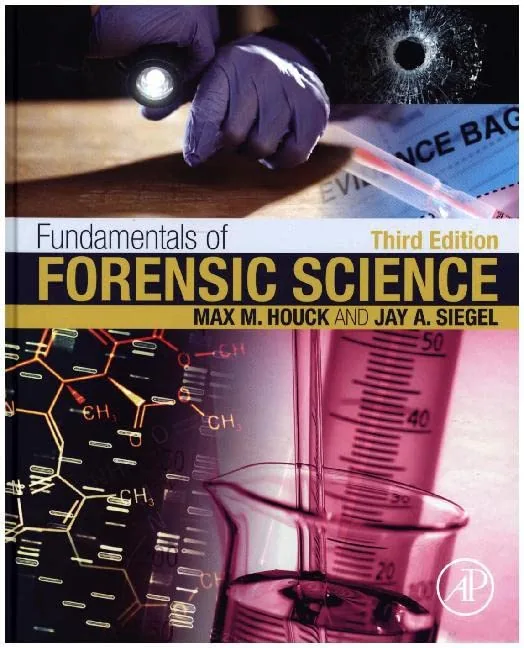
Fundamentals of Forensic Science, 3rd Edition follows evidence from crime scene assessment to laboratory examination and courtroom presentation. Houck and Siegel introduce forensic biology, chemistry, pattern evidence, and investigative methods for forensic science and criminal justice students, with case studies connecting scientific principles to legal contexts.
Inside this title
Crime scene documentation, evidence collection, and laboratory analysis
Current listed price $26.00Regular price $63.00Digital ebook
The investigative sequence gives this text its organizing framework: document the scene, collect evidence, analyze material, and communicate findings. Coverage includes latent fingerprints, DNA profiling, toxicology, firearms and toolmarks, and digital evidence. Scientific methods are considered alongside the responsibilities involved in handling and interpreting evidence.
Case studies and practical examples illustrate how different forensic disciplines contribute to an investigation. The legal discussion addresses expert testimony, admissibility, and professional objectivity, placing laboratory work within the judicial process. Students in forensic science and criminal justice can use the book as an introduction across specialties, while investigators and legal readers can consult it for background on unfamiliar evidence types.
Study guide included
Inside Fundamentals of Forensic Science, 3rd Edition.
Forensic science turns physical traces into answers about past events. Houck and Siegel trace that inference from crime scene to courtroom, showing how sample integrity, validated methods, and candid interpretation decide what a piece of evidence can actually support. Cases keep the reasoning grounded.
The book opens with laboratory organization, crime scenes, and the nature of evidence before introducing microscopy, spectroscopy, and separation methods. It then covers biological findings, chemical traces, physical comparisons, and digital artifacts. Cases woven through the chapters give methods investigative purpose. Closing chapters ask how legal and ethical duties shape reporting, testimony, and laboratory conduct when a finding's significance stays uncertain. Throughout, the reader is asked to match a technique to the question it can answer. That discipline carries into testimony.
From scene to laboratory
Processing a scene changes the conditions investigators meet. Photographs, sketches, and contemporaneous notes preserve how objects related before collection disturbed them, and records should capture where an item lay, its condition, and who handled it. Locard's exchange principle points to material moved during contact, while chain-of-custody documents what happened later.
Preserve relationships before collection
Record location, condition, and handler
Keep transfer explanations apart from custody records
Chapters 1–3
Choosing an analytical method
Microscopy shows particle form, layering, or optical behavior; spectroscopy measures interactions with radiation to characterize composition; separation resolves mixture components for individual examination. The same specimen answers different questions depending on which property is measured and how much survives. A defensible workflow uses suitable references, performance checks, and procedures matched to the sample.
Match the method to the question
Protect enough material for review
Use references and instrument checks
Chapters 4–6
Biology and event reconstruction
Pathology examines injury and death, while anthropology, odontology, and entomology draw on other biological evidence whose value depends on recovery and conditions such as decomposition and environment. A DNA profile supports an inference about who contributed material, and quality plus multiple contributors shape that reading. Bloodstain patterns address deposition and movement as a separate question.
Read biological findings in context
Keep identity and activity questions apart
Distinguish profile probability from commission of an act
Chapters 7–12
Chemical traces and toxicology
Drug analysis identifies submitted material; toxicology considers substances in biological specimens and the circumstances that shape interpretation, including specimen type, concentration, and timing. Detection answers a narrower question than whether a compound caused impairment, injury, or death. Fibers, paint, soil, and glass may support associations through shared properties, though common materials resemble one another widely.
Move from detection to significance
Compare trace features deliberately
Report the scope of a comparison
Chapters 13–18
Pattern and digital evidence
Friction ridges, tool marks, footwear impressions, and questioned documents involve features of varying quality. Some similarities reflect a broad class like a tread design; others discriminating detail, provided the mark records it clearly. Distortion, partial impressions, and examiner judgment limit conclusions. Digital examination uses working copies, and time values depend on device settings and synchronization.
Separate class features from discriminating ones
State how distortion and partial marks limit weight
Preserve originals and record digital context
Chapters 19–23
Reporting and professional duty
A report identifies the submitted material and explains what was done, observed, and how results bear on a question, in language a non-specialist can follow. Validation, documented procedures, independent review, and proficiency checks expose error, and the authors examine how contextual information can sway judgment. Ethical practice includes correcting mistakes and making limits visible.
Show the route from item to opinion
Guard judgment from irrelevant context
Make limitations visible to those who rely on the work
Chapters 24–25
Chapter and section map
Crime Scene Investigation and The Nature of EvidenceCh. 2–3
Microscopy, Light and Matter, and Separation MethodsCh. 4–6
Serology, Bloodstain Pattern Analysis, and DNA AnalysisCh. 10–11
Illicit Drugs and Forensic ToxicologyCh. 13–14
Paint Analysis and Soil and GlassCh. 16–17
Friction Ridges, Documents, Firearms, and ImpressionsCh. 19–22
Digital EvidenceCh. 23
Legal, Ethical, and Professional IssuesCh. 24–25
Key takeaways
Preserve where, how, and by whom each item was collected before selecting a test.
Say whether a result addresses material identity, a possible source, or an activity.
Document the comparison features, alternatives, and limits that determine a conclusion's weight.
Forensic science and criminal justice students, plus investigators and laboratory staff who need a broad introduction. Case studies make it useful for readers preparing for courtroom-facing work.
Topics covered
forensic science
crime scene investigation
trace evidence
DNA analysis
forensic toxicology
fingerprint comparison
digital evidence
expert testimony
Questions about this ebook.
Edition, audience, and study-guide details at a glance.
What is Fundamentals of Forensic Science, 3rd Edition about?
Fundamentals of Forensic Science, 3rd Edition follows evidence from crime scene assessment to laboratory examination and courtroom presentation. Houck and Siegel introduce forensic biology, chemistry, pattern evidence, and investigative methods for forensic science and criminal justice students, with case studies connecting scientific principles to legal contexts.
Which edition of Fundamentals of Forensic Science, 3rd Edition is this?
This listing is for the 3rd edition. Check the title, ISBN, and book details above before ordering, especially if your course or reading list names a specific edition.
Who is Fundamentals of Forensic Science, 3rd Edition for?
Forensic science and criminal justice students, plus investigators and laboratory staff who need a broad introduction. Case studies make it useful for readers preparing for courtroom-facing work.
Does this page include a study guide?
Yes. This page includes an original study guide with six thematic sections, key takeaways, and a chapter and section map for structured reading.