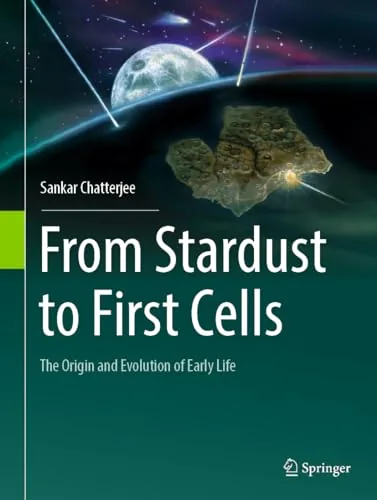
Cover of From Stardust to First Cells: The Origin and Evolution of Early Life

From Stardust to First Cells: The Origin and Evolution of Early Life

By Sankar Chatterjee

About this ebook

From Stardust to First Cells examines the emergence of life through connections among astronomy, geology, and biochemistry. Sankar Chatterjee presents an origin-of-life hypothesis linking cosmic materials, early Earth environments, and cellular organization, addressing advanced students and researchers interested in prebiotic chemistry, protocells, early evolution, and the search for life beyond Earth.

Inside this title
  • Cosmic materials and early Earth conditions in origin-of-life research
Current listed price $38.99Regular price $129.00Digital ebook
Buy now

Digital ebook. Checkout sends an order request.

Format
Digital ebook
ISBN
9783031233975
Last updated
2026-11-03

What this book covers.

Chatterjee connects the history of life's chemical ingredients with the formation of planets and the environmental conditions of the young Earth. The narrative follows a proposed progression from nonliving chemistry toward cellular organization, treating cosmic, geological, and biological processes as parts of an interconnected explanation.

Discussions include organic molecules, prebiotic reactions, RNA-based scenarios, membranes, metabolism, and the development of protocells. Diagrams, maps, and conceptual models accompany the interdisciplinary argument. The book also considers early geological time and implications for astrobiology. Advanced students and researchers in earth and life sciences can engage with the author's hypothesis while comparing the different kinds of evidence used to investigate life's origins.

Study guide included

Inside From Stardust to First Cells: The Origin and Evolution of Early Life.

Chatterjee builds an origin-of-life argument that spans astronomy, geology and biochemistry. Cosmic materials, the chemistry of the young Earth and the path toward organized cells are joined into a single proposed progression, written for advanced students and researchers weighing the evidence.

The book treats the emergence of life as an interdisciplinary problem rather than a purely biological one. It follows the chemical ingredients of life back to their cosmic and planetary sources, then examines the conditions of the early Earth that allowed those ingredients to react. From there the argument moves toward organization: organic molecules, prebiotic reactions, RNA-based scenarios, membranes, metabolism and protocells. Diagrams, maps and conceptual models carry much of the reasoning. Chatterjee presents a particular hypothesis, so the reader is asked to follow a proposal and compare the evidence behind it. The close turns to early geological time and the search for life beyond Earth. Readers in earth and life sciences can follow the whole chain in one place.

Cosmic origins of life's ingredients

The account begins far from Earth, tracing the chemical raw materials of life to their astronomical sources. This move frames biology as continuous with planetary and cosmic history. The reader is invited to see the ingredients of life as having a history before life existed.

  • Life's ingredients have cosmic sources
  • Astronomy and biology are treated as connected
  • Chemistry predates biology in the narrative
Topic 1

Early Earth as a chemical setting

The young Earth is described as an environment where the ingredients could interact. Geological conditions matter because they constrain which reactions are possible. The book connects planetary history to the chemistry that follows.

  • Environmental conditions enable or limit reactions
  • Geology sets the stage for prebiotic chemistry
  • Planetary history is part of the explanation
Topic 2

Prebiotic chemistry and RNA scenarios

Prebiotic reactions are examined as pathways from simple molecules toward more organized chemistry. RNA-based scenarios receive particular attention as one route toward self-replicating systems. The text presents these as hypotheses under discussion rather than settled facts.

  • Prebiotic reactions build complexity step by step
  • RNA scenarios offer a route to replication
  • Competing scenarios are part of the inquiry
Topics 3–4

Membranes, metabolism and protocells

Organization requires boundaries and energy as well as information. Membranes and metabolism are discussed as conditions for early cells, and protocells are presented as a conceptual step toward cellular life. The argument links chemistry to the emergence of a bounded, active entity.

  • Membranes create boundaries around chemistry
  • Metabolism supplies energy and transformation
  • Protocells model an early step toward cells
Topic 5

Models, maps and the evidence

The book relies on diagrams, maps and conceptual models to carry its argument. These are treated as tools for reasoning about a process no one observed directly. The reader is asked to notice what kind of evidence supports each part of the progression.

  • Diagrams and maps organize the argument
  • Models substitute for direct observation
  • Different stages rest on different evidence
Topic 6

Implications for astrobiology

The closing material turns the origin-of-life account outward, toward the search for life elsewhere. If life arose from ordinary cosmic and planetary chemistry, the same conditions become relevant beyond Earth. The book ends by connecting its hypothesis to that broader question.

  • Origin scenarios inform the search for life
  • Cosmic chemistry broadens the relevant conditions
  • Astrobiology extends the book's reasoning
Topic 7

Topic map

  • Life's Chemical Ingredients in SpaceTopic 1
  • The Young Earth as a Setting for ChemistryTopic 2
  • Prebiotic ReactionsTopic 3
  • RNA-Based ScenariosTopic 4
  • Membranes, Metabolism and ProtocellsTopic 5
  • Models, Maps and the EvidenceTopic 6
  • Early Life and the Search Beyond EarthTopic 7

Key takeaways

  • Read the cosmic and geological chapters before the biological ones; the argument is cumulative.
  • Treat the progression as a proposed hypothesis and note the evidence behind each stage.
  • Watch how the same chemistry that explains early life also frames the search for life elsewhere.

Advanced students and researchers in earth and life sciences, readers interested in prebiotic chemistry and astrobiology, and anyone who wants an interdisciplinary account of how life may have begun.

Topics covered

  • origin of life
  • prebiotic chemistry
  • early Earth
  • protocells
  • RNA world scenarios
  • astrobiology
  • cosmic materials
  • Sankar Chatterjee

Questions about this ebook.

Edition, audience, and study-guide details at a glance.

What is From Stardust to First Cells: The Origin and Evolution of Early Life about?

From Stardust to First Cells examines the emergence of life through connections among astronomy, geology, and biochemistry. Sankar Chatterjee presents an origin-of-life hypothesis linking cosmic materials, early Earth environments, and cellular organization, addressing advanced students and researchers interested in prebiotic chemistry, protocells, early evolution, and the search for life beyond Earth.

Who is From Stardust to First Cells: The Origin and Evolution of Early Life for?

Advanced students and researchers in earth and life sciences, readers interested in prebiotic chemistry and astrobiology, and anyone who wants an interdisciplinary account of how life may have begun.

Does this page include a study guide?

Yes. This page includes an original study guide with six thematic sections, key takeaways, and a topic map for structured reading.

Enter your name and email to open a WhatsApp message with your details.