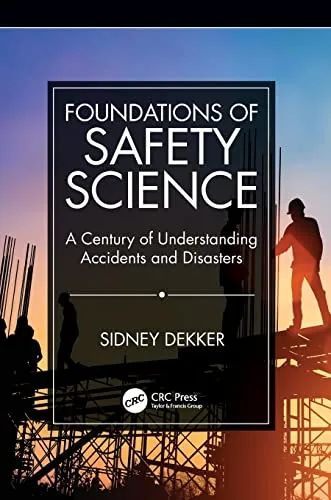
Foundations of Safety Science: A Century of Understanding Accidents and Disasters
By Sidney Dekker
About this ebook
Foundations of Safety Science traces the theories used to explain accidents and disasters over a century of research. Sidney Dekker examines how approaches developed, diverged, and influenced one another, giving safety professionals, students, and researchers a historical framework for comparing ideas about human error, systemic failure, complexity, and resilience.
Inside this title
Historical development of theories explaining accidents and disasters
Current listed price $24.00Regular price $50.00Digital ebook
Explanations of accidents carry assumptions about what counts as a cause and where prevention should focus. Dekker examines those assumptions through the intellectual history of safety science, showing how different theories emerged and how apparently competing approaches share parts of their foundations.
The discussion follows changes from linear causal accounts and individual error toward systemic explanations, complexity, and resilience engineering. It asks why the same event can prompt different interpretations and interventions depending on the model being used. Safety practitioners, incident investigators, and researchers can use the book to understand the origins of professional concepts and to examine the relationship between an explanation of failure and a proposed response.
Study guide included
Inside Foundations of Safety Science: A Century of Understanding Accidents and Disasters.
Dekker reads a century of accident theory as an argument about where causes live and where prevention should aim. Linear models, human error, systemic failure, complexity and resilience are set beside one another so safety professionals can see how each tradition grew, borrowed and diverged.
The book begins from an observation: every account of an accident carries assumptions about what counts as a cause. Dekker follows those assumptions through the intellectual history of safety science, tracing how explanations moved from linear chains and individual error toward systemic, complex and resilience-oriented views. The aim is not to crown a winner but to show that apparently rival models often share foundations and can interpret the same event in different ways. Because an explanation implies a remedy, the choice of model shapes what an investigation looks for and what an organization then changes. Practitioners, investigators and researchers can use the history to place their own assumptions and to see why disagreements about prevention are often disagreements about causes.
Causes and their hidden assumptions
Dekker starts by showing that a cause is not simply discovered; it is framed by a model of how accidents happen. Different traditions define causation in different terms, and those definitions rule some explanations in and others out. The reader is asked to notice the assumptions beneath the question of what went wrong.
A cause is framed by a model, not merely found
Definitions of causation exclude some explanations
Assumptions sit beneath every accident account
Topic 1
Linear models and the search for chains
One early tradition treats failure as a sequence of linked events that can be traced back to an origin. This chain image makes investigation a matter of following links and prevention a matter of breaking them. The book presents it as a foundation that later approaches both build on and react against.
Failure is pictured as a chain of events
Investigation follows the chain toward an origin
Prevention means breaking a link in the sequence
Topics 1–2
Human error as explanation and label
The idea of human error occupies a central place in the history. Dekker examines how it functions both as an explanation and as a label that can stop inquiry. The discussion shows why attributing an accident to error is often the beginning of a question rather than its answer.
Error can explain an outcome or end the search
Labelling an act as error hides prior conditions
The concept has shifted across the century
Topic 3
Systemic failure and complexity
Later approaches relocate cause from individuals to systems and interactions. Complexity enters when failures are understood as emerging from many connected parts rather than a single broken link. The text shows how this shift changes what counts as evidence and where remedies are placed.
Cause moves from persons to systems
Complexity makes failure emergent rather than singular
Remedies shift toward organizational conditions
Topics 4–5
Resilience and adaptation
Resilience engineering is presented as an outlook that asks how systems succeed under strain, not only why they fail. It treats adaptation and everyday performance as the source of both safety and risk. The book places it within the longer history rather than outside it.
Success is studied alongside failure
Adaptation creates both safety and vulnerability
Resilience is a lens with its own lineage
Topic 6
From explanation to intervention
The final thread connects how an accident is explained to what an organization then does about it. Because each model implies a different remedy, choosing a model is a practical decision with consequences. The history therefore doubles as a guide to thinking about prevention.
Each explanation implies a specific remedy
Model choice has practical consequences
History informs present prevention decisions
Topics 6–7
Topic map
What Counts as a CauseTopic 1
Linear Causal ModelsTopic 2
Human Error in Safety ThinkingTopic 3
Systemic and Organizational ExplanationsTopic 4
Complexity in Accident TheoryTopic 5
Resilience EngineeringTopic 6
Linking Explanation to PreventionTopic 7
Key takeaways
Treat every accident explanation as carrying assumptions about causation.
Notice when human error is doing explanatory work and when it is only a label.
Ask what remedy a model implies before adopting it for an investigation.
Safety practitioners, incident investigators, graduate students and researchers who want a historical framework for comparing theories of human error, systemic failure, complexity and resilience.
Topics covered
safety science
accident theory history
human error
systemic failure
complexity
resilience engineering
incident investigation
Sidney Dekker
Questions about this ebook.
Edition, audience, and study-guide details at a glance.
What is Foundations of Safety Science: A Century of Understanding Accidents and Disasters about?
Foundations of Safety Science traces the theories used to explain accidents and disasters over a century of research. Sidney Dekker examines how approaches developed, diverged, and influenced one another, giving safety professionals, students, and researchers a historical framework for comparing ideas about human error, systemic failure, complexity, and resilience.
Who is Foundations of Safety Science: A Century of Understanding Accidents and Disasters for?
Safety practitioners, incident investigators, graduate students and researchers who want a historical framework for comparing theories of human error, systemic failure, complexity and resilience.
Does this page include a study guide?
Yes. This page includes an original study guide with six thematic sections, key takeaways, and a topic map for structured reading.