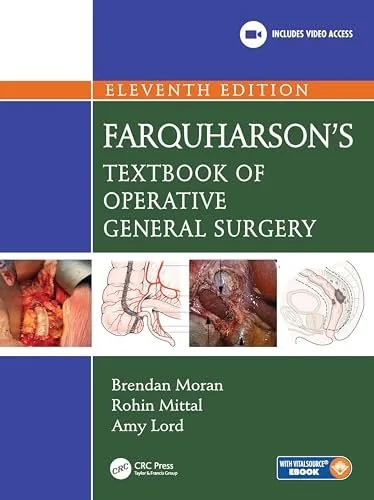
Farquharson's Textbook of Operative General Surgery, 11th Edition
By Brendan Moran, Rohin Mittal, Amy Lord
About this ebook
Farquharson's Textbook of Operative General Surgery, 11th Edition, explains operative anatomy, surgical techniques, and perioperative care for general surgery trainees. Illustrated procedural discussions connect basic skills with emergency operations and specialist areas, including colorectal, hepatobiliary, endocrine, and minimally invasive surgery.
Inside this title
Illustrated operative anatomy across major surgical regions
Current listed price $40.99Regular price $91.00Digital ebook
The eleventh edition follows the operative work of a general surgeon from instruments, suturing, and wound care to procedures involving the abdomen, breast, neck, and other anatomical regions. Its illustrations support explanations of tissue relationships, surgical exposure, and the sequence of an operation.
Emergency surgery and the management of complications sit alongside planned procedures, with attention to choosing an approach and responding to unexpected findings. Chapters on laparoscopic techniques and surgical subspecialties extend the foundation in general surgery. The text suits trainees studying operative principles and surgeons reviewing procedures beyond the narrower focus of their routine practice.
Study guide included
Inside Farquharson's Textbook of Operative General Surgery, 11th Edition.
A structured study companion for surgical trainees working through operative general surgery, from instruments and suturing to emergency abdominal operations and laparoscopic techniques, organised around operative anatomy, procedural sequence, and perioperative decision-making across the breast, abdomen, neck, and related regions.
The eleventh edition follows a general surgeon's operative work in sequence, beginning with instruments, suturing, hemostasis, and wound care before moving to exposure and procedure in the abdomen, breast, and neck. Illustrated discussions emphasise tissue relationships and the order in which an operation unfolds. Emergency procedures and complication management sit beside planned operations, with attention to choosing an approach and responding when findings differ from expectation. Laparoscopic technique and subspecialty chapters on colorectal, hepatobiliary, and endocrine surgery extend the general foundation. Trainees can use it for operative principles; practising surgeons can review procedures outside routine practice.
Operative anatomy as a working map
Each procedure is presented through the tissue relationships a surgeon must recognise before cutting. The guide treats anatomy as a navigational tool: knowing what lies deep, adjacent, or at risk shapes exposure, retraction, and the safe direction of a dissection. Readers should connect surface landmarks to deeper structures rather than memorise steps in isolation.
Relate surface landmarks to deeper structures
Identify structures at risk during exposure
Use anatomy to plan retraction direction
Read the regional anatomy before the procedure it supports, and trace the planned exposure on the illustration.
Instruments, suturing, hemostasis, wound care
The opening material covers the craft that underlies every operation: choosing instruments, handling tissue, achieving hemostasis, closing wounds, and managing the healing wound. Technique is described in terms of what each action does to tissue, so a trainee can understand why a choice is made rather than copying a sequence. These skills recur throughout later procedures.
Select instruments for the task at hand
Control bleeding without unnecessary tissue damage
Close and dress wounds appropriately
Study this foundation first; later procedure sections assume it.
Emergency abdominal operations and decisions
Emergency operations are treated as a distinct decision environment: the diagnosis may be provisional, the patient unstable, and the findings unexpected. The guide emphasises planning an approach that can adapt, controlling contamination, and prioritising what must be done immediately versus what can wait. Planned and emergency versions of similar operations are compared.
Plan an approach that can adapt
Prioritise immediate control of contamination
Compare emergency with planned technique
Read alongside the corresponding elective procedure to see what changes under urgency.
Complications and unexpected findings
Operative plans meet reality when anatomy, pathology, or the patient's condition differs from expectation. This theme follows the reasoning needed to recognise a complication, decide whether to persist, convert, or abandon an approach, and manage the consequences. The emphasis is on judgement during the operation rather than on a list of named complications.
Recognise when findings contradict the plan
Weigh persisting, converting, or abandoning
Manage consequences before closing
Read after the procedure chapters, then reread the complication passages as a decision drill.
Laparoscopic technique and spatial reasoning
Minimally invasive approaches are presented alongside open surgery, with attention to the different view, instrument handling, and spatial reasoning they demand. The guide connects port placement, exposure, and tissue handling to the same operative principles seen in open procedures. Readers are encouraged to compare what changes and what stays the same when the approach changes.
Adapt spatial reasoning to the screen
Connect port placement to exposure
Compare open and laparoscopic principles
Pair each laparoscopic section with its open counterpart.
Colorectal, hepatobiliary, and endocrine surgery
Subspecialty chapters extend the general foundation into colorectal, hepatobiliary, and endocrine surgery, where regional anatomy and operative risk differ from the abdominal core. The guide treats these as applications of shared principles rather than separate subjects, showing how exposure, hemostasis, and complication awareness carry across specialty boundaries. Useful for surgeons reviewing work outside routine practice.
Apply shared principles to new regions
Note where regional risk differs
Review procedures outside routine practice
Use these sections for review when preparing for a rotation or unfamiliar case.
Topic map
Instruments and theatre setupTopic 1
Suturing, hemostasis, wound careTopic 2
Operative anatomy and exposureTopic 3
Emergency abdominal surgeryTopic 4
Complications and unexpected findingsTopic 5
Laparoscopic techniqueTopic 6
Colorectal and hepatobiliary proceduresTopic 7
Endocrine and breast surgeryTopic 8
Key takeaways
Operative anatomy guides exposure and safe dissection more than any memorised sequence of steps.
Instruments, suturing, and hemostasis are basic skills that recur in every later procedure.
Laparoscopy changes the view and instrument handling but not the principles beneath them.
Surgical trainees learning operative principles, and practising general surgeons who want a structured review of procedures beyond their routine practice, including emergency and laparoscopic work.
Topics covered
operative general surgery
surgical trainees study guide
operative anatomy
emergency abdominal surgery
laparoscopic surgery
perioperative care
suturing and hemostasis
colorectal hepatobiliary endocrine
Questions about this ebook.
Edition, audience, and study-guide details at a glance.
What is Farquharson's Textbook of Operative General Surgery, 11th Edition about?
Farquharson's Textbook of Operative General Surgery, 11th Edition, explains operative anatomy, surgical techniques, and perioperative care for general surgery trainees. Illustrated procedural discussions connect basic skills with emergency operations and specialist areas, including colorectal, hepatobiliary, endocrine, and minimally invasive surgery.
Which edition of Farquharson's Textbook of Operative General Surgery, 11th Edition is this?
This listing is for the 11th edition. Check the title, ISBN, and book details above before ordering, especially if your course or reading list names a specific edition.
Who is Farquharson's Textbook of Operative General Surgery, 11th Edition for?
Surgical trainees learning operative principles, and practising general surgeons who want a structured review of procedures beyond their routine practice, including emergency and laparoscopic work.
Does this page include a study guide?
Yes. This page includes an original study guide with six thematic sections, key takeaways, and a topic map for structured reading.