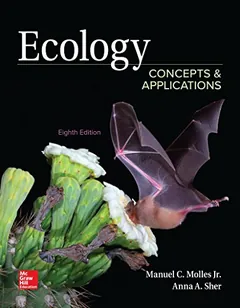
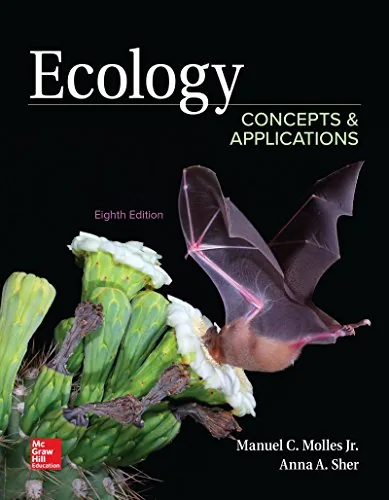
Cover of Ecology: Concepts and Applications, 8th Edition

Ecology: Concepts and Applications, 8th Edition

By Manuel C. Molles Jr., Anna A. Sher

About this ebook

Ecology: Concepts and Applications, Eighth Edition, introduces ecological processes from individual organisms to populations, communities, ecosystems, and global patterns. For introductory ecology students, the text connects energy flow, nutrient cycling, species interactions, and spatial relationships with applied questions involving climate change, invasive species, biodiversity conservation, and environmental management.

Inside this title
  • Ecological processes examined from organisms to global systems
Current listed price $19.99Regular price $40.00Digital ebook
Buy now

Digital ebook. Checkout sends an order request.

Format
Digital ebook
ISBN
9781526891341
Last updated
2026-11-03
Build a fuller reading list

What this book covers.

The book moves across ecological scales, beginning with how organisms respond to their environments and extending to population regulation, species coexistence, and ecosystem processes. Competition, predation, mutualism, and other interactions are examined alongside succession, disturbance, energy transfer, and nutrient cycles. This progression makes the relationship between smaller-scale processes and broader ecological patterns a recurring subject.

Chapter questions and concluding summaries help organize the material for introductory study. Examples concerning climate change, invasive species, restoration, and biodiversity connect ecological concepts with environmental problems. Landscape topics, including habitat patches and corridors, add a spatial perspective for students preparing for further work in ecology, conservation, or natural resource management.
Study guide included

Inside Ecology: Concepts and Applications, 8th Edition.

Ecology explains where organisms live and how many there are by linking local conditions, adaptation, population change and species interaction to ecosystem process. The scale of observation decides which mechanisms become visible and which conclusions the evidence can actually support.

The text moves from natural history and evolution through organismal adaptation, population dynamics and interactions to communities, ecosystems and global change. Examples place concepts in specific settings, including aquatic habitats, forests and fragmented landscapes. Sampling design and case comparison show how ecologists separate competing explanations. Field studies and long-term data sets recur as models for asking a clear question and choosing a comparison that could answer it. Readers are repeatedly asked what a pattern would look like if a different mechanism were responsible.

From habitat patterns to hypotheses

Temperature and precipitation explain broad biome distribution on land, while topography and vegetation create local conditions a climate average hides. In water, flow, light, salinity and depth decide which organisms persist. Individuals may adjust behavior or physiology, while populations evolve as heritable variants change in frequency over generations.

  • Measure variables organisms actually experience
  • Separate acclimation from inherited change
  • Check chance effects in small populations
Chs. 1–4 · Introduction, habitats and natural selection

Limits of temperature, water and food

A distant weather station can misrepresent conditions in leaf litter, a stream pool or on a sunlit rock. Physiological tolerance and behavior shape where an organism functions, and shade seeking or shifts in activity can ease stress while changing access to food or mates. Resource budgets connect gains, losses and the energy left for growth and reproduction.

  • Use microclimate rather than regional averages
  • See behavior as both relief and cost
  • Track energy and water budgets
Chs. 5–8 · Adaptations to the Environment

What changes a population's size

Abundance is a count, while density relates it to area or volume. Individuals may cluster around resources, space out through territoriality or show little pattern. Detectability varies by habitat and season, so consistent effort and multi-patch sampling help separate real change from a shift in what observers find. Growth reflects births and immigration minus deaths and emigration.

  • Distinguish abundance from density
  • Standardize survey effort and timing
  • Connect growth to vital rates
Chs. 9–12 · Population Ecology

Competition, consumers and cooperation

Competition arises when individuals share a limiting resource, with costs from depletion or interference. Predators, herbivores and parasites gain from other organisms, and defenses change how often encounters happen or what they cost. Mutualism benefits both partners, though rewards vary with context, and a change in one interaction can ripple to species that never meet.

  • Name the resource being contested
  • Follow effects beyond two species
  • Separate overlap from real competition
Chs. 13–15 · Species Interactions

Community change and ecosystem budgets

Species richness counts species present, while relative abundance shows whether a few dominate. Disturbance can alter both by opening space or interrupting interactions. Primary succession begins on newly formed surfaces and secondary succession follows disturbance where legacies remain, so recovery need not follow one fixed sequence. Production is a rate, biomass a standing amount.

  • Report richness and evenness separately
  • Distinguish primary from secondary succession
  • Keep production distinct from biomass
Chs. 16–20 · Communities and Ecosystems

Landscapes, islands and global change

Landscape ecology considers patch arrangement, corridors, edges and surrounding land use. The same habitat amount supports different movement when arranged as one block or many fragments. Island biogeography frames immigration and extinction through area and isolation, though the intervening landscape varies in permeability by organism. Global drivers connect distant places and scales.

  • Assess arrangement, not only habitat amount
  • Consider area and isolation together
  • Separate local action from regional change
Chs. 21–23 · Large-Scale Ecology

Chapter and section map

  • Introduction to EcologyPDF p. 22
  • Natural History and EvolutionPDF p. 32
  • Adaptations to the EnvironmentPDF p. 122
  • Population EcologyPDF p. 217
  • InteractionsPDF p. 296
  • Communities and EcosystemsPDF p. 364
  • Large-Scale EcologyPDF p. 464
  • Investigating the EvidencePDF p. 532

Key takeaways

  • Pair a biological count with measurements taken at the scale the organism actually experiences.
  • Keep species richness, relative abundance, biomass and production separate when describing recovery.
  • Use comparison sites and repeated sampling to tell a local intervention from a regional trend.

Introductory ecology students and environmental learners who need a concept-first treatment of populations, communities, ecosystems, landscapes and applied conservation questions across terrestrial and aquatic systems.

Topics covered

  • introductory ecology
  • population dynamics
  • species interactions
  • ecosystem processes
  • ecological succession
  • landscape ecology
  • biodiversity conservation
  • conservation planning

Questions about this ebook.

Edition, audience, and study-guide details at a glance.

What is Ecology: Concepts and Applications, 8th Edition about?

Ecology: Concepts and Applications, Eighth Edition, introduces ecological processes from individual organisms to populations, communities, ecosystems, and global patterns. For introductory ecology students, the text connects energy flow, nutrient cycling, species interactions, and spatial relationships with applied questions involving climate change, invasive species, biodiversity conservation, and environmental management.

Which edition of Ecology: Concepts and Applications, 8th Edition is this?

This listing is for the 8th edition. Check the title, ISBN, and book details above before ordering, especially if your course or reading list names a specific edition.

Who is Ecology: Concepts and Applications, 8th Edition for?

Introductory ecology students and environmental learners who need a concept-first treatment of populations, communities, ecosystems, landscapes and applied conservation questions across terrestrial and aquatic systems.

Does this page include a study guide?

Yes. This page includes an original study guide with six thematic sections, key takeaways, and a chapter and section map for structured reading.

Keep your curiosity going.

More books from this carefully grouped reading set.

See the whole set

Enter your name and email to open a WhatsApp message with your details.