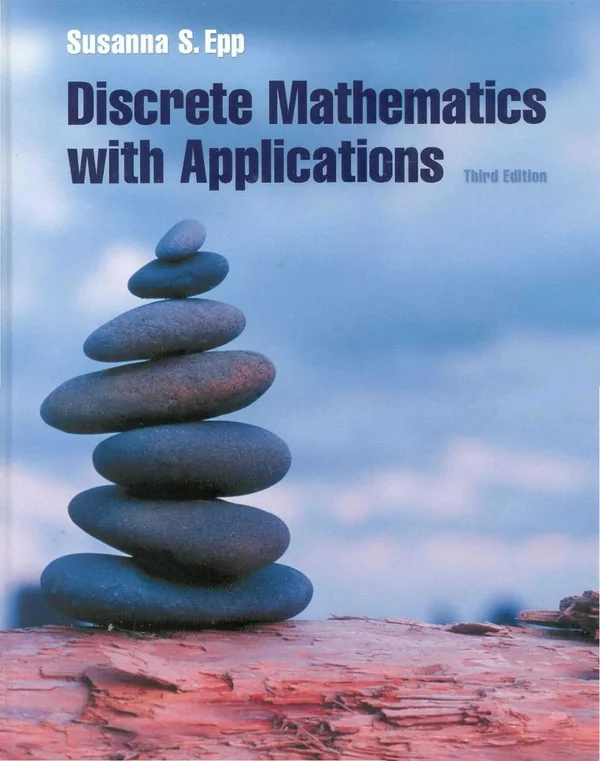
Discrete Mathematics with Applications, third edition, by Susanna S. Epp develops mathematical reasoning and discrete structures for computer science, mathematics, and engineering students. Logic and proof underpin its treatment of sets, functions, algorithms, counting, probability, relations, graphs, trees, and Boolean algebra, with examples and exercises connecting concepts to applications.
Inside this title
Logic, quantifiers, proof methods, and mathematical induction explained
Current listed price $19.99Regular price $40.00Digital ebook
Epp emphasizes the reasoning needed to understand and construct mathematical arguments. Propositional and predicate logic introduce proof methods, including direct reasoning, contraposition, contradiction, and induction, before these tools are used across the book's discrete topics.
Sets and functions lead into counting, probability, relations, graphs, and trees. Algorithm analysis brings attention to running time, loop invariants, and big-O notation, while network examples illustrate graph concepts and spanning trees. Worked explanations and problem-solving exercises encourage readers to justify conclusions rather than reproduce procedures. The third edition is intended for undergraduate discrete mathematics courses and independent preparation for further study of algorithms, data structures, or formal mathematical methods.
Study guide included
Inside Discrete Mathematics with Applications, 3rd Edition.
This text builds discrete mathematics around the practice of making and testing mathematical claims. Epp moves from compound and quantified statements through number-theory proofs, induction, sets, counting, probability, functions, recursion, algorithm efficiency, relations, graphs and finite-state models, with exercises at each step for computing and mathematics students.
Compound and quantified statements open the book, and elementary number theory supplies material for learning proof. Induction, sets, counting, probability, functions and a separate recursion chapter follow. Efficiency, relations, graphs and formal languages then carry the reasoning into computing contexts. Chapter order matches this edition, and each structure arrives with the definitions and argument patterns needed to use it well. Exercises progress from translation through short proofs to extended applications that reward close reading of definitions. Review problems consolidate the techniques and notation.
Compound and quantified statements
Truth tables test a compound statement under every assignment, and two forms are equivalent when they agree everywhere. Validity carries truth from premises to conclusion; it does not assert that the premises are true. Quantified predicates become claims, a universal falls to a single permitted counterexample, and an existential is settled by a witness. With nested quantifiers, note which choice depends on which.
Validity differs from factual truth
One counterexample defeats a universal claim
Track dependence among nested quantifiers
Chs. 1–2 · pp. 1, 75
Proof through elementary number theory
A universal proof selects an arbitrary object meeting the hypotheses, then uses definitions to reach the conclusion. A counterexample must satisfy those hypotheses and still fail the result, and case splits must cover the whole domain. Quotient and remainder support parity and congruence arguments and underlie Euclid's algorithm; contradiction and contraposition keep assumptions explicit when a direct route is awkward.
Select a generic object meeting the hypotheses
Remainders organize parity and congruence
Make each assumption visible to the reader
Ch. 3 · p. 125
Induction, recursion and efficiency
Induction proves starting cases and a step that carries truth forward; strong induction draws on any relevant earlier case. A recursive definition supplies an initial value and a rule, and a proposed closed form remains unproved until its bases and transition are checked. Algorithms must halt and meet their specification, established by loop invariants or recursive reasoning, and efficiency work compares how search and sorting costs grow.
A closed form stays a conjecture until proved
Algorithms need termination and correctness
Efficiency compares growth, not exact times
Chs. 4, 8–9 · pp. 199, 457, 510
Sets, counting and probability
Set identities can be checked by mutual inclusion or refuted with a counterexample. Counting must separate disjoint alternatives from overlapping groups, and possibility trees reveal whether different branches produce the same outcome. Permutations and combinations answer different questions, equal probabilities require a justified model, and conditional probability plus independence depend on how the sample space is specified.
Test set identities with element proofs
Overlap changes the counting approach
Equal outcome weights require justification
Chs. 5–6 · pp. 255, 297
Functions, relations and order
A function's domain fixes its inputs and its codomain fixes the targets, while injectivity and surjectivity determine whether an inverse exists; composition requires compatible sets. Relations list ordered pairs satisfying a rule. Equivalence relations yield disjoint classes such as congruence classes, partial orders express precedence without comparing everything, and Hasse diagrams remove transitive edges to show immediate dependencies.
Domain and codomain constrain composition
Equivalence classes are disjoint
Hasse diagrams show immediate dependencies
Chs. 7, 10 · pp. 389, 571
Graphs and formal languages
Graphs represent connections by vertices and edges, adding direction, multiplicity or weights only when useful. A tree is connected and acyclic; rooting gives hierarchy, and a spanning tree keeps all vertices while dropping some edges. A formal language consists of strings drawn from an alphabet, regular expressions define patterns, and a finite-state automaton changes state on each symbol and accepts according to its final state.
Include direction or weights only when useful
Spanning trees keep connectivity, drop edges
States encode only relevant prefix information
Chs. 11–12 · pp. 649, 734
Chapter and section map
The Logic of Compound Statementsp. 1
The Logic of Quantified Statementsp. 75
Elementary Number Theory and Methods of Proofp. 125
Sequences and Mathematical Inductionp. 199
Counting and Probabilityp. 297
Recursion and The Efficiency of Algorithmspp. 457, 510
Relations, Graphs, and Treespp. 571, 649
Regular Expressions and Finite-State Automatap. 734
Key takeaways
Distinguish checking a handful of cases from proving a claim for every case.
For a recurrence, state both the rule and every starting value needed.
Choose a graph, relation or machine based on the structure the problem asks about.
Students in discrete mathematics and computer science foundations courses, plus instructors who want a careful, proof-oriented treatment with computing applications and a graded exercise sequence.
Topics covered
discrete mathematics
logical equivalence
proof by contradiction
mathematical induction
recursive algorithms
counting methods
relations and partial orders
regular expressions
Other editions of this title.
Compare editions, prices, and book details before you choose.
Edition, audience, and study-guide details at a glance.
What is Discrete Mathematics with Applications, 3rd Edition about?
Discrete Mathematics with Applications, third edition, by Susanna S. Epp develops mathematical reasoning and discrete structures for computer science, mathematics, and engineering students. Logic and proof underpin its treatment of sets, functions, algorithms, counting, probability, relations, graphs, trees, and Boolean algebra, with examples and exercises connecting concepts to applications.
Which edition of Discrete Mathematics with Applications, 3rd Edition is this?
This listing is for the 3rd edition. Check the title, ISBN, and book details above before ordering, especially if your course or reading list names a specific edition.
Who is Discrete Mathematics with Applications, 3rd Edition for?
Students in discrete mathematics and computer science foundations courses, plus instructors who want a careful, proof-oriented treatment with computing applications and a graded exercise sequence.
Does this page include a study guide?
Yes. This page includes an original study guide with six thematic sections, key takeaways, and a chapter and section map for structured reading.