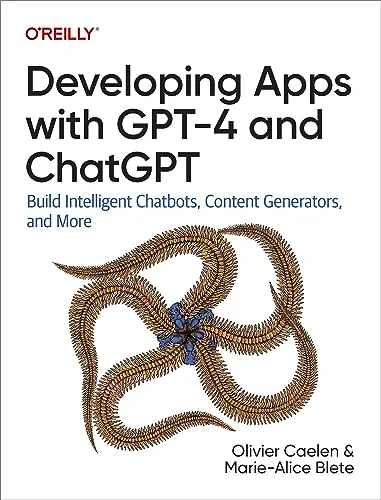
Developing Apps with GPT-4 and ChatGPT: Build Intelligent Chatbots, Content Generators, and More, 1st Edition
By Olivier Caelen, Marie-Alice Blete
About this ebook
Developing Apps with GPT-4 and ChatGPT introduces Python developers to building applications around language models. Olivier Caelen and Marie-Alice Blete cover API use, prompts, context management, chatbots, content generation, customization, and deployment considerations through code examples, presenting the development approaches and model ecosystem discussed in this 2023 first edition.
Inside this title
Python environment setup and introductory language-model API calls
Current listed price $6.00Regular price $10.00Digital ebook
The book starts with setting up a Python environment and making API calls, then connects these foundations with applications such as conversational assistants and text-generation tools. Prompt design and context limits are treated as practical constraints that influence how an application behaves.
Later topics include customization, introductory fine-tuning concepts, deployment, scaling, and API-related costs. Code examples give readers a way to relate the concepts to implementation choices across a small application's lifecycle. Written for Python developers approaching language-model applications, this first edition documents tools and approaches from 2023. Its examples provide a basis for studying that development workflow and the relationship between model behavior, application design, and resource use.
Study guide included
Inside Developing Apps with GPT-4 and ChatGPT: Build Intelligent Chatbots, Content Generators, and More, 1st Edition.
Caelen and Blete take Python developers from a first API call to a working language-model application. The book pairs setup and prompt design with chatbot and text-generation examples, then turns to customisation, early fine-tuning ideas, deployment, scaling and the cost of API use in the 2023 model landscape.
The first edition starts with a Python environment and the mechanics of calling a language-model API, treating those foundations as prerequisites for everything later. Prompt design and context limits are framed as practical constraints that shape application behaviour rather than as tricks. From there the book builds conversational assistants and content-generation tools, then widens to customisation and introductory fine-tuning concepts. Deployment, scaling choices and API costs close the arc, so implementation decisions are considered across a small application's lifecycle. Because the material dates from 2023, it documents a particular moment in the tooling and is best read as a structured study of that workflow.
Setting Up a Python Environment
The book begins with the working conditions for development: a Python setup and the steps needed to reach a language-model service. Getting this groundwork right makes the later examples reproducible and keeps attention on application logic.
Prepare a Python development environment
Connect to the model through its API
Verify a first call before building further
Topics 1-2
Prompts and Context
Prompt design and context management are presented as constraints on behaviour. How a request is framed and how much prior material is supplied both shape responses, so the discussion treats them as design decisions with practical consequences.
Frame prompts deliberately
Track context limits
Expect behaviour to follow the input design
Topics 2-3
Conversational Applications
Chatbots serve as the book's central worked example, showing how API calls, prompt structure and conversation state combine into an interface. The application focus keeps the model's behaviour tied to what a user actually experiences.
Assemble conversational flows
Manage state across exchanges
Evaluate the assistant as a product
Topics 3-4
Content Generation
Text-generation tools extend the same foundations to producing written material. The examples connect prompt choices with output quality and with the practical decisions a developer makes when shaping generated content for a purpose.
Design prompts for generated text
Relate output to intended use
Consider quality and review needs
Topics 4-5
Customisation and Fine-Tuning
Customisation and introductory fine-tuning concepts show how a general model can be adapted to narrower needs. The treatment is conceptual and practical rather than exhaustive, framing adaptation as one option among several for shaping behaviour.
Identify when adaptation is warranted
Understand what fine-tuning changes
Weigh adaptation against other approaches
Topics 5-6
Deployment, Scaling, and Cost
Shipping an application raises questions about hosting, load and expense. The book connects deployment and scaling choices with API usage costs, so that operating a language-model application is treated as an ongoing engineering and budget concern.
Plan deployment beyond local testing
Anticipate scaling demands
Track API usage against cost
Topics 6-7
Topic map
Setting Up the Python EnvironmentTopic 1
Working with the Language-Model APITopic 2
Prompt Engineering and ContextTopic 3
Building ChatbotsTopic 4
Text and Content GenerationTopic 5
Customisation and Fine-TuningTopic 6
Deployment, Scaling, and CostTopic 7
Key takeaways
API foundations and careful prompt design do most of the work before advanced techniques are needed.
Context limits are a design constraint that shapes how an application structures conversation and input.
Deployment, scaling and cost belong in the plan from the start, not after the prototype works.
Python developers new to language-model applications, plus technically minded readers who want a guided, example-based introduction to building with the GPT-4 and ChatGPT APIs as documented in 2023.
Topics covered
Developing Apps with GPT-4 and ChatGPT
Olivier Caelen Marie-Alice Blete
Python language model applications
prompt design and context management
chatbot development with GPT-4
fine-tuning concepts
API deployment and cost
Questions about this ebook.
Edition, audience, and study-guide details at a glance.
What is Developing Apps with GPT-4 and ChatGPT: Build Intelligent Chatbots, Content Generators, and More, 1st Edition about?
Developing Apps with GPT-4 and ChatGPT introduces Python developers to building applications around language models. Olivier Caelen and Marie-Alice Blete cover API use, prompts, context management, chatbots, content generation, customization, and deployment considerations through code examples, presenting the development approaches and model ecosystem discussed in this 2023 first edition.
Which edition of Developing Apps with GPT-4 and ChatGPT: Build Intelligent Chatbots, Content Generators, and More, 1st Edition is this?
This listing is for the 1st edition. Check the title, ISBN, and book details above before ordering, especially if your course or reading list names a specific edition.
Who is Developing Apps with GPT-4 and ChatGPT: Build Intelligent Chatbots, Content Generators, and More, 1st Edition for?
Python developers new to language-model applications, plus technically minded readers who want a guided, example-based introduction to building with the GPT-4 and ChatGPT APIs as documented in 2023.
Does this page include a study guide?
Yes. This page includes an original study guide with six thematic sections, key takeaways, and a topic map for structured reading.