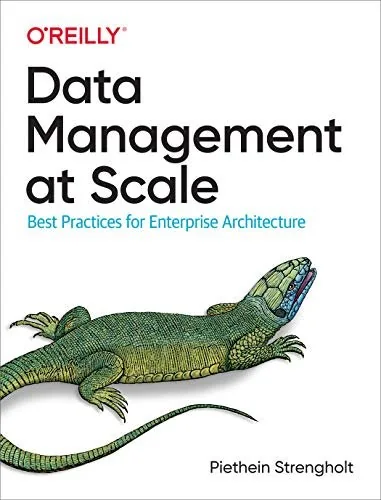
Cover of Data Management at Scale: Enterprise Data Architecture Best Practices

Data Management at Scale: Enterprise Data Architecture Best Practices

By Piethein Strengholt

About this ebook

Data Management at Scale examines the design and evolution of enterprise data architecture. Piethein Strengholt writes for architects, engineers, and data leaders, connecting governance, modeling, integration patterns, and platform choices with the organizational work required to move from tightly coupled systems toward more adaptable data environments.

Inside this title
  • Enterprise architecture migration patterns for interconnected data systems
Current listed price $26.99Regular price $55.00Digital ebook
Buy now

Digital ebook. Checkout sends an order request.

Format
Digital ebook
ISBN
9781492054771
Last updated
2026-11-03

What this book covers.

Strengholt approaches enterprise data management through the relationships between architecture and implementation. The book considers migration patterns, modeling choices, and integration methods such as ETL, ELT, streaming, and virtualization. Data lakes, warehouses, and real-time processing appear as components whose roles must be considered together.

Governance is woven into these design questions through metadata, lineage, and responsibilities for managing information. The discussion also extends to adoption, stakeholder expectations, and the organizational changes that accompany a new platform. Architects and data engineering teams can use the book to examine trade-offs across an enterprise, while managers can study how technical decisions connect with operating practices and longer-term data needs.

Study guide included

Inside Data Management at Scale: Enterprise Data Architecture Best Practices.

Enterprise data architecture is less a single platform choice than a set of connected decisions about modeling, integration and ownership. Strengholt frames those decisions for architects and data leaders, showing how governance and organizational practice have to move alongside the technical work of loosening tightly coupled systems.

The book treats architecture and implementation as one conversation. Migration patterns, modeling choices and integration approaches such as ETL, ELT, streaming and virtualization are compared rather than ranked, so readers can weigh trade-offs for their own estate. Data lakes, warehouses and real-time processing appear as components whose roles depend on each other. Governance runs through the same discussion by way of metadata, lineage and clear responsibilities, while adoption, stakeholder expectations and operating change close the loop between design and everyday use.

Architecture that can absorb change

Strengholt starts from the problem of tightly coupled systems, where a change in one place forces changes elsewhere. The aim is an environment where components can evolve at different speeds. That requires deliberate boundaries and a view of how data moves between them, not just a new product to sit in the middle of the estate.

  • Trace coupling before proposing a redesign
  • Set boundaries that let components evolve separately
  • Judge platforms by how they change
Topics 1-2

Migration patterns for connected systems

Moving an enterprise estate is rarely a clean replacement. The book looks at patterns for shifting data and workloads while old and new systems coexist, and at what each pattern asks of teams in the interim. The emphasis falls on sequencing and coexistence rather than on a single cutover moment.

  • Plan coexistence before the cutover moment
  • Sequence moves by dependency, not convenience
  • Keep old and new paths observable
Topics 2-3

Governance carried by metadata and lineage

Governance here is not a separate committee layered on top of the platform. Metadata and lineage make ownership visible, and responsibilities are assigned where information is created and used. The design question becomes how to record those relationships well enough that people can answer who owns a dataset and where it came from.

  • Record ownership where data is created
  • Use lineage to answer provenance questions
  • Treat metadata as part of the design
Topics 3-4

ETL, ELT, streaming and virtualization

Integration patterns are compared for what they assume and what they cost. Batch ETL and ELT differ in where transformation happens; streaming addresses timeliness; virtualization avoids copying altogether. Strengholt sets these side by side so that the choice follows the requirement instead of habit or vendor preference.

  • Match the pattern to timeliness needs
  • Weigh where transformation should happen
  • Consider virtualization before another copy
Topics 5-6

Lakes, warehouses and real-time processing

Data lakes, warehouses and real-time processing are presented as parts of one picture. Each has a role, and the roles overlap enough that choosing one in isolation creates later problems. The book asks how storage, query and latency needs fit together across an estate rather than which component is best on its own.

  • Assign each component a distinct role
  • Check where storage and latency needs overlap
  • Avoid choosing a component in isolation
Topics 6-7

Adoption, stakeholders and operating practice

A platform only matters once people use it. Strengholt connects technical decisions with stakeholder expectations and the organizational changes a new approach demands. Managers get a view of how architecture choices translate into operating practice, and architects get a reminder that adoption is part of the design problem rather than an afterthought.

  • Map stakeholders before finalizing the platform
  • Plan operating changes alongside the build
  • Measure adoption, not just delivery
Topic 8

Topic map

  • Enterprise data architectureTopic 1
  • Migration and coexistence patternsTopic 2
  • Metadata and data governanceTopic 3
  • Data lineage and ownershipTopic 4
  • ETL, ELT and streaming integrationTopic 5
  • Virtualization and data accessTopic 6
  • Data lakes, warehouses and real timeTopic 7
  • Adoption and organizational changeTopic 8

Key takeaways

  • Design for evolution: the boundary between components matters more than any single product choice.
  • Metadata and lineage turn governance from policy language into something people can actually check.
  • Integration pattern choice should follow the requirement for timeliness, not team habit.

Enterprise architects, data engineers and data leaders who need to weigh modeling, integration and governance decisions across a large estate, plus managers connecting platform choices to operating practice.

Topics covered

  • enterprise data architecture
  • data management at scale
  • migration patterns
  • data lineage
  • metadata governance
  • ETL and ELT
  • streaming integration
  • data lakes
  • platform adoption

Questions about this ebook.

Edition, audience, and study-guide details at a glance.

What is Data Management at Scale: Enterprise Data Architecture Best Practices about?

Data Management at Scale examines the design and evolution of enterprise data architecture. Piethein Strengholt writes for architects, engineers, and data leaders, connecting governance, modeling, integration patterns, and platform choices with the organizational work required to move from tightly coupled systems toward more adaptable data environments.

Who is Data Management at Scale: Enterprise Data Architecture Best Practices for?

Enterprise architects, data engineers and data leaders who need to weigh modeling, integration and governance decisions across a large estate, plus managers connecting platform choices to operating practice.

Does this page include a study guide?

Yes. This page includes an original study guide with six thematic sections, key takeaways, and a topic map for structured reading.

Keep your curiosity going.

More books with overlapping topics.

Browse all ebooks

Enter your name and email to open a WhatsApp message with your details.