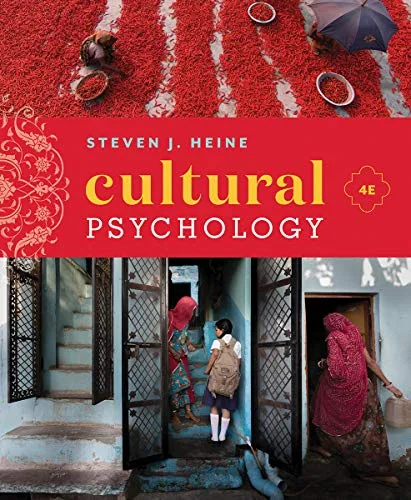
Cultural Psychology, Fourth Edition, examines culture as a central influence on thought, emotion, motivation, and social behavior. Steven J. Heine introduces students to research on the self, perception, morality, and well-being across cultural settings, considering both shared psychological tendencies and variation associated with cultural practices, values, and institutions.
Inside this title
Independent and interdependent self-concepts across different cultural settings
Current listed price $28.99Regular price $68.00Digital ebook
Heine asks how psychological experience is shaped by the cultural settings in which people develop and act. Independent and interdependent views of the self introduce questions that continue through discussions of attention, cognition, emotion, motivation, achievement, and moral reasoning. Examples connect cultural practices with the processes examined in psychological research.
The book also considers conformity, cooperation, aggression, globalization, and acculturation. Cross-cultural comparisons, priming studies, and cultural neuroscience illustrate different ways of investigating the relationship between culture and mind. Designed for psychology students and readers in related social sciences, the fourth edition offers a framework for evaluating similarities and differences without treating either cultural variation or universal tendencies as the whole explanation.
Study guide included
Inside Cultural Psychology, 4th Edition.
A companion to Heine's fourth edition, which treats culture as a set of inherited practices that organize attention, feeling, and relationship. The guide emphasizes comparison done carefully: knowing what a measure captures, what a group average hides, and which evidence would separate one explanation from a rival.
Heine opens with how much humans rely on learning from others, then turns to method: how translation, reference groups, and sampling can quietly distort a cross-group claim. From there the book follows culture through development and identity, motivation and attention, feeling, close relationships, and moral judgment. The final chapters carry the analysis into health and organizational life. The guide presents each unit as a question about mechanism rather than a catalogue of national traits, and it keeps asking what specific practice, institution, or expectation would produce the pattern described.
Learning, transmission, and cultural species
Humans survive by borrowing skills and beliefs from others, and that borrowing is not passive. Teaching, imitation, and prestige guide which practices spread, while communities retain and revise techniques across generations. The unit frames cultural evolution as a two-way street: shared habits shape individual choices, and those choices either sustain a practice or slowly transform it. It sets up the book's central claim that culture is part of human biology's operating environment.
Trace how a technique survives across generations
Note who is copied and why prestige matters
Treat individual choices as part of cultural change
Chs. 1–3, pp. 3, 35 and 71
Fair comparison and measurement traps
Before a difference between groups becomes a cultural finding, the measure has to mean the same thing on both sides. Translated items may still invite different reference groups, and recruitment can tie culture to schooling, age, or geography. The chapter reviews questionnaire studies, experiments, situation sampling, and priming, showing how each makes a different aspect visible. Converging results let a broad contrast become a testable mechanism.
Ask what respondents use as their comparison group
Check whether samples confound culture with schooling
Combine methods so each covers another's blind spot
Ch. 4, p. 117
Socialization, self, and multiple identities
Family care, school, and friendships give children repeated chances to practice attention, restraint, and responsibility. Families differ in priorities and resources, so the developmental story is about ordinary routines training habits over years. The self chapters contrast independent and interdependent understandings, then note that most people carry both. Group averages are a starting point; a person's past and the present setting explain an individual response.
Link daily routines to the habits they train
Hold independent and interdependent selves as possibilities
Read group averages as a starting point only
Chs. 5–7, pp. 159, 203 and 249
Motive, attention, and emotional meaning
Persistence can serve personal competence, social obligation, or the protection of a valued bond, and the same reward means different things depending on which is at stake. The cognition chapters examine analytic versus holistic attention, asking whether people center on an object or its relations and background. Emotion is treated as physical, interpretive, and social at once, so context shapes which feelings are valued and when showing them is appropriate.
Ask what the goal means inside its setting
Test attention to objects versus context
Treat emotion as body, interpretation, and display
Chs. 8–10, pp. 293, 335 and 381
Relationships, moral judgment, and belonging
Friendship and attraction depend on who is available, what people expect, and how replaceable relationships are. Where ties are hard to replace, trust and conflict get managed differently than where new ones form easily. Moral judgment can rest on equality, reciprocity, group duty, or what an obligation means, and religion ties those judgments to common stories and institutions. Comparison asks which concerns reappear and how communities rank them.
Consider how replaceable relationships are locally
Ask which principle a fairness judgment leans on
Look for recurring concerns across communities
Chs. 11–12, pp. 419 and 459
Health systems and workplace legitimacy
Ideas about illness and familiar language for distress shape whether people report symptoms, who hears about them, and where help is sought; material access shapes outcomes too. Organizational chapters examine leadership, cooperation, and justice against differing views of authority, initiative, and membership. A single policy can feel different according to how leaders explain decisions and whether employees can reply. The research task is naming the expectation that links a rule to its evaluation.
Separate reported distress from measured distress
Check access barriers before blaming preferences
Identify which expectation makes a policy feel fair
Chs. 13–15, pp. 495, 533 and 567
Chapter and section map
A Psychology for a Cultural Speciesp. 3
Cultural Evolutionp. 71
Research Methodsp. 117
Development and Socializationp. 159
Self and Personalityp. 203
Cognition and Perceptionp. 335
Mental Healthp. 533
Organizations, Leadership, and Justicep. 567
Key takeaways
Find out what comparison group respondents imagine before reading a cross-cultural rating as absolute.
Pair surveys with experiments or observation so a broad difference becomes a specific mechanism.
Follow one person across situations to learn which features drive the behavior.
Undergraduate and graduate psychology students, instructors teaching cross-cultural research methods, and general readers curious about how evidence separates shared human capacities from learned cultural practice.
Topics covered
cultural psychology
social learning
cross-cultural methods
self and identity
cultural evolution
moral judgment
organizational justice
health beliefs
Questions about this ebook.
Edition, audience, and study-guide details at a glance.
What is Cultural Psychology, 4th Edition about?
Cultural Psychology, Fourth Edition, examines culture as a central influence on thought, emotion, motivation, and social behavior. Steven J. Heine introduces students to research on the self, perception, morality, and well-being across cultural settings, considering both shared psychological tendencies and variation associated with cultural practices, values, and institutions.
Which edition of Cultural Psychology, 4th Edition is this?
This listing is for the 4th edition. Check the title, ISBN, and book details above before ordering, especially if your course or reading list names a specific edition.
Who is Cultural Psychology, 4th Edition for?
Undergraduate and graduate psychology students, instructors teaching cross-cultural research methods, and general readers curious about how evidence separates shared human capacities from learned cultural practice.
Does this page include a study guide?
Yes. This page includes an original study guide with six thematic sections, key takeaways, and a chapter and section map for structured reading.