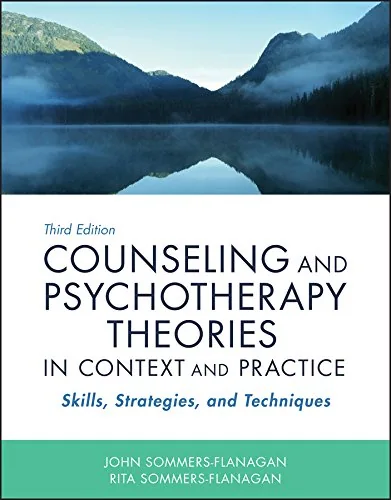
Cover of Counseling and Psychotherapy Theories in Context and Practice, Third Edition

Counseling and Psychotherapy Theories in Context and Practice, Third Edition

By John Sommers-Flanagan, Rita Sommers-Flanagan

About this ebook

Counseling and Psychotherapy Theories in Context and Practice, Third Edition relates therapeutic ideas to the skills and decisions of counseling. John Sommers-Flanagan and Rita Sommers-Flanagan introduce eleven theoretical perspectives through historical context, case examples, exercises, and critical questions for graduate students and practitioners comparing approaches to clinical work.

Inside this title
  • Eleven therapeutic perspectives considered in historical and cultural context
Current listed price $32.99Regular price $78.00Digital ebook
Buy now

Digital ebook. Checkout sends an order request.

Format
Digital ebook
ISBN
9781119279143
Last updated
2026-11-03

What this book covers.

The authors examine counseling theories in relation to their origins, assumptions, research, and practical methods. Historical and cultural context helps explain why an approach asks particular questions about clients and what it considers a useful direction for therapeutic work.

Psychoanalytic, Adlerian, existential, person-centered, Gestalt, behavioral, cognitive, and reality therapy perspectives are among the approaches discussed. Case examples show how theoretical ideas shape conversation and intervention, while exercises and critical thinking questions invite readers to examine their own responses. Designed for graduate study and professional reflection, the third edition provides a setting for comparing models and considering the fit between a theory, a clinician's orientation, and a client's circumstances.

Study guide included

Inside Counseling and Psychotherapy Theories in Context and Practice, Third Edition.

Sommers-Flanagan and Sommers-Flanagan set each theory inside the history and culture that produced it, then test it against practice. Eleven perspectives are introduced through case examples, exercises and critical questions, so graduate students and practitioners can compare approaches by seeing how an idea becomes a response in the consulting room.

The authors treat theory as something that grew out of particular circumstances rather than as a timeless set of techniques, explaining why an approach asks certain questions about clients and what it regards as a useful direction for therapy. Psychoanalytic, Adlerian, existential, person-centered, Gestalt, behavioral, cognitive and reality therapy perspectives are among those discussed. Case examples show theoretical ideas shaping conversation and intervention, while exercises and critical thinking prompts invite readers to notice their own reactions. Written for graduate study and professional reflection, the third edition creates space to compare models and to weigh the fit between a theory, a clinician's orientation and a client's situation.

Theory in historical and cultural context

Each model is presented as a product of its time and place, which explains why it frames client problems as it does. Understanding context removes the impression that theories are neutral discoveries and shows instead that they answer questions their era found pressing. This framing runs through all eleven perspectives.

  • Theories arise from particular circumstances
  • Context explains an approach's questions
  • Models reflect their era's concerns
  • Context precedes evaluation
Topics 1–8

Eleven perspectives side by side

Psychoanalytic, Adlerian, existential, person-centered, Gestalt, behavioral, cognitive and reality therapy approaches are among the perspectives covered, along with others that complete the eleven. Presenting them together allows comparison on shared ground rather than in isolation, and it reveals both overlaps and genuine differences.

  • A broad set of perspectives is covered
  • Models are compared on common ground
  • Overlaps and differences become visible
  • Breadth supports informed choice
Topics 2–5

Case examples turn ideas into practice

Case examples are used to show how a theoretical idea becomes a concrete response in conversation. The same client situation can be handled differently depending on the model in use, and seeing that illustrated makes the practical stakes of theory clear to students who may still find the abstractions remote.

  • Examples link concepts to dialogue
  • The same situation yields different responses
  • Practice exposes theoretical stakes
  • Illustration grounds abstract ideas
Topic 6

Exercises and critical questions

Exercises and critical thinking prompts ask readers to examine their own reactions rather than merely absorb content. This reflective element turns study into practice, because a counselor's personal responses influence what they notice and how they intervene. The book treats self-examination as part of learning theory.

  • Exercises prompt self-examination
  • Critical questions invite reflection
  • Personal reactions shape practice
  • Reflection accompanies content learning
Topic 7

Comparing models on common questions

Comparison is structured around shared questions: what troubles a client, what change requires, and what the therapist does. Answering these questions for each model reveals where the approaches diverge in substance rather than merely in vocabulary, and it gives students criteria for evaluating them.

  • Shared questions structure comparison
  • Models differ in their accounts of change
  • Therapist activity varies by approach
  • Comparison yields evaluative criteria
Topics 1–8

Fit between theory, clinician and client

The third edition asks readers to weigh the fit among a theory, a clinician's orientation and a client's situation. A model can be internally coherent and still suit one clinician or client better than another. Thinking in terms of fit avoids treating theory choice as a single correct answer.

  • Fit involves theory, clinician and client
  • Coherence does not guarantee suitability
  • Suitability varies with circumstances
  • No single correct theory is assumed
Topic 8

Topic map

  • Theory, Context and the Therapeutic EncounterTopic 1
  • Psychoanalytic and Adlerian PerspectivesTopic 2
  • Existential and Person-Centered PerspectivesTopic 3
  • Gestalt and Behavioral PerspectivesTopic 4
  • Cognitive and Reality Therapy PerspectivesTopic 5
  • Case Examples and Clinical Decision-MakingTopic 6
  • Exercises and Critical ReflectionTopic 7
  • Comparing Approaches and Finding FitTopic 8

Key takeaways

  • Understand where a theory came from before judging what it claims.
  • Use case examples to see how an abstract idea becomes a concrete clinical response.
  • Weigh the fit among theory, your own orientation and the client's situation rather than seeking one correct model.

Graduate counseling students and practitioners who want to compare eleven therapeutic perspectives in their historical and cultural context, connect theory to practice through cases and exercises, and reflect on the fit between an approach and their own clinical orientation.

Topics covered

  • counseling theories
  • psychotherapy approaches
  • theoretical context
  • case examples in counseling
  • psychoanalytic therapy
  • person-centered therapy
  • Gestalt therapy
  • reality therapy
  • reflective practice

Questions about this ebook.

Edition, audience, and study-guide details at a glance.

What is Counseling and Psychotherapy Theories in Context and Practice, Third Edition about?

Counseling and Psychotherapy Theories in Context and Practice, Third Edition relates therapeutic ideas to the skills and decisions of counseling. John Sommers-Flanagan and Rita Sommers-Flanagan introduce eleven theoretical perspectives through historical context, case examples, exercises, and critical questions for graduate students and practitioners comparing approaches to clinical work.

Which edition of Counseling and Psychotherapy Theories in Context and Practice, Third Edition is this?

This listing is for the 3rd edition. Check the title, ISBN, and book details above before ordering, especially if your course or reading list names a specific edition.

Who is Counseling and Psychotherapy Theories in Context and Practice, Third Edition for?

Graduate counseling students and practitioners who want to compare eleven therapeutic perspectives in their historical and cultural context, connect theory to practice through cases and exercises, and reflect on the fit between an approach and their own clinical orientation.

Does this page include a study guide?

Yes. This page includes an original study guide with six thematic sections, key takeaways, and a topic map for structured reading.

Keep your curiosity going.

More books from this subject area.

More social sciences ebooks

Enter your name and email to open a WhatsApp message with your details.