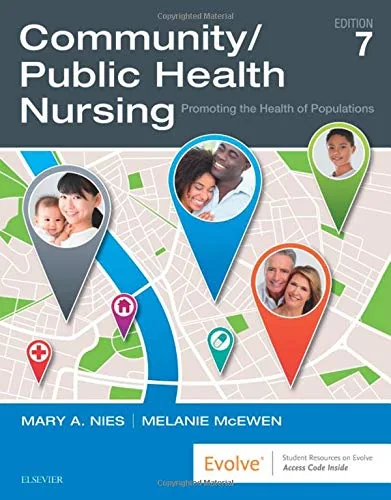
Community/Public Health Nursing: Promoting the Health of Populations, Seventh Edition, approaches population care through prevention and the conditions that shape health. Nies and McEwen connect community assessment, program design, evaluation, and policy advocacy for nursing students and registered nurses studying community roles, with emphasis on social justice and vulnerable populations.
Inside this title
Upstream prevention focused on social conditions affecting population health
Current listed price $36.99Regular price $94.00Digital ebook
An upstream perspective guides this account of community nursing: readers consider the circumstances that contribute to illness before looking at responses to established disease. Assessment, diagnosis, planning, intervention, and evaluation are presented as related parts of work with populations. Cases connect these processes with settings such as home, school, and community health services.
The text examines health disparities, cultural considerations, policy advocacy, and the needs of groups experiencing social or geographical disadvantage. Disaster preparedness and global health extend the discussion beyond routine services. BSN and RN-to-BSN students can use the book to study population-focused practice, while registered nurses moving into community roles can review how prevention and social conditions inform nursing decisions.
Study guide included
Inside Community/Public Health Nursing: Promoting the Health of Populations, 7th Edition.
Nies and McEwen frame population health as work on services and on the circumstances that generate illness. Assessment, planning, education, case management and policy are treated as one continuous effort, with repeated insistence that nurses check whether a change actually reached the people it was designed to help.
The volume defines community-focused practice, then argues for examining causes that sit upstream of any single clinical encounter. Assessment becomes planning, health teaching, case management and policy work. Chapters on culture, environment and global health widen the frame, while later sections follow life stages, specific populations, common community problems and the settings where nurses practice. The recurring test is distributional: who is reached, who is missed, and which shared conditions explain the gap. Theory appears as a tool for organizing explanations, not as a substitute for local observation.
Upstream thinking about shared risk
Community-based care serves an individual or family inside a community; population-focused work asks how outcomes are spread across a group and which conditions produce that spread. A single home visit can supply evidence for both readings. What separates them is the scope of assessment, the result being pursued and whose participation the response requires. Upstream reasoning then directs attention to housing, work, transport and policy.
Distinguish individual care from group-level outcome
Trace risk to housing, employment and transport
Use theory to organize, then test locally
Ch. 1–4
Epidemiology and community assessment
Rates describe events in a population, and their interpretation depends on the interval, the eligibility rules and how events were found. A higher figure may signal better detection rather than greater hazard. Assessment draws on demographic data, direct observation, an inventory of existing services and residents' own accounts. The strongest profile names capacities as well as problems and notices which voices are absent from the available numbers.
Read every rate with its interval and denominator
Combine records, observation and resident accounts
Record assets, not only deficits
Ch. 5–6
Planning, teaching and case management
Planning begins with a priority the community shares and states who should benefit, what will change and by when. Responsibilities are assigned before work starts. Process evaluation asks whether the activity happened and reached the right participants; outcome evaluation asks whether the intended change followed. Teaching must fit what learners can use, and case management addresses needs that cross organizations, so understanding and follow-through are measured apart.
State population, change and time period
Assign duties before implementation begins
Separate understanding from completed referrals
Ch. 7–9
Systems, policy and environment
Financing and organization decide who is eligible, what is available and which choices a provider can make. Culture shapes health meanings, family roles and service use without making any group uniform. Environmental health examines exposure where people live and work, and global health widens the view to resource differences and cross-border threats. An intervention borrowed from elsewhere has to be adapted to these conditions before it is assumed to work.
Find the agency or rule that controls access
Adapt programs to cultural and physical context
Treat global comparisons as capacity questions
Ch. 10–15
Life stages and priority populations
Chapters on children and adolescents, women, men, older adults and families locate transitions where prevention and teaching can land well. Group categories help organize attention but never describe every member. Disability, veteran status, homelessness and rural or migrant work alter transport, continuity, eligibility and communication in ways that vary by person and place. Practice looks for the shared service barrier and asks which change would reach those currently missed.
Use transitions as natural points for teaching
Treat group labels as hints, not portraits
Design around the barrier that excludes people
Ch. 16–24
Threats and practice settings
Mental illness, communicable disease, substance use, violence and disasters are handled as population concerns requiring detection, preparedness and contact across agencies. A response works when it names who monitors the problem, who can reach the affected group and where responsibility transfers. Settings then determine opportunity: a school offers regular contact, a workplace offers a different door, home care exposes daily obstacles and hospice follows the person's own goals.
Clarify monitoring, reach and transfer of duty
Choose the setting that fits the population
Use debriefs to find failing handoffs
Ch. 25–34
Chapter and section map
Thinking UpstreamCh. 3
EpidemiologyCh. 5
Community AssessmentCh. 6
Community Health Planning, Implementation, and EvaluationCh. 7
Case ManagementCh. 9
Cultural Diversity and Community Health NursingCh. 13
Rural and Migrant HealthCh. 24
Community Health SettingsUnit 7
Key takeaways
Ask which shared condition produces a pattern instead of reading it as a run of poor choices.
Combine rates, observation, resident experience and an asset inventory before setting priorities.
Track reach and continuity apart from long-term outcomes so evaluation shows what to revise.
Nursing students and registered nurses studying community roles, plus instructors and preceptors who want a social-justice framing of population assessment, program design and policy advocacy in practice settings.
Topics covered
population health nursing
upstream determinants
community assessment
program evaluation
case management
cultural diversity
rural and migrant health
policy advocacy
Questions about this ebook.
Edition, audience, and study-guide details at a glance.
What is Community/Public Health Nursing: Promoting the Health of Populations, 7th Edition about?
Community/Public Health Nursing: Promoting the Health of Populations, Seventh Edition, approaches population care through prevention and the conditions that shape health. Nies and McEwen connect community assessment, program design, evaluation, and policy advocacy for nursing students and registered nurses studying community roles, with emphasis on social justice and vulnerable populations.
Which edition of Community/Public Health Nursing: Promoting the Health of Populations, 7th Edition is this?
This listing is for the 7th edition. Check the title, ISBN, and book details above before ordering, especially if your course or reading list names a specific edition.
Who is Community/Public Health Nursing: Promoting the Health of Populations, 7th Edition for?
Nursing students and registered nurses studying community roles, plus instructors and preceptors who want a social-justice framing of population assessment, program design and policy advocacy in practice settings.
Does this page include a study guide?
Yes. This page includes an original study guide with six thematic sections, key takeaways, and a chapter and section map for structured reading.