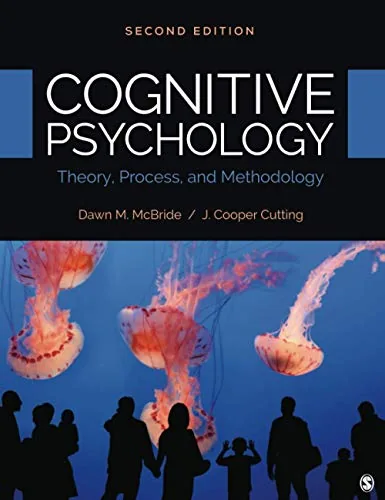
Cognitive Psychology: Theory, Process, and Methodology, 2nd Edition
By Dawn M. McBride, J. Cooper Cutting
About this ebook
Cognitive Psychology: Theory, Process, and Methodology, Second Edition, introduces cognition alongside the research methods used to investigate it. McBride and Cutting address perception, attention, memory, language, and reasoning for undergraduate students, showing how experimental choices shape evidence and how findings contribute to psychological theory.
Inside this title
Cognitive theories paired with the methods supporting them
Current listed price $19.99Regular price $41.00Digital ebook
Scientific inquiry supplies the organizing thread for this introduction to cognitive psychology. Discussions of mental processes are paired with the methods researchers use to study them, so readers encounter both an explanation and the evidence on which it depends. Visual and auditory perception, selective and divided attention, and different memory systems form part of this foundation.
Further coverage considers language comprehension and production, deductive and inductive reasoning, decision making, and creative problem solving. Cognitive neuroscience introduces the neural basis of these functions and the contribution of brain imaging. Undergraduate students can use the text to connect substantive psychology with experimental design, data interpretation, and the continuing revision of theoretical models.
Study guide included
Inside Cognitive Psychology: Theory, Process, and Methodology, 2nd Edition.
Cognitive Psychology: Theory, Process, and Methodology, second edition, introduces cognition together with the methods used to study it. McBride and Cutting cover perception, attention, memory, language, and reasoning for undergraduates, showing how design choices shape evidence and how findings feed psychological theory.
The field and its relation to neuroscience open the book, followed by perception and attention. Memory chapters distinguish structures, retrieval influences, and errors, while imagery, language, and conceptual knowledge address how people represent information. The final chapters take up problem solving, reasoning, and decisions. Throughout, the methodological emphasis asks readers to name the claim, the comparison, and the outcome in a study before deciding what the result establishes. A design that cannot separate explanations limits the conclusion, and students are asked what a finding would look like if a rival account were true.
Design choices and the strength of a claim
Experiments change a condition and measure an outcome; correlational work tracks variables that move together; case studies record a detailed pattern. Each has strengths, but an association cannot say which variable caused the other or rule out a third. Cognitive neuroscience adds information about structures and activity, yet a lesion, a physiological signal, and a behavioral contrast are not interchangeable forms of evidence.
Name the design before judging the claim
Propose a third variable
Say what each measure can support
Chs. 1–2 · Introduction and neuroscience
Transduction, organization, and selection
Transduction converts stimulus properties into neural signals, and the perception chapter asks how those signals are organized, how prior knowledge enters, and how perception supports action; Gestalt accounts stress relations among parts. Attention has been described as filtering, as a beam that highlights, and as a pool of limited capacity. Accuracy and latency can diverge, so selection may change without a large speed difference, or speed may change with accuracy intact.
Explain the sensory transformation
Measure selection and effort
Compare target-alone with distractor trials
Chs. 3–4 · Perception and attention
Encoding, storage, and retrieval cues
Encoding, storage, and retrieval are distinct stages, and a failed test can go wrong at any of them. The modal model separates sensory, short-term, and long-term stores, while working-memory accounts describe verbal and spatial maintenance plus coordination during a task. Recall, recognition, and indirect tests can produce different results from the same experience because the cues and the required response differ.
Keep encoding, storage, and retrieval apart
Fit the cue to the learning condition
Explain why forgetting depends on the test
Chs. 5–6 · Memory structures and influences on retrieval
Distortion, source, and mental images
Errors can arise from suggestion, source confusion, or expectation: a detail may be retained while its origin is misattributed, and reconstruction can fill gaps while introducing new mistakes. Confidence and accuracy therefore need separate measurement. Imagery research asks whether mental representations resemble pictures or are better described abstractly, using transformations and spatial relations in imagined material to test the claim.
Explain errors without assuming erasure
Score confidence separately from accuracy
Ask how imagery represents relations
Chs. 7–8 · Memory errors and imagery
Language levels and category models
Language spans sound or script, meaningful units, syntax, semantics, and pragmatics, and recognizing words does not guarantee understanding a speaker's intention. Comprehension and production make different demands. Categories may be modeled by classical definitions, prototypes, or exemplars, and background knowledge determines which similarities matter for a given purpose, so unusual members are a useful test of any model.
Distinguish levels of language
Compare competing models of categories
Test an unusual category member
Chs. 9–10 · Language and knowledge
Problem definition and decision evidence
A well-defined problem states its goal, constraints, and legal moves; an everyday problem often leaves them open. Algorithms work when the steps are known, and heuristics make search tractable but depend on how the problem is represented. Reasoning may involve generalizing from cases or checking whether a conclusion follows, and an apparent bias may instead reflect a different reading of the task.
Contrast defined and open problems
Ask what a choice is really testing
Check whether bias explains a response
Chs. 11–12 · Problem solving and decisions
Chapter and section map
Introduction and cognitive neuroscienceChs. 1–2
Perception and attentionChs. 3–4
Memory structures and retrievalChs. 5–6
Memory errors and imageryChs. 7–8
Language and conceptual knowledgeChs. 9–10
Problem solving, reasoning, and decisionsChs. 11–12
Key takeaways
Match the strength of a causal claim to the design that generated the evidence.
Use encoding, storage, and retrieval as separate suspects when a memory test fails.
Specify the goal, allowed operations, and success conditions before comparing problem-solving strategies.
Undergraduate psychology students in cognitive psychology courses, especially those who need explicit coverage of research design alongside theories of perception, memory, language, thought, and decision making.
Topics covered
cognitive psychology
research methods
memory retrieval
memory errors
mental imagery
language processing
problem solving
decision making
Questions about this ebook.
Edition, audience, and study-guide details at a glance.
What is Cognitive Psychology: Theory, Process, and Methodology, 2nd Edition about?
Cognitive Psychology: Theory, Process, and Methodology, Second Edition, introduces cognition alongside the research methods used to investigate it. McBride and Cutting address perception, attention, memory, language, and reasoning for undergraduate students, showing how experimental choices shape evidence and how findings contribute to psychological theory.
Which edition of Cognitive Psychology: Theory, Process, and Methodology, 2nd Edition is this?
This listing is for the 2nd edition. Check the title, ISBN, and book details above before ordering, especially if your course or reading list names a specific edition.
Who is Cognitive Psychology: Theory, Process, and Methodology, 2nd Edition for?
Undergraduate psychology students in cognitive psychology courses, especially those who need explicit coverage of research design alongside theories of perception, memory, language, thought, and decision making.
Does this page include a study guide?
Yes. This page includes an original study guide with six thematic sections, key takeaways, and a chapter and section map for structured reading.