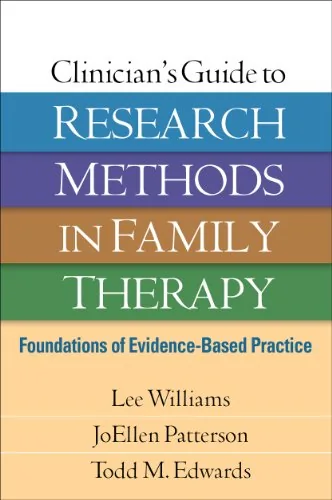
Clinician's Guide to Research Methods in Family Therapy
By Lee Williams, JoEllen Patterson, Todd M. Edwards
About this ebook
Clinician's Guide to Research Methods in Family Therapy connects research design and evaluation with the questions practitioners encounter in couple and family work. Lee Williams, JoEllen Patterson, and Todd M. Edwards address measurement, qualitative and quantitative methods, and the interpretation of published findings for clinicians and family therapy students.
Inside this title
Measurement of couple and family functioning in research
Current listed price $18.99Regular price $42.00Digital ebook
Research about relationships raises questions about what is measured, whose perspective is represented, and how findings relate to clinical decisions. Williams, Patterson, and Edwards frame methodological concepts around marriage and family therapy, beginning with clinically relevant questions and the principles of evidence-based practice.
Coverage includes reliability, validity, cultural considerations, experimental and quasi-experimental designs, correlational studies, grounded theory, and narrative analysis. The emphasis is on understanding the strengths and limits of methods and evaluating how a study's conclusions may inform work with couples and families. Graduate students and practitioners can use the text both when reading research and when considering the design of their own projects.
Study guide included
Inside Clinician's Guide to Research Methods in Family Therapy.
Williams, Patterson and Edwards begin with the questions clinicians actually ask about couples and families, then translate them into research design. Measurement, study types and appraisal are taught as tools for judging published findings and for planning a project, not as abstract methodology detached from relational practice.
The book starts from evidence-based practice and the problem of turning a clinical concern into a researchable question. It examines how couple and family functioning is measured, why reliability and validity matter, and how cultural context shapes what a study can claim. Quantitative coverage includes experimental, quasi-experimental and correlational designs; qualitative coverage includes grounded theory and narrative analysis. Rather than prescribing one method, the text weighs the strengths and limits of each and shows how conclusions should be read before they inform work with families. Graduate students and practitioners can use it both to read research critically and to think through designs of their own.
From clinical concern to research question
The starting point is a question a practitioner genuinely has about couple or family work. Converting that concern into a study requires narrowing it, deciding what would count as an answer, and recognizing which methods could address it. The text keeps that translation visible so research feels continuous with practice.
Clinical concerns motivate research questions
Questions must be narrowed to be answerable
Method follows from the question
Research connects to practice decisions
Topics 1–2
Measuring couple and family functioning
Relational constructs are harder to measure than individual ones because several people, and their differing perspectives, are involved. The book examines what instruments capture, whose viewpoint they represent, and why measurement choices shape the conclusions a study can reach. Reliability and validity are treated as practical questions about trust.
Relational constructs require careful definition
Instruments represent particular perspectives
Reliability concerns consistency
Validity concerns measuring the intended construct
Topics 3–4
Experimental and quasi-experimental designs
These designs address whether an intervention made a difference. The text distinguishes the control available in experimental work from the compromises of quasi-experimental studies conducted in real clinical settings. Readers learn what each design can support and where causal language becomes unwarranted.
Designs test intervention effects
Randomization strengthens causal inference
Field settings impose constraints
Claims must match the design used
Topic 5
Correlational studies and their limits
Correlational research examines relationships among variables as they naturally occur. It is valuable for describing patterns in couple and family life, but the text is careful about what such studies cannot establish. Association is distinguished from causation so readers do not overread findings that merely co-vary.
Correlational work describes associations
Natural variation is observed, not manipulated
Association does not establish causation
Findings are interpreted within their limits
Topic 6
Qualitative inquiry: grounded theory and narrative
Qualitative methods are presented as ways to study meaning, process and experience that numbers may miss. Grounded theory builds concepts from data, while narrative analysis attends to how people tell their stories. Both require rigor in sampling, analysis and reflexivity, and both answer questions quantitative designs cannot.
Grounded theory develops concepts from data
Narrative analysis examines how stories are told
Qualitative work studies meaning and process
Rigor applies to qualitative methods too
Topic 7
Critical appraisal for practice
Reading research well means asking about design, measurement, sample and cultural fit before accepting a conclusion. The book trains that appraisal habit so clinicians can decide whether a published finding applies to the families they see, and so students can avoid designing projects that cannot answer their own questions.
Appraisal examines design and measurement
Cultural context affects applicability
Findings must fit the population studied
Appraisal informs both reading and design
Topics 1–8
Topic map
From Clinical Questions to Research QuestionsTopic 1
Evidence-Based Practice and Critical AppraisalTopic 2
Measuring Couple and Family FunctioningTopic 3
Reliability, Validity and Cultural ContextTopic 4
Experimental and Quasi-Experimental DesignsTopic 5
Correlational StudiesTopic 6
Grounded Theory and Narrative AnalysisTopic 7
Designing and Evaluating a StudyTopic 8
Key takeaways
Start from a clinical question you actually have, then choose the method that can answer it.
Check whose perspective a couple or family measure represents before trusting its results.
Match the strength of a conclusion to the design that produced it.
Graduate students in marriage and family therapy and practicing clinicians who want to read published research critically, understand measurement and design choices, and plan methodologically sound projects grounded in relational clinical questions.
Topics covered
family therapy research methods
evidence-based practice
couple and family measurement
quasi-experimental design
correlational research
grounded theory
narrative analysis
critical appraisal
Questions about this ebook.
Edition, audience, and study-guide details at a glance.
What is Clinician's Guide to Research Methods in Family Therapy about?
Clinician's Guide to Research Methods in Family Therapy connects research design and evaluation with the questions practitioners encounter in couple and family work. Lee Williams, JoEllen Patterson, and Todd M. Edwards address measurement, qualitative and quantitative methods, and the interpretation of published findings for clinicians and family therapy students.
Who is Clinician's Guide to Research Methods in Family Therapy for?
Graduate students in marriage and family therapy and practicing clinicians who want to read published research critically, understand measurement and design choices, and plan methodologically sound projects grounded in relational clinical questions.
Does this page include a study guide?
Yes. This page includes an original study guide with six thematic sections, key takeaways, and a topic map for structured reading.