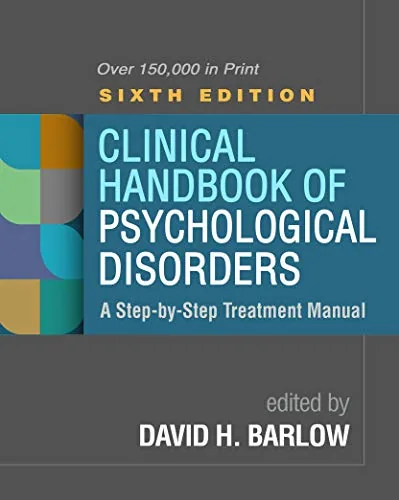
The Clinical Handbook of Psychological Disorders, 6th Edition presents structured psychotherapy approaches across anxiety, mood, trauma-related, and other conditions. David H. Barlow's handbook for clinicians and graduate trainees combines assessment guidance, treatment sequences, case illustrations, and clinical challenges, including chronic pain and process-based therapy.
Inside this title
Assessment guidance connected with structured psychotherapy treatment sequences
Current listed price $40.99Regular price $112.00Digital ebook
Chapters connect an account of a disorder with assessment, treatment planning, and the sequence of therapeutic work. Case illustrations and therapist-client dialogue show how techniques are presented in clinical encounters, while discussion of common difficulties addresses the challenges of applying a protocol to individual presentations.
The sixth edition covers panic, social and generalized anxiety, obsessive-compulsive disorder, posttraumatic stress, depression, bipolar disorder, and borderline personality disorder. Chronic pain, self-injurious thoughts and behaviors, and process-based therapy extend its scope. Clinical psychology trainees, therapists, supervisors, and psychotherapy educators can use the handbook to study research-supported treatment models and compare how assessment and intervention are organized across different psychological problems.
Study guide included
Inside Clinical Handbook of Psychological Disorders: A Step-by-Step Treatment Manual, 6th Edition.
A treatment manual earns its name by showing sequence, not just technique. Barlow's handbook pairs each disorder with assessment, a session-by-session logic, and the moments where a protocol meets a person who does not fit neatly, and the therapist must decide what comes next.
Each chapter follows a similar architecture: a description of the disorder, assessment considerations, a treatment plan, and the order in which interventions are introduced. Transcripts and case illustrations show how techniques are actually said aloud, awkward parts included. Sections on common difficulties acknowledge that adherence is not the same as clinical judgment. Coverage runs from panic, social anxiety, and generalised anxiety through obsessive-compulsive disorder and posttraumatic stress, then depression, bipolar disorder, and borderline personality. Chronic pain, self-injury, and process-based therapy extend the frame.
Assessment before choosing a protocol
Treatment begins with a formulation specific to the person, not merely a diagnosis. Assessment covers symptom patterns, functioning, comorbidity, and the factors maintaining the problem. The handbook uses this to decide whether a protocol fits, how to adapt it, and what to monitor, since a manual applied without formulation tends to treat the label rather than the person.
Formulate the maintaining factors
Check comorbidity and functioning
Decide whether the protocol fits
Topic 1
Anxiety and panic protocols
Panic, social anxiety, and generalised anxiety each receive a structured sequence, usually combining psychoeducation, cognitive work, and exposure. The transcripts show how exposure is framed so that clients understand the rationale, and how therapists handle reluctance. Common difficulties include avoidance, safety behaviours, and the gap between understanding a principle and acting on it.
Explain the exposure rationale clearly
Plan exposure in graded steps
Address safety behaviours and avoidance
Topic 2-3
OCD and trauma treatment
Obsessive-compulsive disorder is approached through exposure and response prevention, with attention to the function of compulsions rather than their content alone. Trauma-focused work follows a different sequence, preparing the client before processing memories. Both sections stress pacing, since moving too quickly can undermine engagement and moving too slowly can reinforce avoidance.
Target the function of compulsions
Prepare clients before trauma processing
Pace work to sustain engagement
Topic 4
Depression and bipolar disorder
Mood chapters combine behavioural activation, cognitive strategies, and relapse planning. Bipolar treatment adds mood monitoring, routine, and attention to early warning signs. The handbook distinguishes acute-phase work from longer-term maintenance, because the priorities differ: reducing symptoms now versus preventing the next episode. The two conditions are not treated as one protocol with a variant.
Use activation to interrupt withdrawal
Monitor mood and early warning signs
Separate acute treatment from maintenance
Topic 5
Personality disorders and self-injury
Borderline personality features and self-injurious behaviour require attention to safety, therapeutic relationship, and skills. The material draws on structured approaches that balance validation with change, and it addresses the therapist's own reactions as part of the work. These chapters are less about a fixed sequence than about managing risk without abandoning treatment.
Balance validation with demand for change
Assess and manage ongoing risk
Attend to therapist reactions
Topic 6
Personality disorders and self-injury
Chronic pain is treated as a condition shaped by biological, psychological, and social factors, requiring goals broader than symptom removal. Process-based therapy shifts attention from protocol to the processes maintaining distress across diagnoses. Together they push against a one-manual-per-disorder view and ask what a clinician does when the presenting problem crosses categories.
Address pain across biological and psychological factors
Set goals beyond symptom reduction
Target processes rather than labels
Topic 7-8
Topic map
Assessment and Case FormulationTopic 1
Panic Disorder and AgoraphobiaTopic 2
Social and Generalised AnxietyTopic 3
Obsessive-Compulsive Disorder and PTSDTopic 4
Depression and Bipolar DisorderTopic 5
Borderline Personality and Self-InjuryTopic 6
Chronic PainTopic 7
Process-Based TherapyTopic 8
Key takeaways
A protocol is a starting structure; formulation decides whether it fits this client and how it must bend.
Exposure and trauma work depend on preparation and pacing as much as on the technique itself.
Relapse planning belongs in treatment from the start, not as an afterthought once symptoms lift.
Clinical psychology trainees, practising therapists, clinical supervisors, and psychotherapy educators who want a structured reference for research-supported treatment sequences across common adult disorders and settings.
Topics covered
psychotherapy manual
cognitive behavioral therapy
anxiety treatment
trauma therapy
mood disorders
borderline personality
chronic pain
process-based therapy
Questions about this ebook.
Edition, audience, and study-guide details at a glance.
What is Clinical Handbook of Psychological Disorders: A Step-by-Step Treatment Manual, 6th Edition about?
The Clinical Handbook of Psychological Disorders, 6th Edition presents structured psychotherapy approaches across anxiety, mood, trauma-related, and other conditions. David H. Barlow's handbook for clinicians and graduate trainees combines assessment guidance, treatment sequences, case illustrations, and clinical challenges, including chronic pain and process-based therapy.
Which edition of Clinical Handbook of Psychological Disorders: A Step-by-Step Treatment Manual, 6th Edition is this?
This listing is for the 6th edition. Check the title, ISBN, and book details above before ordering, especially if your course or reading list names a specific edition.
Who is Clinical Handbook of Psychological Disorders: A Step-by-Step Treatment Manual, 6th Edition for?
Clinical psychology trainees, practising therapists, clinical supervisors, and psychotherapy educators who want a structured reference for research-supported treatment sequences across common adult disorders and settings.
Does this page include a study guide?
Yes. This page includes an original study guide with six thematic sections, key takeaways, and a topic map for structured reading.