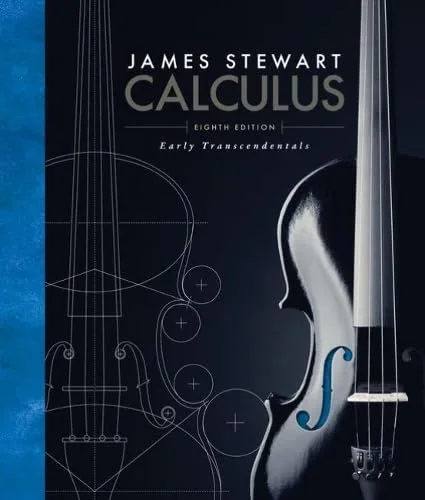
Calculus: Early Transcendentals, eighth edition, covers single-variable and multivariable calculus for students in mathematics, science, and engineering. Exponential, logarithmic, and trigonometric functions enter early in the sequence. Worked examples and application problems accompany limits, differentiation, integration, series, partial derivatives, and multiple integrals across a three-semester course framework.
Inside this title
Early treatment of exponential, logarithmic, and trigonometric functions
Current listed price $37.99Regular price $99.00Digital ebook
Stewart introduces transcendental functions early so their derivatives and integrals can develop alongside those of algebraic functions. Limits and continuity lead into differentiation, optimization, related rates, and integration techniques. Examples connect these methods with areas, volumes, work, pressure, and other applied quantities.
The sequence continues through infinite series, Taylor approximations, parametric curves, and polar coordinates before moving into functions of several variables. Tangent planes, directional derivatives, constrained optimization, and double and triple integrals extend the calculus to multiple dimensions. The eighth edition’s worked examples and exercises support courses in mathematics, physics, engineering, and computer science that combine formal definitions with calculation and modeling.
Study guide included
Inside Calculus: Early Transcendentals, 8th Edition.
Calculus: Early Transcendentals, eighth edition, covers single-variable and multivariable calculus for students in mathematics, science, and engineering. Exponential, logarithmic, and trigonometric functions enter early, and worked examples and applications accompany limits, differentiation, integration, series, partial derivatives, and multiple integrals across a three-semester course.
Stewart ties tangent, motion, area, and change questions to techniques that work across several representations. Functions and limits open the book; differentiation and its uses follow, and the integral is constructed from sums. Later chapters take up differential models, parametric and polar curves, series, multivariable calculus, and a final printed chapter on second-order linear equations. Exercises repeatedly ask students to use a graph or an estimate to test what the symbols claim, so judgment about method matters as much as formula recall.
Representations, models, and approach
Words, numbers, graphs, and formulas each expose a different side of a model, and the text brings exponential and logarithmic examples in early. Limits are introduced through tangent and velocity questions and describe what happens near a point, not the value at it. One-sided limits, continuity, and behavior at infinity help determine whether an apparent approach can be trusted.
Choose the view that exposes the behavior
State domain, units, and assumptions
Do not confuse the limit with the value
Chs. 1–2
The derivative as a local rate
The derivative is the limit of an average rate and is expressed in output units per input unit. Rules for products, quotients, and chains cover common combinations; implicit differentiation handles relations that cannot be solved neatly. Optimization calls for an objective and a feasible interval, after which endpoints and changes in the derivative's sign give the candidates meaning.
Connect a differentiation rule to a rate
Check endpoints and places where the derivative fails
Interpret a sign change, not only a zero
Chs. 3–4
Accumulation through definite integrals
A Riemann sum pairs a sampled function value with a small width, whether the piece represents a thin slice or a short burst of motion. Taking the limit produces the definite integral. The Fundamental Theorem explains how accumulation changes and how an antiderivative evaluates a definite integral, while substitution, parts, partial fractions, and trigonometric methods suit different algebraic forms.
Begin with one representative slice
Estimate numerically when an antiderivative is unavailable
Ask whether an improper integral converges
Chs. 5–8
Differential models and numerical steps
First-order equations are studied through separable and linear cases, with graphs and numerical schemes alongside formulas. An initial condition chooses one curve from a family, a direction field shows local tendencies, and Euler's method advances by short tangent steps, making step size part of the interpretation. The closing printed chapter treats second-order linear equations and models such as springs and circuits.
Read a rate equation with the quantity it governs
Track step size and error in a numerical method
Use initial data to select a solution
Ch. 9 and Ch. 17
Parametric curves and infinite sums
Parametric form expresses coordinates through a parameter; polar form uses distance and angle and can simplify rotationally symmetric problems. Both support slope, area, and length questions, and the parameter's interval and direction affect the answer. A sequence is an ordered list, a series accumulates terms, and power series introduce a variable together with an interval of convergence.
Match the coordinate system to the curve
Note the direction in which the parameter runs
Use a remainder to judge an approximation
Chs. 10–11
Multivariable and spatial calculus
Vectors and vector functions describe direction, planes, curves, and motion in three dimensions. Partial derivatives isolate one coordinate, the gradient summarizes directional change, and tangent planes give local approximations. Lagrange multipliers locate constrained extrema. Multiple integrals accumulate over planar regions and solids, and vector calculus relates a region to its boundary through the classical integral theorems.
Use a tangent plane for local approximation
Pick coordinates that simplify the bounds
Include orientation before invoking a theorem
Chs. 12–16
Chapter and section map
Functions and ModelsCh. 1
Limits and DerivativesCh. 2
Applications of DifferentiationCh. 4
Integrals and ApplicationsChs. 5–8
Differential EquationsCh. 9
Parametric Equations, Polar Coordinates, and SeriesChs. 10–11
Vectors, Partial Derivatives, and Multiple IntegralsChs. 12–15
Vector Calculus and Second-Order Differential EquationsChs. 16–17
Key takeaways
Distinguish a function's value at a point from its limiting behavior nearby.
Separate signed accumulation from total distance when the rate crosses zero during the interval.
Record initial conditions and modeling assumptions before comparing solutions of a differential equation.
Undergraduate students in mathematics, science, and engineering taking single- or multivariable calculus, and instructors seeking a classic early-transcendentals sequence with extensive worked examples, exercises, and application problems.
Topics covered
limits and continuity
differentiation rules
Riemann sums
Fundamental Theorem
Taylor series
differential equations
multiple integrals
vector calculus
Other editions of this title.
Compare editions, prices, and book details before you choose.
Edition, audience, and study-guide details at a glance.
What is Calculus: Early Transcendentals, 8th Edition about?
Calculus: Early Transcendentals, eighth edition, covers single-variable and multivariable calculus for students in mathematics, science, and engineering. Exponential, logarithmic, and trigonometric functions enter early in the sequence. Worked examples and application problems accompany limits, differentiation, integration, series, partial derivatives, and multiple integrals across a three-semester course framework.
Which edition of Calculus: Early Transcendentals, 8th Edition is this?
This listing is for the 8th edition. Check the title, ISBN, and book details above before ordering, especially if your course or reading list names a specific edition.
Who is Calculus: Early Transcendentals, 8th Edition for?
Undergraduate students in mathematics, science, and engineering taking single- or multivariable calculus, and instructors seeking a classic early-transcendentals sequence with extensive worked examples, exercises, and application problems.
Does this page include a study guide?
Yes. This page includes an original study guide with six thematic sections, key takeaways, and a chapter and section map for structured reading.