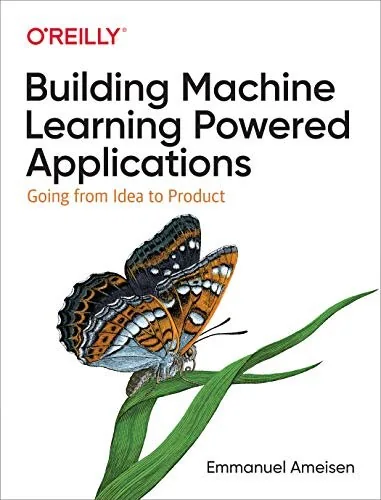
Building Machine Learning Powered Applications follows the engineering work involved in turning an ML idea into an operating product. Emmanuel Ameisen writes for data scientists, software engineers, and product teams, connecting problem definition, data collection, prototyping, evaluation, deployment, and monitoring through a continuing application example.
Inside this title
Problem definition and success measures aligned with product goals
Current listed price $18.99Regular price $36.00Digital ebook
Explore four AI ebooks on AWS data pipelines, probabilistic methods, enterprise NLP, and production ML applications. Compare titles and preview group pricing.
Ameisen organizes the book around the decisions made as an application moves from an initial goal to deployment. Framing the problem and choosing success measures come before collecting and labeling data. An early pipeline provides a basis for evaluating models, identifying bottlenecks, and deciding what to improve next.
The continuing example connects individual techniques with the larger product. Discussions of testing, noisy data, model selection, and evaluation emphasize iteration and trade-offs throughout development. Deployment and monitoring extend the treatment beyond the training stage. Practitioners who understand machine learning fundamentals can use the book to study how software engineering habits, product requirements, and model behavior interact when building an ML-powered feature.
Study guide included
Inside Building Machine Learning Powered Applications.
A machine learning feature succeeds or fails long before the model is trained. Ameisen follows the engineering decisions around it, from framing a problem worth solving to watching a deployed model behave, with one continuing example holding the pieces together.
The book is organized around the decisions made as an application moves from an initial goal to deployment. Framing the problem and choosing success measures come before collecting and labelling data, which prevents later work from optimizing the wrong thing. An early pipeline provides a basis for evaluating models, spotting bottlenecks and deciding what to improve next. A continuing example connects individual techniques to the larger product, and discussions of testing, noisy data, model selection and evaluation emphasize iteration and trade-offs. Deployment and monitoring extend the treatment past training, keeping attention on how a model behaves once real users depend on it.
Framing the problem before the model
A clear problem statement and a sensible success measure come first. The book treats that step as engineering work, not paperwork, because a model trained against the wrong objective is expensive to discover later. Framing connects a product goal to something measurable that a team can actually evaluate.
State the problem in product terms
Choose a measurable success criterion
Check the objective before collecting data
Topics 1-2
Data collection, labelling and validation
Data work gets treated as design work. Collection, labelling and validation determine what a model can learn, and the book shows how weak labels or unexamined data quietly set a ceiling. Validation receives attention as a way to keep the evaluation honest as the data changes.
Design collection around the stated problem
Treat label quality as a constraint
Validate data before trusting a result
Topics 3-4
An early pipeline and prototype
Building a rough pipeline early gives the team something to measure against. It exposes where the work is actually hard and prevents late surprises. The book uses prototyping to turn an abstract plan into evidence, so that subsequent effort goes where the pipeline shows a real bottleneck.
Build an end-to-end path early
Use the prototype to find bottlenecks
Let evidence direct the next effort
Topic 5
Evaluation, testing and iteration
Evaluation is presented as an ongoing activity rather than a final check. Testing a model in the context of the application shows whether a metric improvement matters to the product. Iteration follows from what evaluation reveals, and the book emphasizes trade-offs over the pursuit of a single best score.
Evaluate models in application context
Connect metric changes to product outcomes
Iterate from what testing reveals
Topic 6
Noisy data and model selection
Real data is messy, and the book treats that as normal rather than exceptional. Model selection happens against noisy evidence, so judgement matters more than a leaderboard. Readers are encouraged to reason about how much confidence a comparison supports before committing to a choice, and to keep that caution when small differences decide a ranking.
Expect noise in real datasets
Judge comparisons by their confidence
Avoid overreading small differences
Topic 6
Deployment, monitoring and feedback
Shipping a model changes the problem, because behaviour in production differs from behaviour in evaluation. The book discusses deployment and monitoring together, treating observation as the way a team learns whether the feature actually delivers. That closes the loop between the original goal and what users experience.
Plan for behaviour to shift in production
Monitor the feature after release
Feed observations back into development
Topics 7-8
Topic map
Problem framingTopic 1
Success measuresTopic 2
Data collection and labellingTopic 3
Data validationTopic 4
Early prototypingTopic 5
Model evaluation and testingTopic 6
DeploymentTopic 7
MonitoringTopic 8
Key takeaways
Framing the problem and its success measure is engineering work, not paperwork before the model.
An early end-to-end pipeline reveals where the real difficulty sits before effort is committed.
Monitoring closes the loop: production behaviour is the evidence that the feature works.
Data scientists, software engineers and product teams with machine learning fundamentals who want to see how product requirements, engineering habits and model behaviour interact from framing through deployment.
Topics covered
machine learning applications
ML product development
problem framing
data labeling
model evaluation
model deployment
production monitoring
ML lifecycle
iterative development
Questions about this ebook.
Edition, audience, and study-guide details at a glance.
What is Building Machine Learning Powered Applications about?
Building Machine Learning Powered Applications follows the engineering work involved in turning an ML idea into an operating product. Emmanuel Ameisen writes for data scientists, software engineers, and product teams, connecting problem definition, data collection, prototyping, evaluation, deployment, and monitoring through a continuing application example.
Who is Building Machine Learning Powered Applications for?
Data scientists, software engineers and product teams with machine learning fundamentals who want to see how product requirements, engineering habits and model behaviour interact from framing through deployment.
Does this page include a study guide?
Yes. This page includes an original study guide with six thematic sections, key takeaways, and a topic map for structured reading.
Keep your curiosity going.
More books from this carefully grouped reading set.