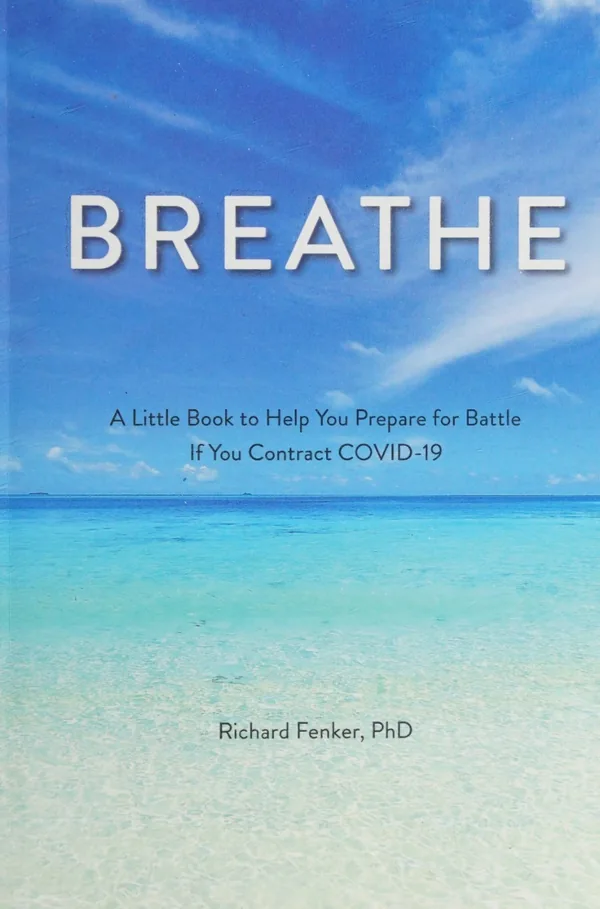
BREATHE: A Little Book to Prepare for COVID-19 Battle
By Richard Fenker
About this ebook
BREATHE is Richard Fenker's short 2020 book on breathing, mental preparation, and stress during the early COVID-19 pandemic. It introduces respiratory concepts, breathing exercises, mental rehearsal, and daily routines for general readers. The booklet reflects the concerns and wellness-oriented discussion of its original pandemic context, rather than a clinical textbook format.
Inside this title
Breathing and mental preparation in an early pandemic context
Current listed price $14.99Regular price $30.00Digital ebook
Written during the early pandemic, BREATHE connects concerns about illness with a discussion of breathing and psychological preparation. Richard Fenker presents respiratory physiology in plain language and introduces exercises involving diaphragmatic breathing, breath patterns, and attention to bodily sensations. Mental rehearsal is discussed as part of responding to fear and uncertainty.
The book's compact structure is directed toward readers without medical training. Its topics include daily practice, changes in respiratory symptoms, and recognizing when medical attention may be needed. Readers interested in pandemic-era wellness writing can examine how the booklet combines performance psychology and breathing practices within the particular anxieties of 2020. Its subject and approach are best understood in that historical setting.
Study guide included
Inside BREATHE: A Little Book to Prepare for COVID-19 Battle.
A study companion to Richard Fenker's short 2020 booklet on breathing and mental preparation during the early COVID-19 pandemic. It organizes the book's plain-language respiratory explanation, breathing exercises, mental rehearsal and daily routines for readers without medical training, while keeping its claims within the pandemic context that shaped it.
The guide follows the booklet's practical arc: understand breathing, practise it deliberately, and prepare mentally for fear and uncertainty. Six themes cover respiratory basics in plain language, diaphragmatic breathing, attention to breath patterns and bodily sensation, mental rehearsal, responses to stress, and daily practice with symptom awareness. Each theme summarizes what the booklet presents and notes where its scope ends, since the material is wellness writing from 2020 rather than clinical guidance. The topic map and takeaways help readers use the exercises as described while remembering the historical setting and the limits of a compact booklet.
Breathing in plain language
The booklet begins by explaining respiration without clinical jargon. The theme covers how breathing is described for general readers, why understanding the mechanics matters for practice, and how the explanation links bodily function to the calming routines that follow. It sets expectations appropriate to a short wellness text rather than a medical manual.
Respiration is explained without clinical jargon
Mechanics support later breathing practice
Scope suits general readers, not clinicians
Topic 1
Diaphragmatic breathing and practice
Diaphragmatic breathing is the booklet's central exercise. The theme describes how the technique is introduced, what the practitioner is asked to notice, and how the exercise is meant to be repeated. It treats the practice as a skill built through repetition rather than a single remedy, matching the book's modest, instructional tone.
The technique is taught step by step
Attention to sensation guides practice
Repetition builds the skill gradually
Topic 2
Breath patterns and body awareness
Beyond the basic exercise, the booklet discusses variations in breath pattern and attention to bodily sensation. The theme explains how noticing breath and physical cues is presented as a way to interrupt automatic stress responses. It preserves the book's emphasis on observation rather than diagnosis.
Breath patterns vary with stress
Bodily cues can be noticed deliberately
Careful observation replaces self-diagnosis
Topic 3
Mental rehearsal for fear
Mental rehearsal is presented as preparation for anxiety and uncertainty. The theme explains how imagining a feared situation is used to reduce its shock and to plan a response. It connects this performance-psychology technique to the pandemic worries the booklet addresses, without claiming clinical efficacy.
Rehearsal imagines feared situations in advance
Planning responses reduces surprise
Claims stay modest and non-clinical
Topic 4
Managing stress and uncertainty
The booklet links breathing and rehearsal to the emotional responses provoked by the pandemic. The theme covers how fear and uncertainty are discussed, and how the exercises are meant to fit into moments of heightened stress. It keeps the discussion at the level of self-management rather than treatment.
Fear and uncertainty are addressed directly
Exercises fit moments of heightened stress
Self-management differs from treatment
Topic 5
Daily routine and symptom awareness
Practice is framed as a routine, and the booklet also addresses changes in respiratory symptoms. The theme explains how daily habits are recommended and where the text points readers toward medical attention. It marks the boundary between wellness practice and clinical care, which the booklet itself acknowledges in compact form.
Daily practice builds consistency
Symptom changes warrant attention
The text defers to medical care
Topics 6–7
Topic map
Respiratory Basics in Plain LanguageTopic 1
Diaphragmatic Breathing ExercisesTopic 2
Breath Patterns and Bodily SensationTopic 3
Mental Rehearsal PracticeTopic 4
Fear, Stress and UncertaintyTopic 5
Building a Daily RoutineTopic 6
Symptom Awareness and Seeking CareTopic 7
Pandemic-Era Wellness ContextTopic 8
Key takeaways
Breathing exercises are presented as learned skills developed through repeated, attentive daily practice.
Mental rehearsal prepares for feared situations by making responses deliberate rather than reactive.
The booklet is 2020 wellness writing, so its guidance should not be substituted for medical care.
General readers curious about breathing practice and pandemic-era wellness writing, plus students of health communication studying how performance psychology was applied during the early COVID-19 period.
Topics covered
breathing exercises
diaphragmatic breathing
mental rehearsal
COVID-19 pandemic
stress management
respiratory health
daily practice
pandemic wellness
Questions about this ebook.
Edition, audience, and study-guide details at a glance.
What is BREATHE: A Little Book to Prepare for COVID-19 Battle about?
BREATHE is Richard Fenker's short 2020 book on breathing, mental preparation, and stress during the early COVID-19 pandemic. It introduces respiratory concepts, breathing exercises, mental rehearsal, and daily routines for general readers. The booklet reflects the concerns and wellness-oriented discussion of its original pandemic context, rather than a clinical textbook format.
Who is BREATHE: A Little Book to Prepare for COVID-19 Battle for?
General readers curious about breathing practice and pandemic-era wellness writing, plus students of health communication studying how performance psychology was applied during the early COVID-19 period.
Does this page include a study guide?
Yes. This page includes an original study guide with six thematic sections, key takeaways, and a topic map for structured reading.