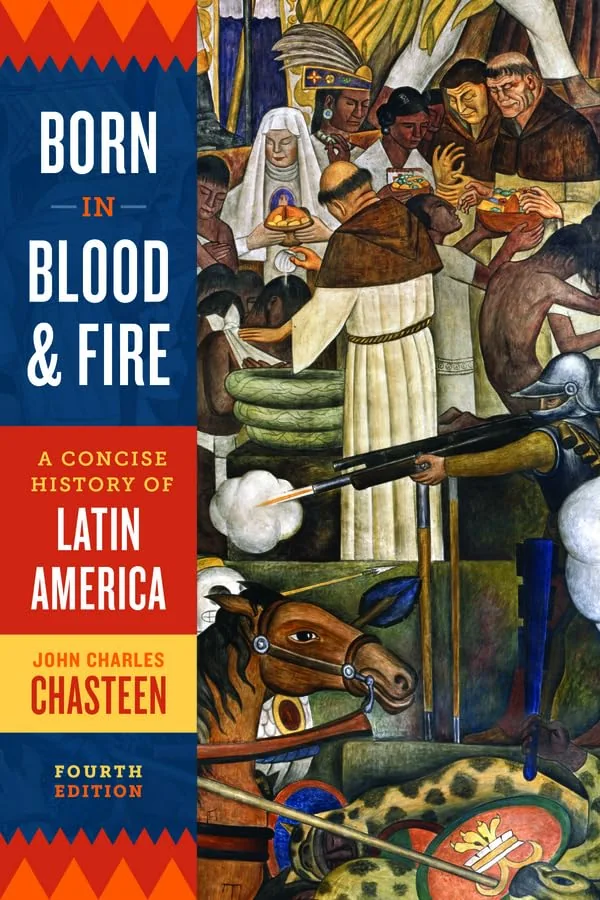
Born in Blood and Fire: A Concise History of Latin America, 4th Edition
By John Charles Chasteen
About this ebook
Born in Blood and Fire: A Concise History of Latin America, 4th Edition surveys the region from pre-Columbian societies to the early twenty-first century. John Charles Chasteen follows conquest, colonial hierarchies, independence, revolution, and economic change. Students and general readers encounter a narrative attentive to inequality, violence, cultural exchange, and resilience.
Inside this title
Latin American history from pre-Columbian societies through modern republics
Current listed price $15.99Regular price $41.00Digital ebook
John Charles Chasteen follows Latin American history through encounters between indigenous societies and European conquerors, the formation of colonial orders, and struggles for independence. Race, class, and gender help explain how power and inequality shaped these societies. The narrative also considers cultural fusion and the forms of resilience that developed within unequal conditions.
Later chapters examine caudillos, foreign intervention, revolutionary movements, economic dependency, debt, and neoliberal reform. The fourth edition carries the regional survey into the early twenty-first century, including questions of migration, inequality, and democracy. For introductory history courses and general reading, it connects political turning points with longer patterns in social and economic life.
Study guide included
Inside Born in Blood and Fire: A Concise History of Latin America, 4th Edition.
Chasteen compresses five centuries into a narrative built around power, labor, and resistance. Conquest and slavery set the terms, and later chapters show how independence, export economies, nationalism, revolution, and market reform repeatedly renegotiated those terms without dissolving the inequalities behind them.
The book opens with the diversity of Indigenous societies and the alliances, disease, and violence that made conquest possible, then follows colonial economies built on mining, plantations, and enslaved African labor. Independence wars produce sovereign states with weak capacity and persistent hierarchies. Export booms and liberal reform bring railways, investment, and uneven benefits. Nationalist movements redefine belonging and expand state economic roles, before Cold War conflict, military government, and later neoliberal policies reshape the region again. Short countercurrent essays interrupt the main chronology with individuals and episodes that complicate it, and each chapter closes by asking whose rights and resources actually changed.
Invasion, alliance, and forced labor
Conquest was not a single event but a process shaped by rivalry among Indigenous polities, epidemic disease, and shifting alliances with Europeans. Spanish and Portuguese ventures differed in style and outcome because geography, population, and resources varied. Enslaved Africans became central to colonial production and culture. The las Casas episode shows that criticism of imperial conduct existed inside the empire, even when the profitable institutions he condemned survived largely intact.
Ask who allied with whom
Treat disease as a military factor
Notice dissent inside the empire
Ch. 2 · p. 17
Silver, status, and cultural mixing
Colonial wealth ran through specific institutions: mining conscription, landed estates, tribute, and the church. Potosí's silver ties Andean labor to distant markets and shows how extraction organized daily life. Hegemony explains why domination held without constant force, and transculturation names how people remade borrowed practices into something their own. Sor Juana illustrates the double edge — institutions that enabled intellectual work also capped who could claim authority.
Read the economy through institutions
See consent alongside coercion
Watch culture change both ways
Ch. 3 · p. 55
Breaking away, governing badly
When Napoleon's pressure weakened Iberian crowns, elites in the Americas, army officers, and popular groups seized an opening, though they wanted different things from it. Patriots built coalitions around local belonging while disagreeing about slavery, land, and who counted as a citizen. Brazil kept a monarchy; Spanish America split into republics. After sovereignty, tax income, patronage, provincial competition, and personal networks decided whether any government could actually rule.
Compare Brazil with Spanish America
Ask which hierarchy survived
Trace loyalty into political power
Chs. 4–5 · pp. 95, 127
Exports, railroads, and uneven progress
Liberal reformers promised that trade, foreign capital, and modern infrastructure would bring prosperity. Railways often linked an exporting region with a port while bypassing interior communities, so the route itself reveals whom modernization served. Coffee, sugar, and mineral exports tied national budgets to volatile world prices. The chapter asks who could join the new economy — urban consumers and exporters gained, while rural workers and women usually did not.
Ask what a rail line connects
Separate ownership from sovereignty
Note who is left outside
Chs. 6–7 · pp. 161, 193
National identity and state economic roles
Nationalists rejected the idea that progress required copying North Atlantic models and instead promoted homegrown histories, art, and traditions. Indigenismo gave marginalized ancestry public visibility while raising the question of who could speak for living communities. Import substitution shifted production toward domestic demand and gave activist states more leverage over investment and labor. Populist leaders could widen participation and concentrate authority in the same movement.
Question who defines the nation
Follow industry toward home demand
See inclusion and control together
Ch. 8 · p. 233
Revolution, state violence, and market reform
Urban growth and blocked participation set the stage for insurgent movements, and Cuba became both a model and a threat depending on who was watching. Military governments justified repression in the language of security, and the pattern differed between the southern cone and Central American cases. The end of the Cold War opened transitions and neoliberal experiments built around markets and trade. Inequality, memory, and demands for participation outlasted each change in regime and policy.
Place revolution in local conditions
Compare South with Central America
Track grievances across regimes
Chs. 9–11 · pp. 267, 297, 329
Chapter and section map
Encounterp. 17
Colonial Cruciblep. 55
Independencep. 95
Postcolonial Bluesp. 127
Neocolonialismp. 193
Nationalismp. 233
Revolution and Reactionpp. 267, 297
Neoliberalism and Beyondp. 329
Key takeaways
Whenever an order changes, ask who ends up controlling land, labor, and the institutions that enforce both.
Compare countries using the same questions but let chronology, coalitions, and evidence produce different answers.
Read the countercurrent essays as correctives: they reveal actors and relationships the main narrative skips.
Undergraduate Latin American history and survey courses, general readers seeking a compact regional narrative, and travelers or professionals who want context beyond a single country's story.
Topics covered
Latin American history
colonial rule
independence movements
nationalist politics
revolutionary movements
neoliberal reform
social inequality
cultural history
Questions about this ebook.
Edition, audience, and study-guide details at a glance.
What is Born in Blood and Fire: A Concise History of Latin America, 4th Edition about?
Born in Blood and Fire: A Concise History of Latin America, 4th Edition surveys the region from pre-Columbian societies to the early twenty-first century. John Charles Chasteen follows conquest, colonial hierarchies, independence, revolution, and economic change. Students and general readers encounter a narrative attentive to inequality, violence, cultural exchange, and resilience.
Which edition of Born in Blood and Fire: A Concise History of Latin America, 4th Edition is this?
This listing is for the 4th edition. Check the title, ISBN, and book details above before ordering, especially if your course or reading list names a specific edition.
Who is Born in Blood and Fire: A Concise History of Latin America, 4th Edition for?
Undergraduate Latin American history and survey courses, general readers seeking a compact regional narrative, and travelers or professionals who want context beyond a single country's story.
Does this page include a study guide?
Yes. This page includes an original study guide with six thematic sections, key takeaways, and a chapter and section map for structured reading.