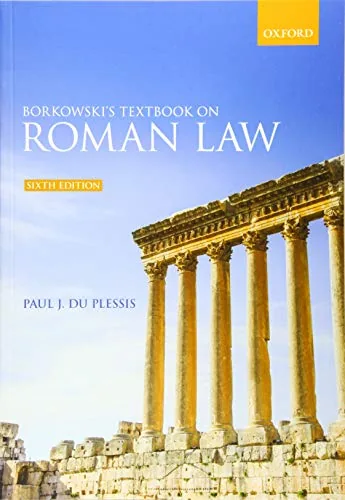
Borkowski's Textbook on Roman Law, 6th Edition, introduces Roman private law and civil procedure through explanation and translated source material. Paul J. du Plessis examines persons, property, obligations, and succession within their legal setting. Law students and readers of ancient history can study both legal concepts and their historical development.
Inside this title
Roman private law covering persons, property, and obligations
Current listed price $21.99Regular price $47.00Digital ebook
Roman legal institutions provide the setting for this account of private law. Paul J. du Plessis explains the roles of jurists, emperors, and the praetor before considering legal status, ownership, possession, contracts, delicts, and inheritance. Distinctions among Roman legal traditions help readers understand how rules and remedies developed.
Translated extracts from sources such as the Digest and the Institutes of Gaius bring the discussion into contact with Roman legal writing. Civil procedure traces changing forms of litigation, while the reception of Roman law connects the ancient material with later European legal traditions. The sixth edition supports introductory courses and independent study that combine legal analysis with attention to historical context.
Study guide included
Inside Borkowski's Textbook on Roman Law, 6th Edition.
A structured companion to Borkowski's sixth edition, following Roman private law from its institutional setting through persons, property, obligations and succession. It pairs conceptual explanation with translated source material so readers can see how jurists, the praetor and emperors shaped rules and remedies later European law inherited.
The guide treats Roman law as a working system rather than a list of rules. Six themes begin with sources and institutional actors, then move through legal status, ownership and possession, contracts and delicts, and inheritance, closing with civil procedure and reception. Each theme summarizes the doctrinal shape of a topic and points to translated extracts, including Digest passages and Gaius, that show Roman legal writing in practice. The topic map and takeaways help students connect doctrine to historical context and to the later tradition, supporting both exam revision and independent reading of the source material.
Sources and legal actors
Roman law developed through statutes, edicts, juristic writing and imperial pronouncements. The theme introduces the praetor's edict, the role of jurists in interpreting and systematizing rules, and the different legal traditions that shaped practice. Understanding who made law, and how, prepares readers to interpret the doctrines that follow in the remaining themes.
Praetorian edict shaped available remedies
Jurists interpreted and systematized rules
Legislation and imperial rulings added layers
Topic 1
Legal status of persons
Roman law organized persons by status, including freedom, citizenship and family position. The theme explains how these categories affected capacity to act, marry, own property and litigate, and how status could change through manumission or other events. It shows why personal status sits at the base of much of the private-law system.
Freedom and citizenship shaped legal capacity
Family position affected property and marriage
Status could change through legal acts
Topic 2
Ownership, possession and property
The theme separates ownership from possession and traces how property could be acquired, transferred and defended. It covers the categories of things, modes of acquisition, and the remedies protecting an owner or possessor. Distinguishing right from factual control is central to understanding Roman property disputes and the actions available to litigants.
Ownership and possession are different concepts
Acquisition modes varied by thing and form
Remedies protected both owner and possessor
Topics 3–4
Obligations and contractual forms
Obligations bind parties to perform, whether arising from agreement, wrongdoing or other recognized sources. The theme examines the recognized contract types, the role of consent and form, and the remedies available for non-performance. It shows how Roman jurists reasoned about promises, delivery and risk in commercial and personal dealings.
Obligations arose from several recognized sources
Contract types differed in form and consent
Remedies addressed non-performance and default
Topic 5
Delicts, wrongs and remedies
Delicts concern wrongs that generate liability, such as theft, damage to property and injury. The theme explains the elements and available actions, and how penal and compensatory consequences were distinguished. It connects private wrongs to the procedural remedies that gave them effect in Roman litigation.
Delicts define private wrongs and liability
Penal and compensatory claims were distinguished
Actions gave substantive rights effect
Topic 6
Succession and later reception
Inheritance covers testate and intestate succession, the claims of heirs, and limitations on testamentary freedom. The theme pairs this doctrinal core with civil procedure and the reception of Roman law in later European traditions, showing how ancient categories traveled into medieval and modern legal thought and why the material still rewards study.
Testate and intestate succession follow different paths
Heirs faced claims and obligations
Reception carried Roman categories forward
Topics 7–8
Topic map
Institutional Setting and Sources of LawTopic 1
Status, Capacity and the PersonTopic 2
Ownership and Modes of AcquisitionTopic 3
Possession and Property RemediesTopic 4
Obligations and Contract TypesTopic 5
Delicts and Available ActionsTopic 6
Succession and InheritanceTopic 7
Civil Procedure and European ReceptionTopic 8
Key takeaways
Roman private law is a system of statuses, things, obligations and actions rather than isolated rules.
Reading translated juristic extracts shows how doctrine was argued, not merely declared by authority.
Procedure and remedies determine what a legal right actually meant in practice for Roman litigants.
Law students taking Roman law courses, ancient-history readers, and anyone using Borkowski's sixth edition who wants a doctrinal map alongside the translated primary source material and commentary.
Topics covered
Roman law
private law
law of obligations
succession law
civil procedure
Digest excerpts
Institutes of Gaius
legal history
Questions about this ebook.
Edition, audience, and study-guide details at a glance.
What is Borkowski's Textbook on Roman Law, 6th Edition about?
Borkowski's Textbook on Roman Law, 6th Edition, introduces Roman private law and civil procedure through explanation and translated source material. Paul J. du Plessis examines persons, property, obligations, and succession within their legal setting. Law students and readers of ancient history can study both legal concepts and their historical development.
Which edition of Borkowski's Textbook on Roman Law, 6th Edition is this?
This listing is for the 6th edition. Check the title, ISBN, and book details above before ordering, especially if your course or reading list names a specific edition.
Who is Borkowski's Textbook on Roman Law, 6th Edition for?
Law students taking Roman law courses, ancient-history readers, and anyone using Borkowski's sixth edition who wants a doctrinal map alongside the translated primary source material and commentary.
Does this page include a study guide?
Yes. This page includes an original study guide with six thematic sections, key takeaways, and a topic map for structured reading.