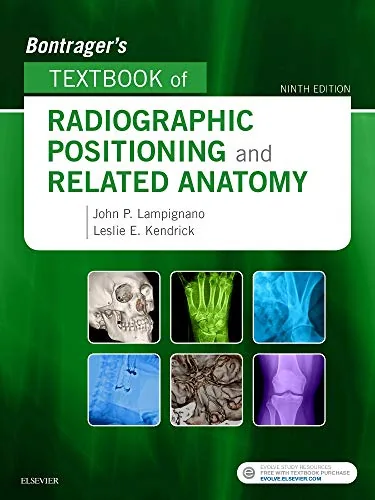
Bontrager's Textbook of Radiographic Positioning and Related Anatomy, 9th Edition organizes radiographic technique around individual projections. John P. Lampignano and Leslie E. Kendrick connect patient positioning, central ray alignment, anatomical landmarks, and image evaluation. The text serves radiography students and technologists reviewing the relationship between positioning choices and the resulting radiograph.
Inside this title
Individual projections paired with positioning instructions, drawings, and radiographs
Current listed price $42.99Regular price $170.00Digital ebook
The one-projection-per-page presentation gives each positioning task a consistent place for study. Instructions appear with line drawings and radiographic images, linking the arrangement of the patient and equipment to the anatomy being demonstrated. Related anatomy sections provide context for identifying the structures visible in each projection.
Image evaluation criteria encourage readers to examine positioning results rather than study technique in isolation. Radiation protection principles accompany the procedures, and the ninth edition includes discussion of digital radiography. Students can use the repeated visual format while learning routine and selected specialty projections, while technologists can consult the material to review particular anatomical regions or positioning requirements.
Study guide included
Inside Bontrager's Textbook of Radiographic Positioning and Related Anatomy, 9th Edition.
A study guide to the ninth edition's projection-by-projection approach, pairing positioning instructions with anatomical landmarks, central ray alignment, image evaluation criteria, and radiation protection. It supports radiography students learning routine and specialty projections and technologists reviewing positioning requirements for a particular region.
The textbook gives each projection a consistent page of its own, so instructions, line drawings, and radiographic images sit together with related anatomy. That repeated structure lets readers study the link between how a patient and equipment are arranged and what appears on the image. Evaluation criteria turn attention from doing a projection to judging its result, and radiation protection principles accompany the procedures. The ninth edition also addresses digital radiography. This guide organizes the material into six themes with a topic map for study and reference.
Projection-Based Page Structure and Layout
Each projection occupies a consistent place with its instructions, illustrations, and images. The repeated format is itself a study aid: readers learn where to look for the positioning step, the anatomy, and the expected result. Recognizing the structure reduces the effort of navigating the book and lets attention go to the content of a projection.
Consistent layout for every projection
Instructions beside illustrations and images
Where to find related anatomy
Structure as a study aid
Book description - one-projection-per-page presentation
Central Ray and Landmarks
Central ray alignment and anatomical landmarks govern how a projection is set up. The theme connects landmark identification with the direction of the beam, so a reader can see why a particular position produces the required view. Learning to locate landmarks reliably is presented as the practical core of positioning technique.
Identifying anatomical landmarks reliably
Aligning the central ray
Landmarks determining patient position
Why alignment produces the required view
Book description - central ray alignment and anatomical landmarks
Related Anatomy and Clinical Context
Related anatomy sections explain what a projection is meant to demonstrate. Anatomy is not treated as a separate subject but as the reason a particular arrangement is chosen. With that context, a reader can anticipate which structures should appear and can recognize when an image fails to show what the projection intended.
Anatomy as the reason for a projection
Structures expected in each view
Recognizing when structures are absent
Connecting anatomy to arrangement choices
Book description - related anatomy sections
Image Evaluation Criteria in Practice
Evaluation criteria shift attention from performing a projection to judging the result. The theme asks readers to compare an image against stated standards and to identify positioning errors from what they see. This habit supports consistency and gives a basis for deciding whether a repeat is warranted.
Criteria for judging an image
Recognizing positioning errors visually
Deciding whether repetition is needed
Consistency through stated standards
Book description - image evaluation criteria
Radiation Protection in Positioning
Protection principles accompany the procedures rather than appearing as a separate lecture. The theme treats shielding, beam limitation, and patient consideration as part of how a projection is performed. Positioning decisions and protection decisions are therefore made together, which is how the textbook presents them alongside each procedure.
Protection accompanying each procedure
Beam limitation and shielding practice
Patient consideration during positioning
Joint positioning and protection decisions
Book description - radiation protection principles
Digital Radiography and Image Review
The ninth edition includes discussion of digital radiography, where capture and display differ from film-based practice. The theme considers how digital acquisition affects the way an image is produced and reviewed, while the positioning fundamentals of the earlier themes continue to apply. Readers are asked to keep both the newer technology and the enduring principles in view.
Digital capture and display differences
Positioning fundamentals that still apply
Reviewing images produced digitally
Holding technology and principles together
Book description - digital radiography discussion
Topic map
Projection Layout and Study MethodTopic 1
Landmarks and Central Ray AlignmentTopic 2
Related Anatomy for Each ProjectionTopic 3
Image Evaluation CriteriaTopic 4
Radiation Protection in PracticeTopic 5
Digital RadiographyTopic 6
Routine and Specialty ProjectionsTopic 7
Key takeaways
Learn the page structure once and the book becomes faster to use for every projection.
Evaluation criteria make positioning visible as a result you can check, not only a procedure.
Protection choices belong inside positioning decisions rather than being added after the exposure.
Radiography students working through positioning coursework and technologists who want a systematic review of projection requirements, related anatomy, evaluation criteria, and routine radiation protection practice.
Topics covered
radiographic positioning
central ray alignment
anatomical landmarks
image evaluation
radiation protection
digital radiography
radiography study guide
related anatomy
Questions about this ebook.
Edition, audience, and study-guide details at a glance.
What is Bontrager's Textbook of Radiographic Positioning and Related Anatomy, 9th Edition about?
Bontrager's Textbook of Radiographic Positioning and Related Anatomy, 9th Edition organizes radiographic technique around individual projections. John P. Lampignano and Leslie E. Kendrick connect patient positioning, central ray alignment, anatomical landmarks, and image evaluation. The text serves radiography students and technologists reviewing the relationship between positioning choices and the resulting radiograph.
Which edition of Bontrager's Textbook of Radiographic Positioning and Related Anatomy, 9th Edition is this?
This listing is for the 9th edition. Check the title, ISBN, and book details above before ordering, especially if your course or reading list names a specific edition.
Who is Bontrager's Textbook of Radiographic Positioning and Related Anatomy, 9th Edition for?
Radiography students working through positioning coursework and technologists who want a systematic review of projection requirements, related anatomy, evaluation criteria, and routine radiation protection practice.
Does this page include a study guide?
Yes. This page includes an original study guide with six thematic sections, key takeaways, and a topic map for structured reading.